Which Educational Toys Teach Kids Through Play?
Magna-Tiles Classic 100 Piece Set tops this list because open-ended magnetic building grows with a child for years. Melissa and Doug’s Wooden Shape Sorting Cube is the toddler value pick. Osmo’s Genius Starter Kit turns existing tablet time into something more active for older kids.
Open-ended construction toys keep earning their place for years, unlike most educational toys that get solved once and shelved. Magna-Tiles Classic leads this list for exactly that reason. Toddlers learning shape and spatial reasoning are better served by the value-priced Melissa and Doug Wooden Shape Sorting Cube, while households already using a tablet should look at the Osmo Genius Starter Kit.
Packaging often promises skills a toy rarely delivers, and the plainest-looking toys frequently teach the most reasoning. A toy with one correct outcome gets solved and shelved; an open-ended one gets rebuilt differently every week. We compared age fit, play structure, specific skills, durability and required adult involvement, then weighed that against owner reports of which toys were still in use six months later.
The shortlist, ranked

Magna-Tiles Classic 100 Piece Set
Magnetic tiles sit in the rare zone that is simple enough for a three-year-old and interesting enough for a nine-year-old. Children build flat patterns first, then towers, then enclosed structures as spatial reasoning develops. Fully sealed magnets and durable ABS plastic survive years of daily building and rebuilding.
Pros
- Play value grows with the child for years
- Durable enough to survive daily use
- Compatible with additional sets over time
Cons
- Expensive per piece against generic tiles
- Large sets need dedicated storage

Melissa and Doug Wooden Shape Sorting Cube
Shape sorting is one of the first real problem-solving tasks a toddler faces, and this wooden cube presents it without lights, sounds or batteries competing for attention. Twelve chunky shapes cover the basics plus a few that take longer to master. Owners report it survives being thrown, chewed and stood on, the actual durability test at this age.
Pros
- No batteries or noise to compete for focus
- Solid wood survives toddler treatment
- Very low cost for the learning value
Cons
- Outgrown within a couple of years
- Loose shapes are easy to lose

Osmo Genius Starter Kit for iPad
A base and reflector turn an iPad camera into something that reads physical tiles and drawings, so the child manipulates real objects while the screen responds. Bundled activities span math, spelling, drawing and problem solving. A compatible iPad is required and sold separately, so check the model list before buying.
Pros
- Turns tablet time into physical activity
- Broad range of subjects in one kit
- Difficulty adapts as the child progresses
Cons
- Requires a compatible iPad you already own
- Small physical pieces are easy to misplace

LEGO Classic Creative Brick Box 10698
No instructions ship with this box, which turns building into design rather than assembly by numbers. A wide mix of colors and shapes arrives alongside baseplates, wheels and windows to get started. Most long-term LEGO collections are built on a foundation set exactly like this one.
Pros
- No instructions means genuine open-ended play
- Mixes with any other LEGO set
- Wide age span of usefulness
Cons
- Small pieces unsuitable for under threes
- Sorting and storage becomes a project

Learning Resources Botley the Coding Robot 2.0
A remote lets a child queue up movement commands, teaching sequencing and logic with no screen or app involved. Children build a route, watch it execute, then debug what went wrong, the actual thinking behind programming. Included obstacle pieces give Botley something to navigate instead of driving in circles.
Pros
- Teaches real sequencing without a screen
- Immediate feedback when a program fails
- Activity cards give structure for parents
Cons
- Needs batteries in robot and remote
- Interest can fade once routes are mastered
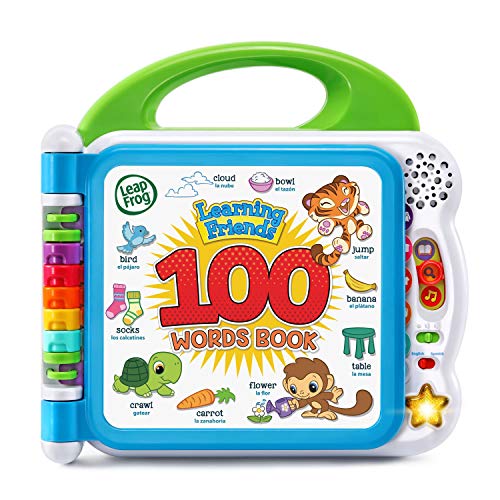
LeapFrog Learning Friends 100 Words Book
Toddlers connect pictures with words here, at the vocabulary-building stage where that link forms fastest. Bilingual audio adds Spanish at the age children absorb a second language most easily. Sturdy board-style pages and buttons survive rough handling, though the single-purpose format wants pairing with an open-ended toy.
Pros
- Bilingual audio at the ideal absorbing age
- Sturdy pages survive toddler handling
- Clear category structure for vocabulary
Cons
- Repetitive audio wears on adults
- Limited play value once words are learned

VTech Touch and Learn Activity Desk Deluxe
A desk that converts into an easel and a whiteboard covers several years of content through swappable activity pages. One purchase spans letters through early math, which is the appeal despite the size. Real floor space and a noticeable volume level are worth checking before committing to it.
Pros
- Covers several developmental stages
- Converts into an easel for drawing
- Expansion pages extend the life
Cons
- Takes significant floor space
- Sound level is high even at low settings
Side by side
| # | Model | Age range | Best for | Score | Price |
|---|---|---|---|---|---|
| 1 | Magna-Tiles Classic 100 Piece Set | 3 years and up | Best overall | 9.4 | Check price |
| 2 | Melissa and Doug Wooden Shape Sorting Cube | 2 years and up | Best value | 9.2 | Check price |
| 3 | Osmo Genius Starter Kit for iPad | 6 to 10 years | Best for screen time balance | 9.0 | Check price |
| 4 | LEGO Classic Creative Brick Box 10698 | 4 years and up | Best for creative building | 8.8 | Check price |
| 5 | Learning Resources Botley the Coding Robot 2.0 | 5 years and up | Best for early coding | 8.6 | Check price |
| 6 | LeapFrog Learning Friends 100 Words Book | 18 months to 4 years | Best for early vocabulary | 8.3 | Check price |
| 7 | VTech Touch and Learn Activity Desk Deluxe | 2 to 5 years | Best all in one desk | 8.0 | Check price |
How to pick the right one
Why open-ended toys beat single-outcome toys A toy with one correct answer gets solved once, then put away. Blocks, magnetic tiles and loose bricks have no defined end, so they get rebuilt into something new every session. Choosing between two toys that teach the same skill, the open-ended one nearly always delivers more hours and more thinking per dollar spent.
How do you match a toy to a child’s age? Age labels mostly describe small-parts safety, not developmental readiness. A toy far below a child’s ability gets ignored, and one far above it causes frustration and abandonment. The useful target sits just past a child’s current skill, manageable with a little help, since that range is where real learning happens.
Do noisy electronic toys hurt learning? Electronic toys earn a real place, especially for language and phonics practice. They also compete for the attention of an entire household. A toy that repeats the same eight-second tune hundreds of times tends to end up in a cupboard regardless of educational merit. Between two toys teaching the same skill, the quieter one usually survives longer.
Which skills matter most at each age? Fine motor control, cause and effect, and vocabulary matter most under age two. Shape sorting, matching and early counting take over between two and four. Sequencing, letters and building from a plan arrive around four to seven. Logic and coding concepts, plus longer projects, suit age seven and up. One strong toy per stage beats a shelf of overlapping ones.
Frequently asked questions
What actually makes a toy educational?
A toy earns that label when the play itself demands a skill, such as sorting, sequencing, building to a plan or forming words. A packaging claim means little on its own. Ask what the child has to think about to play, and the answer becomes obvious.
Are wooden toys better than plastic ones?
Not automatically. Wood is durable, quiet and pleasant to handle, which suits toddler toys well. Plastic allows shapes and mechanisms wood cannot manage, and magnetic tiles or building bricks would not work in wood at all. Judge by what the toy asks the child to do.
How many toys should a child have out at once?
Fewer than most homes provide. Rotating a small selection while storing the rest tends to deepen how a child plays with each one. A crowded shelf usually produces brief, shallow engagement across many items instead.
Do coding toys really teach programming?
They teach the thinking underneath it, namely sequencing, prediction and debugging, which transfers well to real programming later. They do not teach syntax or a specific language, and are not meant to. For a five to eight year old, that foundation is the right target.
Is screen-based learning worth it for young children?
It depends on the format. Passive video carries limited value at young ages. Systems combining physical manipulation with screen feedback keep a child active and tend to be viewed more favorably. Time limits and adult involvement matter more than the specific product.
How do you stop a new educational toy from being abandoned?
Play alongside the child for the first few sessions, since abandonment usually happens when a child cannot get past the first difficulty alone. Step back after that. Storing the toy visibly at child height also matters more than most parents expect.
Are expensive building sets worth the premium over cheap ones?
Often yes, because clutch strength and magnet quality determine whether a build stands up. A tower that collapses under its own weight breeds frustration rather than persistence. This is one category where cheaper alternatives are genuinely, noticeably worse.
What is the best educational toy for a toddler specifically?
There is no single universal answer, but a solid set of blocks or a shape sorter covers more developmental ground than almost anything else at that age. Both cost little, need no batteries and rarely stop being useful before age four.
Educational toys vs screen time: which builds more skill?
Physical, open-ended toys generally build more spatial and problem-solving skill per hour than passive screen time. Hybrid systems like Osmo split the difference by keeping a child physically active while using a screen for feedback.
The bottom line
Magna-Tiles Classic 100 Piece Set keeps paying off for years, since open-ended magnetic building suits a three-year-old and a nine-year-old equally well, just differently. Budget-conscious toddler shopping points to the Melissa and Doug Wooden Shape Sorting Cube, which covers the same problem-solving instinct in solid wood. Families already using a tablet should look at the Osmo Genius Starter Kit to make that screen time more active.


