Phonics Toys That Make Letter Sounds Stick for Kids
LeapFrog’s Letter Factory Phonics is the clearest introduction to letter sounds for preschoolers, the Osmo Little Genius Starter Kit is the most engaging tactile option, and LeapFrog Fridge Phonics is the best value for everyday practice. LeapFrog’s LeapStart system offers the longest progression.
LeapFrog’s Letter Factory Phonics is the top overall pick for teaching letter sounds, the Osmo Little Genius Starter Kit is the most engaging for children who resist drill-style toys, and LeapFrog Fridge Phonics gives daily reinforcement for very little.
Phonics toys get tricky because many alphabet products teach letter names rather than the sounds children actually need for blending, and plenty stop being interesting after a week. We compared how each toy presents sounds, whether it builds toward blending, how much adult involvement it needs, and what parents report about durability and repeat play.
The top picks, ranked

LeapFrog Letter Factory Phonics
This toy leads with letter sounds rather than letter names, the foundation children need before they can blend words. Three modes move from single sounds to letter names to a song, so the same toy stays useful as understanding grows. Parents consistently report children repeating the sounds independently within days, exactly the behaviour phonics instruction aims for.
Pros
- Teaches sounds before names
- Three modes grow with the child
- Children repeat the sounds unprompted
Cons
- Repetitive audio for nearby adults
- No volume off, only high and low

Osmo Little Genius Starter Kit
A tablet camera reads real silicone letter shapes as the child arranges them on the table, bridging physical and screen play. Hands stay busy while the app gives immediate feedback on sounds and word building. Setup is more involved than a standalone toy, since it needs a compatible tablet and a stand.
Pros
- Physical manipulation with instant feedback
- Holds attention longer than most toys
- Several activities in one kit
Cons
- Needs a compatible tablet and stand
- Involves screen time
LeapFrog Fridge Phonics Magnetic Letter Set
Slotting a magnetic letter into the reader triggers its sound, its name and a short song, and living on the fridge means it gets used in small bursts throughout the day. That casual repetition builds recall over time. Chunky letters suit small hands, though families report the occasional letter disappearing under furniture.
Pros
- Encourages short frequent practice
- Chunky letters suit small hands
- Low cost per learning minute
Cons
- Individual letters get lost easily
- Only one letter reads at a time

Educational Insights Hot Dots Jr. Let’s Master Reading
An interactive pen reads printed dots on workbook pages and responds instantly with a correct or try-again cue, so a child can practise without an adult sitting alongside. That self-checking loop suits children already past single sounds and moving into word reading. It leans closer to structured practice than free play, which some children take to and others do not.
Pros
- Children can practise unsupervised
- Immediate corrective feedback
- Expandable with more workbook sets
Cons
- Feels like schoolwork to some children
- Pen must be pressed firmly to register

VTech Touch and Learn Activity Desk Deluxe
This activity desk starts as a phonics and letter station and converts into an easel and drawing desk, with swappable page sets covering letters, words and early maths. That conversion is why families report several years of use rather than several months. Real floor space is required, so measure before buying for a small room.
Pros
- Converts as the child grows
- Covers letters, words and numbers
- Sturdy enough for daily use
Cons
- Takes significant floor space
- Extra content costs more
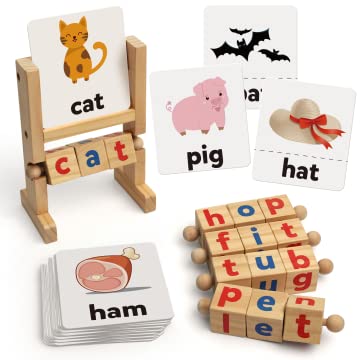
Coogam Wooden Reading Blocks Short Vowel Rods
These wooden rods spin to build three-letter words, turning blending into a physical, screen-free activity. Because the child forms the word rather than being told it, the connection between sounds and spelling lands more firmly. No audio comes built in, so an adult needs to be present to model the sounds at first.
Pros
- Completely screen free and quiet
- Physical word building supports blending
- Durable wooden construction
Cons
- No audio, so needs adult input
- Limited to short vowel words

LeapFrog LeapStart Interactive Learning System
LeapStart pairs a stylus with replaceable books covering a wide curriculum, from early phonics through to reading comprehension. Breadth is the appeal, since one device carries a child from letter sounds to sentences. Ongoing book cost is the catch, and the base system alone comes with very little content.
Pros
- Covers a long age and skill range
- Large library of levelled books
- Stylus interaction is intuitive
Cons
- Books are an ongoing cost
- Little content included in the box
Before you buy
Letter sounds come before letter names A child who knows a letter is called bee cannot use that fact to read the word bat. What they need is the sound buh. Many alphabet toys teach names because a song is easier to build, but phonics instruction depends on sounds. Check whether a toy leads with sound, as LeapFrog’s Letter Factory does, or treats it as an afterthought behind the alphabet song.
Look for a path toward blending Recognising individual sounds is only the first step. Blending those sounds into a word is the skill that actually unlocks reading, and a toy that never moves past single letters leaves a child at the starting line. Word-building toys such as the Coogam rods, or self-checking readers like Hot Dots Jr., carry a child from sounds to actual words.
Screen free versus interactive Digital toys give instant feedback and hold attention well, which matters for children who resist repetition. Screen-free toys keep hands busy and demand more thought, but usually need an adult nearby to model the sounds. Most families do best pairing one of each, using the digital toy for independent practice and the wooden or magnetic set for shared time.
Age fit and how long attention lasts A toy aimed too young becomes boring within days, while one aimed too old produces frustration and avoidance. Match the toy to what a child can already do, not to what you hope they will do. Parents report that products with multiple modes or expandable content hold interest longest, since the difficulty can rise as the child improves.
Compared at a glance
| # | Model | Age range | Best for | Score | Price |
|---|---|---|---|---|---|
| 1 | LeapFrog Letter Factory Phonics | About 2 to 5 years | Best overall | 9.4 | Check price |
| 2 | Osmo Little Genius Starter Kit | About 3 to 5 years | Best for engagement | 9.2 | Check price |
| 3 | LeapFrog Fridge Phonics Magnetic Letter Set | About 2 to 5 years | Best value | 9.0 | Check price |
| 4 | Educational Insights Hot Dots Jr. Let’s Master Reading | About 4 to 6 years | Best for independent practice | 8.8 | Check price |
| 5 | VTech Touch and Learn Activity Desk Deluxe | About 2 to 5 years | Best for long term use | 8.6 | Check price |
| 6 | Coogam Wooden Reading Blocks Short Vowel Rods | About 3 to 6 years | Best screen free option | 8.3 | Check price |
| 7 | LeapFrog LeapStart Interactive Learning System | About 2 to 7 years | Best for structured progression | 8.0 | Check price |
Common questions
At what age should phonics toys start?
Many children enjoy letter-sound toys from around two, though the sounds mainly register as fun noises at that stage. Genuine phonics learning usually takes hold between three and five, which is when blending toys start to make sense.
Do phonics toys actually teach reading?
They build the components, letter-sound knowledge and blending practice, but do not replace reading with an adult. Parents who pair a phonics toy with daily shared reading report the strongest progress.
What is the difference between letter names and letter sounds?
The name of the letter s is ess, but the sound it makes is sss. Reading depends on sounds, which is why toys leading with sounds serve early literacy better than alphabet songs.
Are screen based phonics toys a problem?
Used in short sessions they can be very effective, since immediate feedback is hard to replicate otherwise. Osmo mitigates the concern by keeping the child working with physical pieces rather than tapping a screen.
Which toy works best for a child who resists sitting still?
The Osmo Little Genius Starter Kit and LeapFrog Fridge Phonics both suit restless children, since one turns learning into a physical game and the other works in thirty-second bursts throughout the day.
How much adult supervision do these toys need?
Hot Dots Jr. and LeapStart are designed for independent use once set up. The wooden Coogam rods need an adult to model sounds at first. Everything else sits somewhere in between.
Do I need multiple phonics toys?
Not necessarily, though most families find one audio toy for sounds plus one tactile toy for word building covers more ground than two similar products would.
How long do children stay interested in a phonics toy?
Parents commonly report a few intense weeks of use followed by occasional returns. Toys with multiple modes or expandable content, such as the VTech activity desk or LeapStart, tend to come back into rotation longer.
Our take
LeapFrog’s Letter Factory Phonics is the toy to put in front of a preschooler first, since it teaches the sounds reading actually depends on and children repeat them unprompted. Pair it with something tactile for blending, either the Osmo Little Genius kit for engagement or the Coogam wooden rods for screen-free practice. Fridge Phonics is worth adding regardless, simply because a toy on the fridge gets used far more often than one in a toy box.

