How to Choose an Exercise Bike for Home Workouts
The Schwinn IC4 leads for magnetic resistance and open app support, the Peloton Bike suits riders who want live studio classes, and the NordicTrack S22i stands out for automatic incline and decline training on a large touchscreen.
Magnetic resistance and open app support make the Schwinn IC4 the strongest all-around exercise bike this year. Live class fans do better with the Peloton Bike, while anyone chasing automatic incline training should look at the NordicTrack S22i.
Exercise bikes span plain flywheels under a few hundred dollars and connected machines well past a thousand, which makes comparison tricky. Drive type, resistance range, adjustability and app lock-in decide whether a bike gets used daily or abandoned within a month. We compared seven current models on published specifications and what owners consistently report about noise, fit and reliability.
What we recommend

Schwinn IC4
Magnetic resistance across 100 levels keeps the Schwinn IC4 nearly silent during hard intervals. Bluetooth broadcasting opens it to Peloton, Zwift and Explore the World, so no single subscription is required. Dual-sided pedals switch between clips and cages depending on the shoes you wear.
Pros
- Quiet magnetic resistance
- Works with multiple training apps
- Dual-sided clip and cage pedals
Cons
- No built-in touchscreen
- Handlebars adjust up and down only

Peloton Bike
A rotating HD touchscreen anchors the Peloton Bike’s live and on-demand class library. Steel frame construction and magnetic resistance keep the ride stable and quiet even during standing sprints. Most of the machine’s value depends on an ongoing class membership.
Pros
- Large motivating class library
- Very quiet magnetic drive
- Rotating touchscreen for floor workouts
Cons
- Membership required for full value
- Locked to one ecosystem
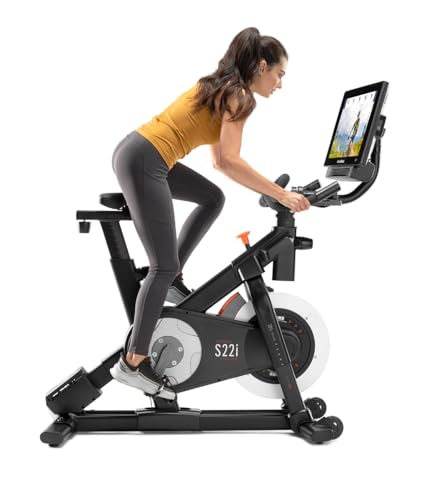
NordicTrack S22i
Automatic incline and decline tilt the entire S22i frame to match whatever terrain a trainer sets. iFIT sessions stream across a large swiveling touchscreen that also adjusts resistance for you. Its footprint runs large, so measuring the room first matters.
Pros
- Automatic incline and decline
- Large immersive touchscreen
- Trainer-controlled resistance
Cons
- Large and heavy footprint
- Best features tied to iFIT

YOSUDA Indoor Cycling Bike
Friction-pad resistance and a heavy flywheel give the YOSUDA a stable ride well below the cost of connected bikes. A simple tablet bracket lets riders bring their own apps or videos instead of paying for a bundled ecosystem. Assembly takes under an hour according to owner reports.
Pros
- Very affordable entry point
- Stable, sturdy frame
- Simple to assemble and use
Cons
- Friction pads wear over time
- No app integration or metrics

Echelon EX-5
Wide-range magnetic resistance and a quiet belt drive put the EX-5 close to premium connected bikes at a lower entry cost. Riders supply their own tablet, since the frame includes a device holder rather than a built-in screen. Echelon’s class library still runs on a paid membership.
Pros
- Lower cost of entry to connected fitness
- Broad resistance range
- Quiet belt drive
Cons
- No included touchscreen on this model
- Classes need a membership

Sunny Health & Fitness SF-B1805
Magnetic belt drive replaces Sunny’s older friction design here, cutting noise and eliminating pad wear. A heavy flywheel adds stability during standing efforts, and the console stays basic, covering speed, time and distance only. No subscription is needed to use the bike at all.
Pros
- Quiet magnetic belt drive
- Heavy stabilizing flywheel
- No subscription needed
Cons
- Very basic console
- No app connectivity
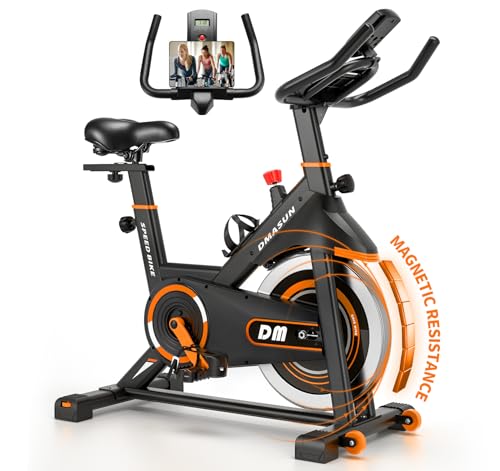
DMASUN Indoor Cycling Bike
Emergency brake resistance gives new riders a familiar, forgiving way to slow the flywheel compared to a click-adjust dial. Four-way seat and handlebar adjustment fits a wider range of heights than many budget bikes manage. A basic LCD monitor covers time, speed and distance, with no app connection built in.
Pros
- Easy, beginner-friendly resistance
- Wide fit adjustment range
- Sturdy for the price
Cons
- Friction resistance is louder
- Limited built-in metrics
What matters most
What actually separates one exercise bike from another Resistance type is the first fork in the road. Friction pads cost less and mimic a real bike’s feel, but they wear down and get louder with age. Magnetic systems have no contact with the flywheel, so they stay quiet and hold their calibration for years. Riders training early mornings or near a shared wall usually notice the difference within the first month.
Open training apps versus bundled class ecosystems Some bikes, like the Schwinn IC4, broadcast resistance and cadence over Bluetooth so any app can read them. Others, including Peloton and NordicTrack’s iFIT, pair a screen with their own class library and lock most features behind a membership. Neither approach is wrong, but the ongoing cost differs sharply between them. Decide before buying whether you want app freedom or one polished, turnkey experience.
Sizing a bike to your height and your room Every model lists a recommended rider height range, and riders near either edge should check it before ordering. Seats that adjust up, down, forward and back accommodate more body types than a single-axis design. Interactive bikes with tilting frames or large screens can need several extra feet of clearance around them. Measure doorways too, since some large consoles do not pass through standard frames easily.
Buying for daily use or a multi-person household Heavier flywheels and wider bases hold up better under standing sprints and daily mileage. Bikes shared across a household benefit from tool-free seat adjustment, since several riders will reset it often. Basic consoles suit casual users fine, while anyone tracking output or heart rate over time should confirm the bike measures or broadcasts those figures natively. Warranty length is also worth checking against how hard the bike will be used.
How they stack up
| # | Model | Drive system | Best for | Score | Price |
|---|---|---|---|---|---|
| 1 | Schwinn IC4 | Belt with magnetic resistance | Best overall | 9.4 | Check price |
| 2 | Peloton Bike | Belt with magnetic resistance | Best for live classes | 9.2 | Check price |
| 3 | NordicTrack S22i | Magnetic resistance | Best for incline training | 9.0 | Check price |
| 4 | YOSUDA Indoor Cycling Bike | Belt with friction resistance | Best budget pick | 8.7 | Check price |
| 5 | Echelon EX-5 | Belt with magnetic resistance | Best connected-fitness value | 8.5 | Check price |
| 6 | Sunny Health & Fitness SF-B1805 | Belt with magnetic resistance | Best belt-drive value | 8.3 | Check price |
| 7 | DMASUN Indoor Cycling Bike | Belt with friction resistance | Best for beginners | 8.1 | Check price |
Questions worth asking
Is magnetic resistance worth the extra cost over friction pads?
For most riders, yes. Magnetic systems have no pads touching the flywheel, so they run quieter and need less maintenance, and many allow precise level adjustments. Friction bikes cost less and feel closer to an outdoor ride, but the pads wear and can squeak as they age.
Do I need a paid subscription to use an exercise bike?
It depends on the model. Open bikes like the Schwinn IC4 work fully without any subscription, though free or paid apps can still connect over Bluetooth. Closed ecosystems such as Peloton and NordicTrack’s iFIT deliver most of their value through membership, so factor that ongoing cost into your budget.
How much floor space does an exercise bike need?
Compact indoor cycles fit in a small corner, while interactive bikes with tilting frames and large screens need more clearance around them. Check the listed length and width, add room to mount and dismount, and confirm the bike clears your doorways before buying.
What flywheel weight makes for a smoother ride?
There is no single right number, but a heavier flywheel generally builds and holds momentum through hard efforts. Weigh that against the bike’s overall weight and how often you plan to move it, since heavier flywheels usually mean a heavier frame.
Can tall or short riders fit comfortably on these bikes?
Most models list a recommended height range and offer multi-way seat and handlebar adjustment. Riders near the edges of that range should check the specifications closely and look for four-way adjustable seats. Many owners also swap in a wider saddle to fine-tune the fit.
Are built-in touchscreens necessary, or is a tablet holder enough?
A built-in touchscreen makes bundled classes seamless, but plenty of strong bikes rely on a simple tablet or phone holder instead. Owners who already have a device and prefer choosing their own apps get a similar experience for less money.
How loud is an indoor exercise bike during a hard interval?
Magnetic, belt-driven bikes stay quietest and suit apartments or early sessions near sleeping family. Friction and chain systems make more noise, particularly as components wear. Owners consistently point to magnetic belt-drive models when quiet operation is the priority.
Do budget exercise bikes track heart rate and cadence?
Coverage varies widely. Higher-end connected bikes track cadence, output and often heart rate through paired straps, while budget models show only basic figures on a small monitor. Confirm the bike either measures those metrics natively or broadcasts data to an app you already use.
Is assembly hard for a heavy connected exercise bike?
Most indoor bikes ship largely pre-assembled, and owners typically report finishing setup in under an hour with the included tools. Interactive bikes with screens and tilting frames weigh more and can benefit from a second person during the build.
Which exercise bike suits a complete beginner?
Beginners tend to do well with a stable bike that has forgiving resistance and easy fit adjustments, such as the YOSUDA or DMASUN. Both let you build a routine without a subscription, and app-based classes can always be added later through a tablet holder.
The bottom line
The Schwinn IC4 stands out overall thanks to quiet magnetic resistance, open app support and a comfortable adjustable fit. Riders who want live studio motivation should pick the Peloton Bike, and anyone excited by automatic incline training will get more from the NordicTrack S22i. Tighter budgets are served well by the YOSUDA, which skips subscriptions entirely.

