What Thickness Should Your Exercise Mat Really Be?
The Gorilla Mats Premium Large Exercise Mat leads for home workouts that need floor space. BalanceFrom GoYoga gives the best balance of cushioning and cost, while the Manduka PRO is the pick for yoga practitioners who want a dense, stable surface that lasts years.
Full-body workouts at home call for the Gorilla Mats Premium Large Exercise Mat first. BalanceFrom GoYoga covers general use at a modest cost, and the Manduka PRO is the long-term buy for dedicated yoga. Each targets a different mix of cushioning and stability.
Thickness and stability pull in opposite directions, which is what makes this choice trickier than it looks. A plush mat that protects knees during floor work makes single-leg balance feel wobbly underfoot. We compared stated thickness, material composition, dimensions and surface texture, then weighed what owners report about grip once palms get sweaty, odor when new, and whether edges curl after rolling.
How to pick the right one
What thickness of exercise mat fits your workout Roughly 3 to 5 mm suits yoga and anything requiring balance, 6 to 8 mm is the general home workout sweet spot, and half an inch or more works for floor-based stretching, core and rehab work. Splitting time between styles? A firmer mat with a folded towel under the knees beats a thick mat that fights stability.
Grip depends on material as much as texture Natural rubber and polyurethane surfaces grip best once damp, PVC needs a break-in period and can feel slick at first, and closed-cell foam sheds sweat but offers less bite. Heavy hand sweat responds better to a rubber-topped mat or a mat towel than to a textured foam surface.
Measuring the space, not just the mat Standard mats run about 68 to 72 inches long, short for anyone over six feet and narrow for lateral movement or dumbbell work. Large-format mats and interlocking tiles solve both problems. Check diagonal clearance in the room too, since arms overhead in a lunge need more space than the mat’s footprint suggests.
Planning for cleaning and storage from day one Closed-cell mats wipe down in seconds, while open-cell surfaces absorb sweat and need proper drying to avoid odor. Rolled mats need a corner, folding mats stand against a wall, and tiles stack flat. Rolling a mat with the top surface facing outward reduces edge curl the next time it unrolls.
Our top picks

Gorilla Mats Premium Large Exercise Mat
Full-body movement stays on the mat here, not just a single yoga position, thanks to its large-format sizing. Thickness options span cushioned floor work and firmer standing exercises, with a textured top that holds grip once hands get damp. Owners report it lying flat within minutes of unrolling rather than fighting back for days.
Pros
- Large enough for full workouts, not just yoga
- Lies flat soon after unrolling
- Grippy surface holds up when damp
Cons
- Bulky to store in small apartments
- Heavier to carry than a standard yoga mat

BalanceFrom GoYoga All-Purpose Exercise Mat
Half-inch cushioning is the defining feature here, protecting knees, elbows and spine during floor-based work. A carrying strap ships with the mat, making it practical for both classes and living-room sessions. That same cushioning makes standing balance poses feel less stable than on a thinner yoga mat.
Pros
- Thick cushioning is kind to knees and elbows
- Strap included for carrying
- Light for its thickness
Cons
- Too soft for stable balance work
- Foam surface dents under heavy equipment

Manduka PRO Yoga Mat
Density, not plushness, is the point of this 6 mm mat, which stays flat and stable through standing and balancing poses. Its weight is part of why it resists sliding across a hardwood floor. Owners describe a short break-in period, during which the closed-cell top feels slick before it grips properly.
Pros
- Very stable for standing and balance poses
- Closed cell top resists sweat absorption
- Built to last many years of practice
Cons
- Slippery until broken in
- Heavy to carry to classes

ProsourceFit Extra Thick Puzzle Exercise Mat
Interlocking EVA tiles let you cover exactly the floor area needed, from a kettlebell corner to a full spare room. Hard floors get better protection from dropped weights than a rolled mat provides, and individual tiles lift out for cleaning. Heavy static loads can dent the foam, so bodyweight and light dumbbell work suit it best.
Pros
- Cover any shape or size of floor area
- Protects hard floors under equipment
- Individual tiles lift out for cleaning
Cons
- Seams can separate during vigorous training
- Foam dents under heavy static loads

Amazon Basics 1/2-Inch Extra Thick Exercise Yoga Mat
Simplicity defines this thick foam mat, built for stretching, core work and general home exercise without extra features. An included strap and light weight let it store upright in a wardrobe corner. New-mat odor is common for the first few days, according to owner reports, and fades with airing.
Pros
- Low cost entry to cushioned floor work
- Light and easy to store
- Strap included
Cons
- Odour when new needs airing out
- Surface wears faster than premium mats

Retrospec Solana Yoga Mat
Lighter than a premium yoga mat, the Solana rolls tightly at roughly 6 mm thick and comes with its own strap for studio commutes. More cushioning than a thin travel mat arrives without sacrificing portability. Lower density means it shows compression sooner under daily practice than denser mats do.
Pros
- Light enough for a daily commute
- Rolls tightly without fighting the strap
- Reasonable cushioning for the weight
Cons
- Compresses over time with heavy use
- Less grip than rubber topped mats
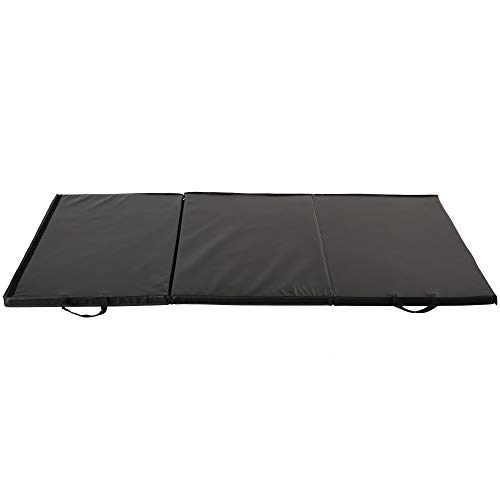
Sunny Health & Fitness Folding Gym Mat
Folding panels give this mat thicker impact cushioning than any rolled option, suiting stretching, gymnastics practice and softer landings for older users. Storage needs a wall rather than a rolled corner, since it folds into a compact block. High loft makes it unsuitable for standing balance or weighted exercises.
Pros
- Thick cushioning for impact and tumbling
- Folds into a block for upright storage
- Wipe clean cover is easy to sanitise
Cons
- Far too soft for standing exercises
- Bulky even when folded
How they compare
| # | Model | Sizes | Best for | Score | Price |
|---|---|---|---|---|---|
| 1 | Gorilla Mats Premium Large Exercise Mat | Multiple large formats | Best overall | 9.4 | Check price |
| 2 | BalanceFrom GoYoga All-Purpose Exercise Mat | About 1/2 in | Best value | 9.2 | Check price |
| 3 | Manduka PRO Yoga Mat | 6 mm | Best for yoga | 9.0 | Check price |
| 4 | ProsourceFit Extra Thick Puzzle Exercise Mat | Interlocking foam tiles | Best for home gym floors | 8.8 | Check price |
| 5 | Amazon Basics 1/2-Inch Extra Thick Exercise Yoga Mat | 1/2 in | Best budget | 8.6 | Check price |
| 6 | Retrospec Solana Yoga Mat | About 6 mm | Best for travel and classes | 8.3 | Check price |
| 7 | Sunny Health & Fitness Folding Gym Mat | Folding panel mat | Best for tumbling and stretching | 8.0 | Check price |
Frequently asked questions
What thickness of exercise mat should I choose?
For general home workouts, 6 to 8 mm is the best compromise between joint comfort and stability. Go thinner for yoga and balance work, and half an inch or more if most of the session happens lying or kneeling on the floor.
Are thicker mats always more comfortable?
For floor work, yes, but thickness costs stability. Standing on a very soft mat makes single-leg and balance exercises noticeably harder, sometimes feeling unsafe with weights in hand, which is why dedicated yoga mats stay thin.
How do I stop a mat sliding on hardwood?
Heavier and denser mats slide less, so weight becomes a feature rather than a drawback. If a light mat still moves, a low-pile rug underneath, a textured base, or a thin non-slip underlay of the kind used beneath area rugs all help.
What is the best way to clean an exercise mat?
Wipe with a cloth dampened with water and a small amount of mild soap, then dry fully before rolling. Avoid soaking foam mats, and skip alcohol or bleach-based sprays on rubber, which dries the surface and shortens the mat’s life.
Why does my new mat smell?
Foam and PVC mats often release a manufacturing odor for the first several days. Unrolling the mat in a ventilated room, wiping it with a mild soap solution, and leaving it open rather than rolled usually clears the smell within a week or two.
Can I use a yoga mat for HIIT and weights?
A thin yoga mat works for bodyweight cardio but offers little impact protection and can tear under dumbbell edges. For weight work, interlocking tiles or a large-format workout mat protect both the floor and the mat far better.
How long should an exercise mat last?
Budget foam mats commonly show compression within a year of frequent use, while dense mats such as the Manduka PRO are built to last many years. Longevity depends mostly on density and storage, since edge curl and cracking often arrive before the surface actually wears out.
Do interlocking tiles work over carpet?
They can, but the combined softness reduces stability and tiles are more likely to separate as they shift. Over carpet, a firm large-format mat generally performs better, leaving tiles best suited to hard floors where they also protect the surface underneath.
Final word
The Gorilla Mats Premium Large Exercise Mat is the best choice for most home workouts, since it gives real floor space with grip that holds when you sweat. Choose BalanceFrom GoYoga for cushioned floor work at low cost, and the Manduka PRO if yoga is the main practice and a mat that lasts matters more than price.