Flash Cards That Kids Actually Want to Practice With
School Zone Alphabet Flash Cards suit early letter recognition best, with clear print and sturdy card stock. Trend Enterprises Sight Words Skill Drill cards offer the strongest value for reading practice. Think Tank Scholar Multiplication cards handle times tables best, with self checking answers built into each card.
School Zone Alphabet Flash Cards top this list for preschool letter work. Trend Enterprises Sight Words cover early reading, and Think Tank Scholar Multiplication handles times tables. Carson Dellosa, Star Right, Merka and Preschool Prep fill out the remaining age ranges.
Picking flash cards is harder than the box suggests, since pedagogy and paper stock both matter. Thin card curls within a week, busy print distracts from the target skill, and the wrong stage gets abandoned fast. We compared card counts, stock quality, age guidance and what parents report about daily use, then ranked each set by skill area.
Our top picks

School Zone Alphabet Flash Cards
Each card in this set carries one letter with a single clean illustration, suited to three and four year olds. Upper and lower case sit together so kids link both forms early. Parents report the card stock survives shuffling by small hands better than thinner supermarket sets.
Pros
- Uncluttered design keeps focus on one letter
- Shows upper and lower case together
- Holds up to daily handling
Cons
- Covers letters only, not sounds
- Corners soften after heavy use

Trend Enterprises Sight Words Skill Drill Flash Cards
Plain type and no artwork keep attention on the word itself, which is why this classroom staple works. An example sentence printed on the back turns recognition into real reading. Teachers report it drills well in groups and one on one at home.
Pros
- Plain type builds true word recognition
- Context sentence printed on the reverse
- Matches how schools teach sight words
Cons
- Plain look feels dull to some kids
- Card stock is thinner than premium sets

Think Tank Scholar Multiplication Flash Cards
Facts are grouped by number family, with the answer printed on the back for independent checking. Colour coding shows a child’s progress through the times tables. Parents report the ring bound box makes it easy to isolate two or three tricky facts.
Pros
- Self checking supports independent practice
- Colour coded by fact family
- Ring bound box keeps cards organised
Cons
- Large set can overwhelm younger kids
- Covers multiplication only, not division
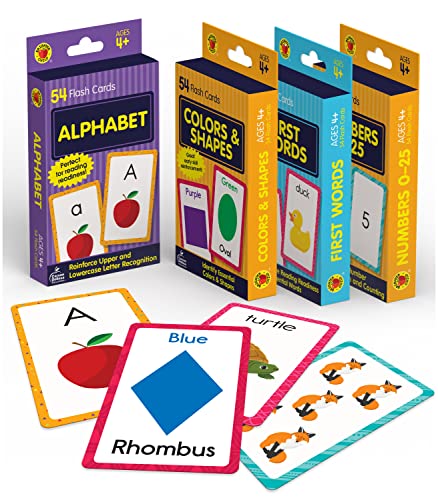
Carson Dellosa Colors, Shapes and More Flash Cards
Colours, shapes, numbers and early words share one box, suited to toddlers cycling through several concepts at once. Bold, large artwork gives toddlers something to name with confidence. Parents report the variety keeps sessions short and playful rather than drill like.
Pros
- Several early concepts in one box
- Large cards suit a toddler grip
- Bright artwork holds attention
Cons
- Broad coverage means less depth per skill
- Too few cards per concept for long drilling
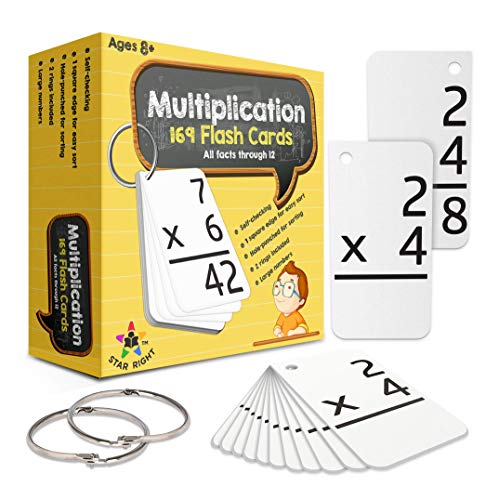
Star Right Math Flash Cards
Addition, subtraction, multiplication and division each get their own ring bound deck inside one box. That range carries a child from early arithmetic through the end of primary maths. Parents highlight the rings, since a targeted stack of ten facts beats shuffling hundreds of cards.
Pros
- Covers years of maths in one purchase
- Rings make targeted practice simple
- Answers printed for self checking
Cons
- Bulkier box than single skill sets
- Card stock is mid weight, not premium

Merka Baby Flash Cards
Large, simple images against clean backgrounds suit how infants and toddlers focus. Vocabulary sets pair a photograph with its word so parents can point and name together. Parents report using them as naming games rather than tests, which fits this age group.
Pros
- Simple visuals suit very young children
- Thick laminated card resists chewing
- Photographs support real world naming
Cons
- Outgrown quickly as vocabulary expands
- No self checking element by design

Preschool Prep Meet the Sight Words Flash Cards
Cards mirror the Preschool Prep video series many families already watch, so children recognise words from familiar characters. That link between screen and card turns practice into continuation rather than homework. Parents report the set works best paired with the videos rather than alone.
Pros
- Familiar words carry over from the videos
- Simple presentation with no clutter
- Small set size avoids overwhelming kids
Cons
- Fewer words than classroom sets
- Works best alongside the wider video series
How to choose
How to match flash cards to your child’s stage Two kids of the same age can sit a year apart in reading or number confidence. Choose cards for what a child can nearly do, not what the box states. A slightly easy set builds momentum, while a hard one ends sessions early. Buying the next set later works fine.
Why short daily sessions beat long weekly ones Five minutes most days beats a half hour once a week, because recall strengthens with spacing. Keep an active stack of ten to fifteen cards. Retire ones a child answers instantly, then add new ones in their place. Rings and boxes exist specifically to split a deck this way.
Does card stock quality actually matter? Thin uncoated card curls, tears at the corners and stops shuffling cleanly, which quietly ends the habit. Coated or laminated stock, rounded corners and a real storage box are worth paying for. Larger cards suit small hands and work better for group use.
Are self checking answers worth it? When answers sit on the back, a child can practise alone, and an older sibling can help without an adult present. That independence matters most for maths facts. For letters and early vocabulary, an adult naming and repeating the word is the actual point, so self checking matters less there.
Compared at a glance
| # | Model | Age range | Best for | Score | Price |
|---|---|---|---|---|---|
| 1 | School Zone Alphabet Flash Cards | Around 3 to 5 years | Best overall for preschoolers | 9.4 | Check price |
| 2 | Trend Enterprises Sight Words Skill Drill Flash Cards | High frequency sight words | Best value for early reading | 9.2 | Check price |
| 3 | Think Tank Scholar Multiplication Flash Cards | Multiplication facts 0 to 12 | Best for maths facts | 9.0 | Check price |
| 4 | Carson Dellosa Colors, Shapes and More Flash Cards | Colours, shapes, numbers, words | Best for toddlers | 8.8 | Check price |
| 5 | Star Right Math Flash Cards | Addition, subtraction, multiplication, division | Best all four operations set | 8.6 | Check price |
| 6 | Merka Baby Flash Cards | Infant through toddler | Best for babies and early vocabulary | 8.3 | Check price |
| 7 | Preschool Prep Meet the Sight Words Flash Cards | Early sight words | Best for pre reading practice | 8.0 | Check price |
Frequently asked questions
What age can kids start using flash cards?
Simple picture cards work as a naming game from around eighteen months, as long as it stays playful rather than testing. Letter and number recognition usually clicks between three and five. Sight words and maths facts follow once formal reading and arithmetic begin.
How many cards should be in the active stack?
Ten to fifteen cards is plenty for most children. Bigger stacks dilute repetition and hide progress. Move cards a child answers instantly into a review pile and revisit it weekly.
Are paper flash cards better than an app?
Paper skips notifications and screen fatigue, and younger kids handle physical cards more naturally. Apps add adaptive scheduling and instant feedback. Many families use both, cards for short daily practice and an app for variety.
Do flash cards actually help kids learn?
Retrieval practice, which is exactly what a flash card forces, has strong support as a study method across age groups. Recalling before checking drives the benefit, not staring at the answer. Keep that pause before the reveal.
What should we do if a child gets frustrated?
Shorten the session, shrink the stack and mix in cards they already know so most attempts succeed. Frustration usually means the stack is too hard or runs too long. Ending on a known card makes the next session easier to start.
Which flash cards suit a child starting kindergarten?
Sight word cards such as the Trend Enterprises set track closely with early school curricula. Pair them with an alphabet set if letter recognition is still forming. Ask the class teacher which word list the school follows.
How should flash cards be stored?
A rigid box, elastic band or ring binder keeps a stack together and stops corners bending in a drawer. Rings work well for splitting active and mastered piles. Wipe laminated cards occasionally if they live near a kitchen table.
Can two children share one flash card set?
Yes, as long as their levels sit close together. Take turns answering, or let the older child quiz the younger one, which reinforces both. Run separate short sessions instead if the skill gap is wide.
Our pick
School Zone Alphabet Flash Cards give preschoolers the strongest start on letters, and Trend Enterprises Sight Words carry a child through early reading for little money. Once times tables arrive, Think Tank Scholar Multiplication makes independent practice realistic. Short daily sessions with a small active stack matter more than which box sits on the shelf.


