Floor Puzzles Built for Little Hands and Big Pieces
The Melissa & Doug Underwater Jumbo Floor Puzzle leads this list for its thick pieces and large finished size. The Melissa & Doug Alphabet Train Floor Puzzle folds in early letter learning, and the Crocodile Creek 36-Piece Floor Puzzle stands out for its original artwork and tin storage.
Two things decide whether a floor puzzle earns repeat play: can small hands actually pick up the pieces, and is the finished picture big enough to feel like a real accomplishment. The Melissa & Doug Underwater Jumbo Floor Puzzle, the Melissa & Doug Alphabet Train Floor Puzzle and the Crocodile Creek 36-Piece Floor Puzzle lead this ranking on both counts.
Piece count alone is a poor guide to difficulty at this age, and a thin board delaminates within weeks of being walked on. We compared board thickness, finished dimensions, piece counts and packaging, then weighed what parents and educators report about durability and how long each puzzle stayed in rotation.
The shortlist, ranked
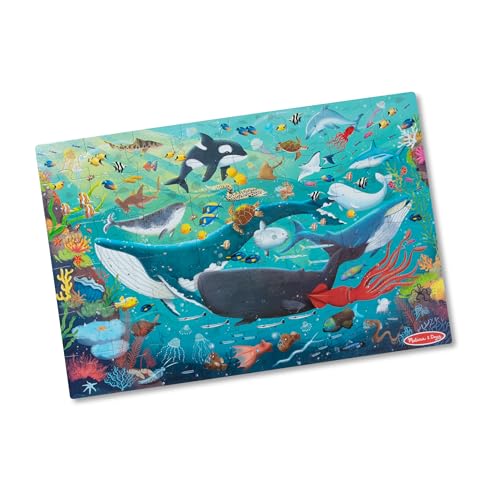
Melissa & Doug Underwater Jumbo Floor Puzzle
Thick, well-laminated board is what lets this puzzle survive being knelt on and occasionally stood on. Forty eight pieces build into a picture large enough to feel like a real project for a young child. Sea creature artwork gives plenty to talk about while assembling it, and owners report pieces still fitting cleanly years later.
Pros
- Durable board resists bending underfoot
- Large finished picture feels like an achievement
- Rich detail sparks conversation while building
Cons
- Box is bulky to store
- Too easy for children over about six

Melissa & Doug Alphabet Train Floor Puzzle
Letters run in sequence along a train shape, so building the puzzle reinforces alphabet order alongside shape matching. Twenty seven pieces build long and narrow rather than square, which fits a hallway or the gap beside a sofa. Board thickness matches the brand’s other floor puzzles, which owners rate highly for durability.
Pros
- Teaches letter sequence while building
- Narrow shape suits smaller spaces
- Fewer pieces suit younger builders
Cons
- Long shape needs a clear run of floor
- Limited replay value once letters click

Crocodile Creek 36-Piece Floor Puzzle
Original illustrations set this puzzle apart from the generic clip art used on cheaper brands, and adults tend to enjoy building it alongside a child. Pieces cut cleanly and hold up to repeated use. Most designs ship in a round storage tin that survives a toy cupboard far longer than a cardboard box.
Pros
- Original illustrations stand out from clip art
- Storage tin outlasts cardboard packaging
- Clean, precise piece cutting
Cons
- Fewer pieces than rivals at the same age
- Tin takes more shelf space than a flat box

Ravensburger Giant Floor Puzzle
Precision die cutting means pieces click together without being forced, which matters for a toddler who gives up quickly on a piece that almost fits. Designs range from 24 to 60 pieces depending on the theme chosen. A thinner board than the chunkiest rivals makes this better suited to carpet or table use than a bare hard floor.
Pros
- Excellent piece fit with no forcing needed
- Wide range of designs and piece counts
- Smooth, non-glare surface finish
Cons
- Thinner board than the chunkiest puzzles
- Box packaging wears with heavy use

The Learning Journey Puzzle Doubles Big Floor Puzzle
Numbers, the human body and the solar system are the kind of subjects this puzzle line builds around, with labels worked into the artwork itself. That educational framing gives the puzzle a second life as a talking point long after it has been solved a few times. Large, chunky pieces suit small hands still developing grip strength.
Pros
- Strong educational content built into the art
- Large pieces suit small hands
- Stays useful as a talking point after solving
Cons
- Artwork is functional rather than beautiful
- Board is thinner than premium floor puzzles

Mudpuppy Floor Puzzle
Bold color and graphic shapes give Mudpuppy puzzles a modern illustration style that suits a shelf even before the box is opened. Board quality is solid and pieces are sensibly sized for the stated age range. Durability sits a step behind the top picks, so this suits careful use over a busy nursery floor.
Pros
- Distinctive modern artwork
- Recycled, environmentally conscious materials
- Decorative box suits gifting
Cons
- Less rugged than the thickest boards
- Box corners wear with repeated use
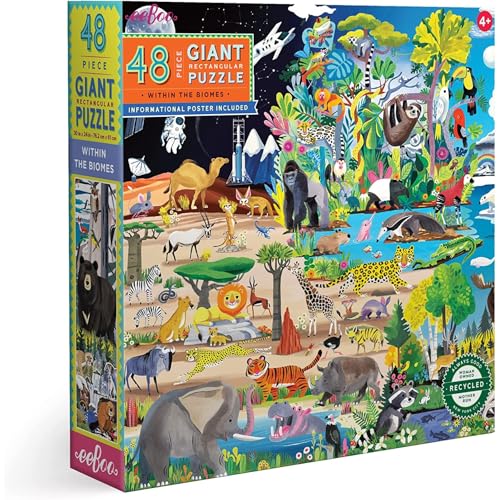
eeBoo Floor Puzzle
Higher piece counts and busier scenes extend the challenge for children who have outgrown simpler floor puzzles. Small hidden details reward close looking across the illustration. Younger toddlers tend to find these frustrating, so the four-plus age guidance is worth taking seriously rather than as a suggestion.
Pros
- Higher piece counts extend the challenge
- Detailed artwork rewards close looking
- Made from recycled materials
Cons
- Too difficult for younger toddlers
- Busy scenes make some pieces hard to place
Side by side
| # | Model | Pieces | Best for | Score | Price |
|---|---|---|---|---|---|
| 1 | Melissa & Doug Underwater Jumbo Floor Puzzle | 48 | Best overall | 9.4 | Check price |
| 2 | Melissa & Doug Alphabet Train Floor Puzzle | 27 | Best for early learning | 9.2 | Check price |
| 3 | Crocodile Creek 36-Piece Floor Puzzle | 36 | Best artwork | 9.0 | Check price |
| 4 | Ravensburger Giant Floor Puzzle | 24 to 60 depending on design | Best piece fit | 8.8 | Check price |
| 5 | The Learning Journey Puzzle Doubles Big Floor Puzzle | Around 50 | Best for learning themes | 8.6 | Check price |
| 6 | Mudpuppy Floor Puzzle | Commonly 25 to 48 | Best design led choice | 8.3 | Check price |
| 7 | eeBoo Floor Puzzle | Commonly 20 to 100 depending on design | Best for older children | 8.0 | Check price |
What to look for
Board thickness decides how long a puzzle lasts Floor puzzles get knelt on, stood on and occasionally sat on. A thin board delaminates at the corners within weeks of that treatment. Thick laminated board, the kind Melissa & Doug and Crocodile Creek use, survives it. When a listing skips the thickness spec, compare box weight against piece count instead, since heavier usually means thicker.
Match piece count to age, then check finished size Twenty to thirty pieces suits a child around three years old, while forty eight or more works from four upward. Finished size matters separately from piece count. A large picture feels like an achievement, while a small one feels like a table puzzle stuck on the floor. A high piece count with tiny pieces defeats the purpose.
Grip friendly shapes matter more than difficulty Small hands struggle with thin, fiddly interlocking tabs. Chunky pieces with simple shapes are easier to pick up and place, which keeps frustration down. Precision cutting counts just as much, since a piece that needs forcing convinces a child they grabbed the wrong one even when they did not.
Plan for storage before the second puzzle arrives Floor puzzle boxes are large, and they fall apart fast once a child starts opening them alone. Tin packaging, like Crocodile Creek uses, outlasts cardboard by years. Failing that, a large resealable bag with the box lid cut out and kept as a picture reference is what most families end up doing anyway.
Common questions
What age are floor puzzles for?
Most carry guidance of three years and up, based mainly on piece size. Simpler twenty piece designs suit children around three, while forty eight piece and larger puzzles suit four and above.
How many pieces should a toddler’s puzzle have?
Twenty to thirty pieces is a comfortable starting range for a three year old. Success matters more than challenge at this stage, so starting easy and moving up beats handing over something frustrating.
Are floor puzzles better than table puzzles for toddlers?
Generally yes. Larger pieces are easier to handle, the floor gives room to spread out, and a bigger finished picture feels more rewarding than a small tabletop version.
Do floor puzzle pieces get damaged easily?
Thin boards do, especially at the corners, and moisture is the main enemy. Thick laminated board handles being knelt on well. Keeping puzzles away from drinks and drying any damp piece flat prevents most damage.
How much floor space does a floor puzzle need?
Enough room for the finished puzzle plus space for loose pieces around it. Jumbo designs need a clear area, while narrow formats like the alphabet train fit into a hallway or beside furniture.
Can floor puzzles help with early learning?
They build shape recognition, spatial reasoning and persistence, and themed designs add letters, numbers or subject vocabulary on top. Much of the actual learning happens in conversation while building.
How do you store a floor puzzle without the box falling apart?
A large resealable bag works well, with the box front kept as a picture reference. Puzzles that ship in tins, like Crocodile Creek’s, avoid the problem entirely.
What if a floor puzzle piece goes missing?
Many manufacturers will send a replacement piece on request, so it is worth contacting them before replacing the whole puzzle. Storing puzzles in a sealed bag rather than a broken box helps avoid losing pieces in the first place.
Floor puzzles vs jigsaw puzzles, what is the difference for young kids?
Floor puzzles use larger, chunkier pieces and build on the ground, which suits toddlers still developing fine motor control. Standard jigsaw puzzles use smaller, thinner pieces meant for a table and generally suit children five and older.
Final word
The Melissa & Doug Underwater Jumbo Floor Puzzle is the one to buy first, since thick board and a genuinely large finished picture are what make a floor puzzle last. Pick the Melissa & Doug Alphabet Train Floor Puzzle to work letters into playtime, or the Crocodile Creek 36-Piece Floor Puzzle for artwork worth leaving out on display.


