Tankless or Tank? Choosing a Gas Water Heater
The Rinnai RU199iN is the strongest whole house tankless unit, with high flow output and condensing efficiency. Rheem’s Performance Platinum gas tank is the simpler swap for existing tank installs. Takagi T-H3-DV-N is the value tankless option for smaller homes.
For a whole house replacement, the Rinnai RU199iN is the tankless unit with the flow rate to run several fixtures at once. If your home already has a vented tank and you want a straight swap, Rheem’s Performance Platinum is the simpler path, while the Takagi T-H3-DV-N covers smaller homes for less.
Gas water heaters are harder to compare than they look because the headline numbers describe different things: tank models quote capacity in gallons, tankless models quote flow in gallons per minute, and neither tells you whether your existing gas line and flue will support the unit. We compared published BTU inputs, flow rates, efficiency factors and venting requirements, then noted where installation constraints matter more than the specification. Gas appliance installation is work for a licensed professional, not a weekend project.
Before you buy
Tankless against storage tank A storage tank keeps a fixed volume hot around the clock, which means instant availability and a hard limit once it runs out. A tankless unit heats water on demand with no standing losses and no limit on duration, but a firm ceiling on flow rate at any one moment. Households that shower back to back tend to prefer tankless, while homes with an existing flue and a modest budget usually come out ahead replacing like with like. Installation cost, not appliance cost, is what usually decides it.
Sizing by flow rate and temperature rise Tankless capacity is quoted in gallons per minute at a given temperature rise, and both halves matter. A unit rated at 11 gallons per minute is quoting a small rise in warm inlet water. In a cold northern winter, incoming water might be 40 degrees cooler, and the same unit delivers far less. Add up the flow demands of the fixtures you expect to run simultaneously, check your coldest inlet temperature, and size from that figure rather than the headline number.
Venting, gas supply and combustion air This is where installations get expensive. Condensing tankless units vent through PVC because their exhaust is cooler, while atmospheric tanks need a proper metal flue with adequate draft. Many tankless units also need a larger gas line than an old tank required, because their peak input is far higher. Combustion air supply matters too, particularly in a sealed utility cupboard. Have a licensed installer assess the gas line size, flue route and air supply before choosing a model, since those constraints often narrow the field for you.
Efficiency, maintenance and lifespan The uniform energy factor rating lets you compare running efficiency across models, with condensing tankless units at the top and standard atmospheric tanks at the bottom. Maintenance differs too: tanks need the anode rod checked periodically and the tank flushed to control sediment, while tankless units need descaling on a schedule that depends on water hardness. In hard water areas, skipping descaling shortens tankless life significantly. Budget for that servicing when comparing lifetime cost, not just purchase price.
The top picks, ranked

Rinnai RU199iN Tankless Water Heater
The RU199iN is a condensing indoor tankless unit with enough output to run two or three fixtures at once in most climates, which is where cheaper tankless models fall down. Condensing design means it recovers heat from the exhaust and vents through PVC rather than metal flue. It needs a substantial gas supply, so the gas line size is the first thing to check before ordering.
Pros
- High flow supports multiple fixtures
- Condensing efficiency lowers running cost
- Vents through inexpensive PVC
Cons
- Often needs a larger gas line
- Higher upfront and installation cost
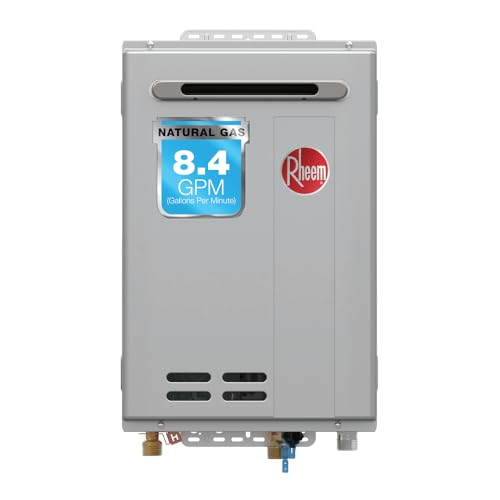
Rheem Performance Platinum Natural Gas Water Heater
For a house that already has a vented gas tank, this is the least disruptive upgrade, using the same footprint and flue arrangement. Rheem includes a self diagnostic control module and a leak detection feature that shuts off water supply. Standing heat loss means it will never match tankless efficiency, but the install is far simpler and cheaper.
Pros
- Straightforward replacement for an old tank
- Leak detection and shutoff included
- Lower installation cost than tankless
Cons
- Standing losses raise running cost
- Hot water runs out on heavy demand

Takagi T-H3-DV-N Tankless Water Heater
Takagi’s T-H3 offers condensing efficiency and direct vent operation at a lower outlay than the flagship Rinnai, suiting homes with one or two bathrooms. Flow output is a step down, which shows if two showers run at once in a cold climate. Owners report the controls are less refined but perfectly usable once set.
Pros
- Condensing efficiency at a lower price
- Direct vent simplifies flue routing
- Compact wall mounted footprint
Cons
- Struggles with simultaneous heavy demand in cold inlet water
- Control interface is basic
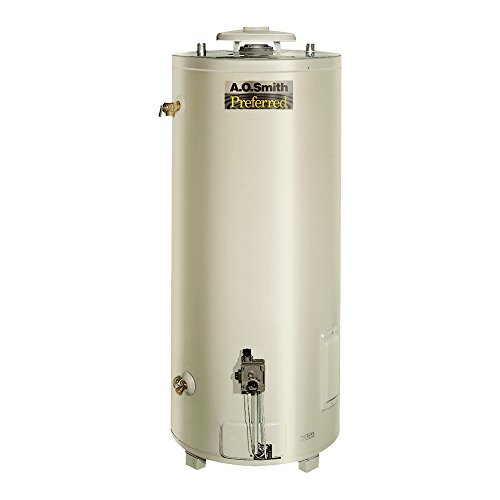
A.O. Smith Signature 100 Natural Gas Water Heater
This 40 gallon tank suits one or two people or a small home where a 50 gallon unit is more than the household needs. It uses a conventional atmospheric flue, keeping installation cost down. Recovery rate is the figure to watch, since a smaller tank refills faster only if the burner input is adequate.
Pros
- Right sized for small households
- Simple, well understood installation
- Replaceable anode extends tank life
Cons
- Smaller reserve for back to back showers
- Standing heat loss like all tank models

Noritz NR501-OD Tankless Water Heater
Mounting outdoors removes the venting problem entirely, which is why the NR501-OD makes sense in mild climates where freezing is rare. It suits a single bathroom or a supplementary use such as a workshop sink. In cold regions, freeze protection and pipe insulation become critical, so check the manufacturer guidance for your climate.
Pros
- No flue or venting work needed
- Frees indoor space entirely
- Simple install in mild climates
Cons
- Not suited to hard freezing climates
- Lower flow limits it to one fixture

Camplux 5L Outdoor Portable Propane Water Heater
Camplux packs a small propane burner, a shower head and a hose into a unit light enough to hang on a van or a tree, running from a standard propane cylinder. It is aimed at camping, horse washing and outdoor rinse offs rather than a house. Water pressure requirements are low, so it works with a small pump from a jerry can.
Pros
- Genuinely portable with a shower kit
- Works from a small pump and low pressure
- Runs off standard propane cylinders
Cons
- Outdoor use only, never enclosed spaces
- Very low flow rate
Eccotemp L10 Portable Tankless Water Heater
The L10 covers the same portable propane brief as the Camplux for slightly less, with a simple two dial control for gas and water. It is a common choice for cabins, outdoor kitchens and dog washing stations. Build quality is basic and the ignition needs fresh batteries to work reliably, which is the most common owner complaint.
Pros
- Low cost for propane hot water anywhere
- Simple manual controls
- Higher rated flow than the smallest units
Cons
- Ignition depends on battery condition
- Not for indoor or enclosed use
How they stack up
| # | Model | Type | Best for | Score | Price |
|---|---|---|---|---|---|
| 1 | Rinnai RU199iN Tankless Water Heater | Condensing tankless, indoor | Best overall | 9.4 | Check price |
| 2 | Rheem Performance Platinum Natural Gas Water Heater | Atmospheric vent storage tank | Best tank replacement | 9.2 | Check price |
| 3 | Takagi T-H3-DV-N Tankless Water Heater | Condensing tankless, direct vent | Best value tankless | 9.0 | Check price |
| 4 | A.O. Smith Signature 100 Natural Gas Water Heater | Atmospheric vent storage tank | Best for smaller households | 8.8 | Check price |
| 5 | Noritz NR501-OD Tankless Water Heater | Outdoor tankless | Best for outdoor installation | 8.6 | Check price |
| 6 | Camplux 5L Outdoor Portable Propane Water Heater | Portable propane tankless | Best for camping and off grid | 8.3 | Check price |
| 7 | Eccotemp L10 Portable Tankless Water Heater | Portable propane tankless | Best budget portable | 8.0 | Check price |
Good to know
Is a tankless gas water heater worth it?
It is if you have high or extended hot water demand and your gas line and venting can support one. You get unlimited duration and lower standing losses. Against that, installation cost is higher and you need to descale periodically, especially in hard water areas.
What size gas water heater do I need?
For tanks, 40 gallons suits one or two people and 50 gallons is the common family size. For tankless, add up the flow rates of fixtures you would run at once and check the unit’s output at your coldest inlet water temperature, not its best case rating.
Can I install a gas water heater myself?
Gas appliance work involves fuel connections, combustion air and flue gas, and it is regulated in most areas. Use a licensed installer. Beyond the legal position, an incorrectly vented gas appliance can release carbon monoxide into the house.
What is the difference between condensing and non condensing?
Condensing units extract additional heat from exhaust gases, which raises efficiency and lets them vent through PVC because the flue gas is cooler. Non condensing units run hotter exhaust and require metal venting. Condensing models cost more upfront and generally use less gas.
How long does a gas water heater last?
Storage tanks commonly serve around eight to twelve years, with anode rod condition and water hardness making a large difference. Tankless units often last longer, frequently past fifteen years, provided they are descaled on schedule. Neglected maintenance shortens both considerably.
Do tankless heaters work during a power cut?
Most modern tankless units need mains power for the control board, ignition and fan, so they stop working when the power does. Older atmospheric tanks with a standing pilot keep producing hot water, which is one practical advantage they retain.
Why does my tankless unit run cold briefly?
That gap is usually the cold water sitting in the pipe between the unit and the tap, plus the moment the burner takes to fire when flow starts. Low flow fixtures can also fall below the unit’s activation threshold. A recirculation setup reduces the wait if the plumbing supports it.
Can I use a portable propane heater indoors?
No. Portable outdoor units like the Camplux and Eccotemp are explicitly for outdoor and well ventilated use, because they produce combustion gases including carbon monoxide. Never run one inside a tent, van, bathroom or any enclosed space.
The verdict
The Rinnai RU199iN is the unit to aim for in a whole house tankless conversion, provided your gas line and venting support it. If the existing setup is a vented tank and the budget is tight, the Rheem Performance Platinum is a far cheaper install for a similar result day to day. Have a licensed installer confirm gas sizing and flue routing before you commit to any model.


