World Globes That Make Geography Click for Kids
The Replogle Explorer Globe leads for its clear cartography and sturdy meridian. Waypoint Geographic’s Light Up Globe Journey is the value pick because it works as both a map and a night light. For younger children, the Shifu Orboot Earth AR Globe turns lookups into a game.
The Replogle Explorer Globe is our overall pick because the cartography stays legible without cramming labels, while the Waypoint Geographic Light Up Globe Journey doubles as a lamp and the Shifu Orboot Earth AR Globe turns geography into an interactive scavenger hunt for younger children.
Globes are harder to choose than they seem because the photographs never show whether the type is readable at arm’s length or whether the mounting wobbles when a child spins it. We compared published diameters, mounting styles, illumination methods and label density across current models, then weighed what owners report about durability and how often each globe actually gets used.
The best picks, ranked

Replogle Explorer Globe
Replogle has been printing globes for generations and the Explorer shows it, with balanced label density that stays readable without hiding the geography. The full meridian lets you tilt and rotate smoothly for measuring latitude. It looks appropriate in a study or a classroom rather than a toy box.
Pros
- Readable labelling at normal desk distance
- Smooth, stable rotation on a full meridian
- Classic look that suits any room
Cons
- No illumination
- Political borders eventually date

Waypoint Geographic Light Up Globe Journey
Switched off, this globe shows political boundaries in muted tones. Switched on, illumination brings out physical geography such as mountain ranges and ocean depths, giving two maps in one object. Owners report it earns its place on a bedside table as a soft night light.
Pros
- Two distinct maps in a single globe
- Doubles as a gentle night light
- Good value for an illuminated model
Cons
- Needs a nearby socket
- Lit view can wash out fine labels

Shifu Orboot Earth AR Globe
Orboot ships with a deliberately label free sphere and an app that overlays animals, monuments, cuisines and cultures when a tablet camera points at it. That approach keeps young children exploring rather than reading dense text. It works best for roughly ages four to ten.
Pros
- Highly engaging for younger children
- Content covers culture and wildlife, not just borders
- Durable sphere designed for handling
Cons
- Requires a device and app to be useful
- Sphere carries no printed labels on its own

MOVA Globe Satellite View
The MOVA rotates continuously using ambient light and the earth’s magnetic field, with no cord and no motor noise. The satellite imagery shows landforms and cloud patterns rather than political borders. It is a conversation piece for a desk more than a study tool.
Pros
- Rotates without batteries or cords
- Striking satellite imagery
- Completely silent operation
Cons
- No country labels for study use
- Small sphere limits detail

Little Experimenter 3 in 1 World Globe
This globe shows a political map unlit, a constellation map when illuminated and includes an AR app for extra detail. The combination suits a child’s bedroom where the object needs to work day and night. The stand is compact enough for a small desk.
Pros
- Constellation view adds astronomy interest
- USB power is easy to route
- Fits small desks and shelves
Cons
- Smaller sphere means smaller type
- App content is lighter than dedicated AR globes

Waypoint Geographic Zoogeography Kids Globe
This globe replaces dense political text with illustrations of animals in their native regions, which gives young children a reason to spin and search. Country outlines remain so the geography still registers. It suits playrooms and early primary classrooms.
Pros
- Illustrations invite exploration
- Large sphere is easy for small hands to spin
- Links animals to real geography
Cons
- Fewer place names than a reference globe
- Illustrated style suits younger ages only
LeapFrog Magic Adventures Globe
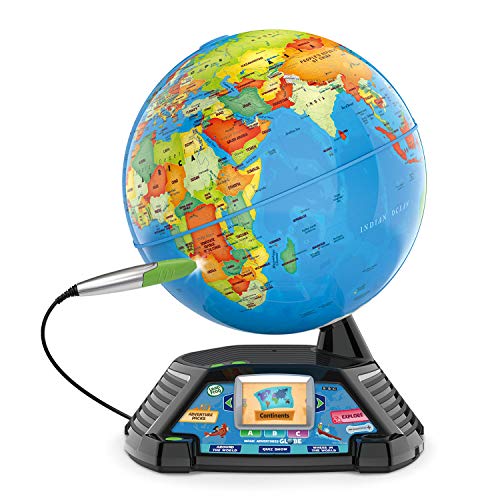
LeapFrog builds a screen into the stand and a stylus into the globe, so tapping a country plays short documentary clips and quizzes. Nothing extra is needed beyond batteries. It gives children an independent way to explore without borrowing a parent’s tablet.
Pros
- Self contained, no tablet required
- Video content holds attention well
- Quizzes reinforce what children find
Cons
- Small screen limits viewing comfort
- Battery use adds up with regular play
How to choose
Decide whether the globe is for reference or play A reference globe such as the Replogle Explorer rewards a reader who wants accurate borders and legible names, and it will sit on a desk for years. A play focused globe uses illustrations, lights or an app to pull younger children in. Buying a dense reference globe for a five year old usually means it gets spun twice and forgotten, so match the format to the age.
Check sphere size against where it will live Twelve inch globes are the classic study size and keep type readable, but they need real shelf space and a stable spot. Smaller spheres fit bedside tables and desks at the cost of detail. Measure the space before ordering, remembering that the stand and meridian add several inches beyond the sphere itself.
Look at the mounting, not just the map A full meridian ring allows tilting and makes latitude easy to demonstrate, while a simple semi meridian is lighter and cheaper. Weighted bases matter with children because an enthusiastic spin can topple a light stand. Owners report that wobbly bases are the most common reason a globe gets moved out of reach and stops being used.
Remember that borders change Any political globe reflects the world as it was when the map was printed, and country names and boundaries shift over time. Physical and satellite maps age more gracefully, which is one argument for illuminated globes that show both. For classroom use, checking the copyright date before buying avoids teaching an outdated map.
Compared at a glance
| # | Model | Diameter | Best for | Score | Price |
|---|---|---|---|---|---|
| 1 | Replogle Explorer Globe | 12 inch sphere | Best overall | 9.4 | Check price |
| 2 | Waypoint Geographic Light Up Globe Journey | 12 inch sphere | Best value | 9.2 | Check price |
| 3 | Shifu Orboot Earth AR Globe | About 10 inch sphere | Best for young children | 9.0 | Check price |
| 4 | MOVA Globe Satellite View | About 4.5 inch sphere | Best for display | 8.8 | Check price |
| 5 | Little Experimenter 3 in 1 World Globe | About 8 inch sphere | Best for bedrooms | 8.6 | Check price |
| 6 | Waypoint Geographic Zoogeography Kids Globe | About 12 inch sphere | Best for animal lovers | 8.3 | Check price |
| 7 | LeapFrog Magic Adventures Globe | About 12 inch sphere | Best interactive learning | 8.0 | Check price |
Good to know
What size globe is best for a child’s room?
A twelve inch globe keeps labels readable and is easy to spin, which suits primary and secondary age children. Eight inch models fit small desks but the type becomes harder for younger readers.
Are illuminated globes worth it?
They are if you want two maps in one, since many switch from political boundaries unlit to physical terrain when lit. They also work as a soft night light, which increases how often they stay in the room.
Do augmented reality globes actually teach anything?
They work well for younger children because the app supplies context that a printed sphere cannot. The trade off is that the globe itself carries fewer labels, so it complements rather than replaces a reference globe.
How do I know the map is up to date?
Look for a copyright or revision date in the product details, and check a few countries whose names have changed recently. Reputable cartographers such as Replogle publish updated editions regularly.
What is the difference between a political and a physical globe?
Political globes emphasise countries, borders and cities using colour blocks. Physical globes show terrain, elevation and ocean depth. Illuminated models often show one unlit and the other lit.
Are globes safe for toddlers?
Larger illustrated globes with sturdy bases suit preschoolers under supervision, though small parts on interactive models and mains cords need checking. A cordless design avoids the cable risk entirely.
Can a globe replace an atlas?
Not quite. A globe teaches true relative size and distance in a way flat maps distort, while an atlas gives far more detail per region. The two work best together.
How should I clean a globe?
A soft dry cloth is usually enough, with a barely damp cloth for marks. Avoid solvents and abrasive cleaners because they lift printed ink and dull the finish permanently.
Final word
The Replogle Explorer Globe is the pick for a globe that will still be useful in ten years, thanks to clear cartography and a solid mount. Choose the Waypoint Geographic Light Up Globe Journey when you want a map and a night light in one, and the Shifu Orboot Earth AR Globe for children too young to enjoy reading borders.