Which Guitar Capo Actually Holds Tune? Seven Compared
Kyser’s Quick-Change KG6 suits most players who swap keys mid-song and want a single-hand clamp. Players who need exact tension should compare the G7th Performance 3, which flexes to fretboard curvature, or the Shubb C1, which locks a screw-set pressure with a lever. Both cost more than a basic trigger capo.
Kyser’s Quick-Change KG6 wins this comparison for players who swap keys mid-set and want a one-hand clamp. Aluminum construction keeps it under two ounces on a six-string acoustic. It skips tension adjustment, so guitars with an unusual neck profile may buzz under the pad.
Tension control trades off against swap speed, and that tradeoff drives most of the decisions below. We compared mechanism type, materials, and owner feedback across seven current Amazon listings to sort screw-adjust precision from trigger-clamp speed.
Our top picks

Kyser Quick-Change KG6
A spring-loaded trigger clamps this capo in under two seconds, no tools or tension dial needed. Aircraft aluminum keeps total weight near 1.8 ounces. Kyser builds it specifically for six-string acoustic guitars, not electrics or twelve-strings.
Pros
- Fastest single-hand key change on stage
- Backed by a lifetime guarantee from Kyser
- Available in a wide range of finishes
Cons
- No tension adjustment for wide or flat necks
- Not rated for twelve-string or electric guitars
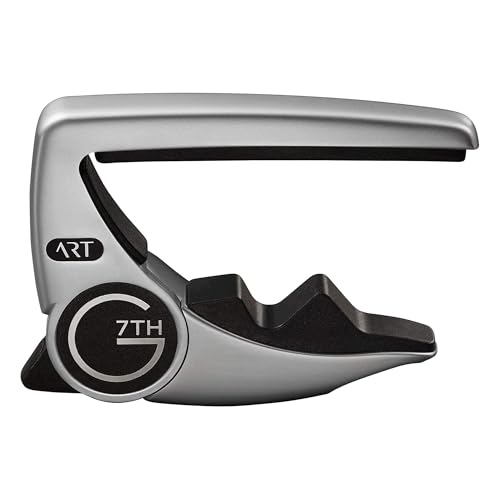
G7th Performance 3
Adaptive Radius Technology lets the clamp bar flex to match a curved fretboard. That flex cuts buzz on frets with slight relief. Owners report clean fretting on both acoustic and electric necks at 63 grams.
Pros
- Clamp bar self-adjusts to fretboard curvature
- Stores on the headstock or behind the nut
- Covered by a free lifetime warranty from G7th
Cons
- Heavier than basic trigger capos
- Costs more than trigger-style options

Shubb C1 Steel String Capo
A screw-adjustable roller sets exact clamping pressure once. An over-center lever then locks that setting in place for repeatable placement. Nickel-plated brass construction with rubber-foam padding protects the neck finish.
Pros
- Numbered dial gives repeatable pressure settings
- Rarely needs readjustment once dialed in
- Compact two-inch bar fits most neck widths
Cons
- Slower to reposition than a trigger capo
- Initial tension setup takes a few tries

D’Addario Planet Waves NS Capo Pro
A patented micrometer dial spreads pressure evenly across every string. Even pressure matters most on a twelve-string neck, where uneven force causes tuning drift. The body is machined from aircraft-grade aluminum.
Pros
- Dial gives fine, repeatable tension control
- Rated for both six-string and twelve-string necks
- Owners report buzz-free performance at low frets
Cons
- Dial takes longer to set than a spring trigger
- Small dial is fiddly to turn with cold hands

Dunlop 83CB Trigger Capo
A padded spring-action trigger uses a curved pressure pad shaped to match standard fretboard radius. Low-profile design keeps it clear of fretting fingers during play. Dunlop rates it for six-string and twelve-string acoustic guitars.
Pros
- Costs less than screw-adjust alternatives
- Padding protects the neck finish from scratches
- Rated for twelve-string acoustic use
Cons
- No tension adjustment for atypical neck shapes
- Padding wears faster than metal-on-nickel designs
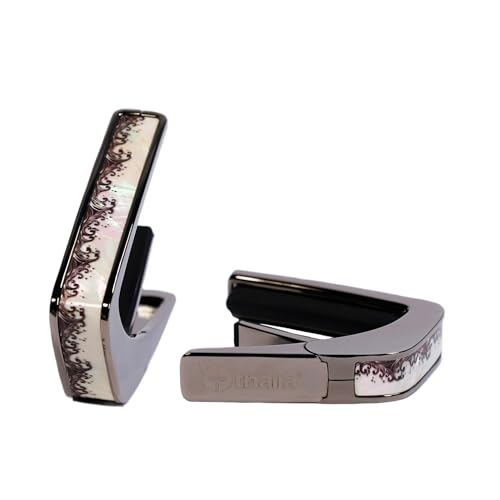
Thalia Capo Deluxe Series
Two interchangeable OctaveTouch fret pads ship in the box, one standard-tension pad for six-string guitars and one high-tension pad for twelve-strings, mandolins, and slim necks. A reverse lever arm allows one-handed placement.
Pros
- Two pad tensions cover multiple instrument types
- Also rated for banjo, bouzouki, and ukulele
- Decorative inlay finishes are available
Cons
- Swapping pads between instruments takes extra steps
- Costs more than single-purpose trigger capos

Paige Clik PC-6-ETI
A molded tone bar carries individually radiused outserts for each string. Those outserts apply only the pressure needed to fret a clean note. A push-button release lets players reposition it with one hand.
Pros
- Individually molded outserts reduce string bending
- Hand-built in the USA
- Stores above the nut when not in use
Cons
- Standard version does not fit wide necks
- Wide-neck and twelve-string versions sell separately
The lineup, side by side
| # | Model | Material | Best for | Score | Price |
|---|---|---|---|---|---|
| 1 | Kyser Quick-Change KG6 | Aircraft aluminum | Best overall | 9.4 | Check price |
| 2 | G7th Performance 3 | Anodized aluminum body | Best for precise intonation | 9.2 | Check price |
| 3 | Shubb C1 Steel String Capo | Nickel-plated brass | Best for minimal retuning | 9.0 | Check price |
| 4 | D’Addario Planet Waves NS Capo Pro | Aircraft-grade aluminum | Best for twelve-string guitars | 8.8 | Check price |
| 5 | Dunlop 83CB Trigger Capo | Aircraft-quality aluminum | Best budget | 8.5 | Check price |
| 6 | Thalia Capo Deluxe Series | Black chrome-plated body with rubber fret pads | Best for multiple instruments | 8.3 | Check price |
| 7 | Paige Clik PC-6-ETI | Nickel-plated bar with molded string outserts | Best for reducing string pressure | 8.0 | Check price |
How to choose
How capo mechanism affects tone and tuning Trigger capos like the Kyser KG6 and Dunlop 83CB clamp with a fixed spring force. That speed can overtighten light strings and pull them sharp. Screw or micrometer designs, including the Shubb C1 and D’Addario NS Capo Pro, let a player dial in the minimum pressure a fret needs, which cuts pitch drift on open chords.
Which capo suits acoustic versus electric necks? Acoustic fretboards usually carry a more pronounced radius than electric necks, so a flat or fixed-curve capo can leave middle strings buzzing. G7th’s Performance 3 flexes automatically to match that curve. Thalia’s Deluxe Series instead swaps fret pads to suit different neck shapes.
What changes for twelve-string or alternate-tuning players Twelve-string guitars pair octave and unison strings at different gauges, so uneven capo pressure mutes the thinner string first. Paige Clik and D’Addario’s NS Capo Pro apply stepped or dial-based pressure built for that pairing. Dunlop’s 83CB also carries a twelve-string rating.
Is a lightweight capo worth it for gigging musicians? Capos under 40 grams, such as the Dunlop 83CB or Paige Clik, add negligible weight to a headstock and rarely shift neck balance mid-set. Heavier screw-adjust models like the G7th at 63 grams trade some portability for tension precision, which session and studio players value more than weight.
Frequently asked questions
What is the best capo for beginners?
Kyser’s Quick-Change KG6 is simplest to operate. One squeeze clamps it, and no tension setup is required before playing.
Trigger capo vs screw capo, which holds tune better?
Screw or micrometer capos such as the Shubb C1 and D’Addario NS Capo Pro let a player set exact clamping pressure. That control generally holds tune more consistently than a fixed-spring trigger.
Can a six-string capo work on a twelve-string guitar?
Standard six-string capos spread even pressure across every course, which can mute the thinner octave strings. Twelve-string-rated models like the Dunlop 83CB or Paige Clik’s dedicated version apply stepped pressure instead.
Do capos affect intonation higher up the neck?
A capo seated too close to a fret, or clamped too tight, can pull strings sharp above the fifth fret. Adjustable-tension capos such as the G7th Performance 3 reduce that by applying only the force a fret needs.
Which capo works best for classical or nylon-string guitars?
Thalia’s Deluxe Series and Shubb’s classical variant use flatter curves and softer pads suited to nylon-string necks. Trigger capos built around steel-string radius fit those necks less precisely.
How much does a good capo weigh?
Most quality capos weigh between 30 and 65 grams. Trigger models like the Dunlop 83CB sit near the light end, while tension-adjustable designs like the G7th run heavier due to the locking mechanism.
Is a partial capo different from a standard capo?
Yes. A partial capo clamps only select strings for altered tunings. None of these seven models do that; all seven clamp across the full neck width for standard key changes.
Can one capo work on both acoustic and electric guitars?
Several models here, including the G7th Performance 3, D’Addario NS Capo Pro, and Paige Clik PC-6-ETI, carry ratings for both acoustic and electric necks. Electric necks tend to run narrower and flatter than acoustic ones.
What is the best capo for twelve-string guitars specifically?
D’Addario’s NS Capo Pro spreads pressure with a micrometer dial rated for six-string and twelve-string necks, which limits the tuning drift uneven pressure causes on paired strings.
How fast can a trigger capo be repositioned mid-song?
A spring trigger like the Kyser KG6 clamps or releases in under two seconds with one hand, which is why gigging players favor it over screw-adjust designs for live key changes.
Final word
Kyser’s Quick-Change KG6 remains the pick for players who swap keys mid-set and want a reliable one-hand clamp without fuss. Home-studio players chasing precise intonation should choose the G7th Performance 3 or Shubb C1 instead, since both dial in exact string tension rather than relying on a fixed spring. Twelve-string owners get the most consistent tuning from the D’Addario NS Capo Pro’s stepped pressure dial.