HDMI Cables: What Really Matters for 4K and 8K
For most setups, the Zeskit Maya 8K is the HDMI cable we recommend, with certified 48Gbps bandwidth for 4K and 8K. The Amazon Basics High-Speed cable covers everyday 1080p and 4K affordably, while the Belkin UltraHD is a reliable certified choice for demanding 8K displays.
If you just want a straight answer, the Zeskit Maya 8K is the HDMI cable we recommend for most people, because its certified 48Gbps bandwidth comfortably handles 4K at high refresh rates and future 8K sources without guesswork.
HDMI cables are confusing because the box rarely tells the whole story, and uncertified cables can fail at high resolutions even when they look identical. We compared certification labels, published bandwidth ratings, connector build quality, and patterns in verified owner feedback to sort genuine performers from marketing claims.
Our top picks

Zeskit Maya 8K HDMI 2.1
The Zeskit Maya 8K carries Ultra High Speed certification and 48Gbps bandwidth, so it supports 4K at 120Hz and 8K at 60Hz without dropouts. Owners running gaming consoles and high-end TVs report a rock-solid handshake, and the slim connectors fit tight cabinet spaces.
Pros
- Certified 48Gbps handles 4K120 and 8K60
- Reliable handshake with consoles and TVs
- Slim connectors fit tight spaces
Cons
- Shorter lengths only for full bandwidth
- Costs more than basic cables

Amazon Basics High-Speed HDMI
The Amazon Basics High-Speed cable is a dependable everyday performer for 1080p and standard 4K playback. Owners like that it just works for streaming boxes and older consoles, though it is not the pick for cutting-edge 8K or high-refresh gaming setups.
Pros
- Affordable and widely available
- Reliable for everyday 4K and 1080p
- Multiple lengths to choose from
Cons
- Not rated for 8K or 4K120
- Basic connector build

Belkin UltraHD High Speed HDMI 2.1
The Belkin UltraHD High Speed cable is Ultra High Speed certified and built to a noticeably sturdy standard. Owners pairing it with 8K TVs and next-gen consoles report consistent performance, and the reinforced connectors inspire confidence for cables that get plugged and unplugged often.
Pros
- Certified for full 8K bandwidth
- Sturdy reinforced connectors
- Trusted brand support
Cons
- Premium price for the length
- Stiffer cable is harder to route
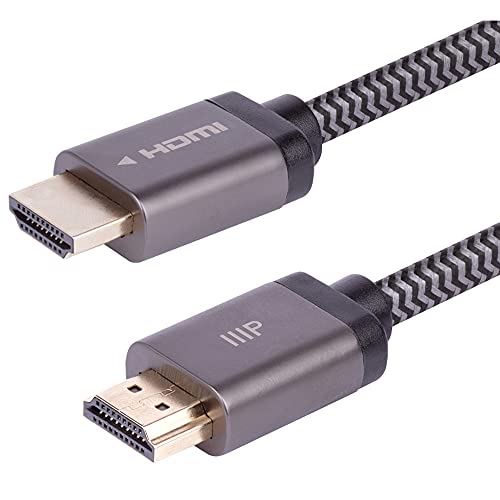
Monoprice Certified Premium High Speed HDMI
Monoprice’s Certified Premium High Speed cable targets 4K HDR at a sensible price, carrying Premium High Speed certification for reliable 4K at 60Hz with wide color. Owners setting up living-room streaming and Blu-ray playback find it a no-drama choice that punches above its cost.
Pros
- Certified for reliable 4K60 HDR
- Strong value for the performance
- Good range of length options
Cons
- Not intended for 8K or 4K120
- No braided jacket

Cable Matters 48Gbps HDMI 2.1
The Cable Matters 48Gbps cable is aimed at high-refresh gaming, supporting features like variable refresh rate and 4K at 120Hz on capable hardware. Owners with current consoles and gaming monitors report smooth performance, and the braided jacket adds durability for frequent moves.
Pros
- Supports 4K120 and VRR for gaming
- Durable braided jacket
- Good value for HDMI 2.1 features
Cons
- Full bandwidth limited to shorter runs
- Thicker cable can be less flexible

UGREEN 8K HDMI 2.1 Braided
The UGREEN 8K cable wraps 48Gbps performance in a nylon-braided jacket with zinc-alloy connectors. Owners appreciate the premium feel and tangle-resistant sleeve, and it handles 4K at 120Hz and 8K at 60Hz on supported devices, making it a tidy match for visible cable runs.
Pros
- Attractive, durable braided design
- Handles 4K120 and 8K60
- Solid metal connector shells
Cons
- Stiffer than unbraided cables
- Longer runs may need active versions

Ruipro 8K Fiber Optic HDMI
The Ruipro 8K Fiber Optic cable uses optical transmission to carry 48Gbps signals over long distances where copper struggles. Owners running cables through walls to projectors value the thin, flexible design, though the directional connectors must be oriented correctly during installation.
Pros
- Maintains full bandwidth over long distances
- Thin and flexible for in-wall routing
- Immune to typical electrical interference
Cons
- Directional connectors must face correctly
- Higher cost than copper cables
How they stack up
| # | Model | Version | Best for | Score | Price |
|---|---|---|---|---|---|
| 1 | Zeskit Maya 8K HDMI 2.1 | HDMI 2.1 | Best overall | 9.4 | Check price |
| 2 | Amazon Basics High-Speed HDMI | HDMI 2.0 | Best budget | 9.1 | Check price |
| 3 | Belkin UltraHD High Speed HDMI 2.1 | HDMI 2.1 | Best for 8K | 8.9 | Check price |
| 4 | Monoprice Certified Premium High Speed HDMI | HDMI 2.0 | Best value for 4K HDR | 8.6 | Check price |
| 5 | Cable Matters 48Gbps HDMI 2.1 | HDMI 2.1 | Best for gaming | 8.4 | Check price |
| 6 | UGREEN 8K HDMI 2.1 Braided | HDMI 2.1 | Best braided build | 8.2 | Check price |
| 7 | Ruipro 8K Fiber Optic HDMI | HDMI 2.1 | Best for long runs | 8.0 | Check price |
How to pick the right one
Match the cable to your resolution Not every HDMI cable can carry every signal. For 1080p and standard 4K at 60Hz, a High Speed cable is fine, but 4K at 120Hz or 8K needs an Ultra High Speed cable rated for 48Gbps. Buying more bandwidth than you need is harmless; buying too little causes dropouts.
Why certification matters Anyone can print HDMI 2.1 on a package. Certified High Speed, Premium High Speed, and Ultra High Speed labels come with testing behind them, and many carry a scannable authentication code. Based on specifications, certification is the closest thing to a guarantee that a cable will perform as claimed.
Length changes everything Copper HDMI cables lose signal integrity as they get longer, so a short cable may pass full 48Gbps while a much longer version of the same line cannot. For long runs to projectors or wall-mounted displays, active or fiber optic cables hold up far better than passive copper.
Build quality and connectors Braided jackets and metal connector shells resist wear from repeated plugging, and a snug connector fit reduces intermittent dropouts. If a cable will be hidden and rarely touched, a basic jacket is fine; for cables you handle often, sturdier construction pays off.
Good to know
Do expensive HDMI cables improve picture quality?
No. HDMI is a digital signal, so a certified inexpensive cable delivers the same picture as a costly one as long as both meet the bandwidth your setup needs. Spend on certification and the right length rather than premium branding.
What is the difference between HDMI 2.0 and HDMI 2.1?
HDMI 2.1 raises bandwidth to 48Gbps and adds support for 4K at 120Hz, 8K at 60Hz, variable refresh rate, and other gaming features. HDMI 2.0 tops out around 18Gbps, which comfortably handles 4K at 60Hz but not the newest high-refresh modes.
Can I use any HDMI cable for 4K?
Most High Speed cables handle 4K at 60Hz, but 4K at 120Hz requires an Ultra High Speed cable. If you see flicker, blank screens, or dropped signal at 4K, an under-rated cable is a common cause, and upgrading usually fixes it.
Do I need an 8K HDMI cable if I do not own an 8K TV?
Not strictly, but an Ultra High Speed 48Gbps cable future-proofs your setup and also unlocks 4K at 120Hz for gaming today. Many owners buy one now so they do not have to replace cables when they upgrade displays.
Are braided HDMI cables better?
Braiding improves durability and resists tangling, but it does not change signal performance. The certification and bandwidth rating determine picture and sound quality; braiding is mainly about longevity and how the cable looks and feels.
How long can an HDMI cable be before it loses signal?
Passive copper cables generally stay reliable up to roughly 15 to 25 feet for high bandwidth, with shorter being safer at 8K. For longer distances, active or fiber optic HDMI cables maintain the signal where standard copper would fail.
What does Ultra High Speed certification mean?
It is the official HDMI label for cables tested to carry the full 48Gbps needed for 4K120 and 8K60. Certified cables usually include a hologram and QR code you can scan to confirm authenticity through the licensing program.
Will a new HDMI cable fix my sound or handshake problems?
Sometimes. Intermittent audio dropouts, blank screens, or handshake failures at high resolutions often trace back to a marginal or damaged cable. Swapping in a properly certified cable rated for your resolution resolves many of these issues.
Does HDMI cable direction matter?
Standard copper cables are not directional, so either end can face the source or display. Active and fiber optic cables are the exception; they are labeled for source and display ends and will not pass a signal if reversed.
The verdict
For most homes, the Zeskit Maya 8K offers the safest mix of certified bandwidth, reliable handshakes, and sensible pricing. Budget-focused buyers can trust the Amazon Basics High-Speed cable for everyday 4K, while gamers chasing 4K at 120Hz should look to the Cable Matters 48Gbps.

