Kids Microscopes That Keep Young Scientists Curious
The AmScope M30-ABS-KT2-W is our top pick because it pairs real optics with a complete beginner slide kit. The My First Lab Duo-Scope MFL-06 suits younger children who want to look at whole objects, while the National Geographic Dual LED Student Microscope offers the best value starter package.
For a child who is genuinely interested in science, the AmScope M30-ABS-KT2-W leads our picks, with the My First Lab Duo-Scope MFL-06 for younger users and the National Geographic Dual LED Student Microscope as the best value starter kit.
Kids microscopes are unusually easy to buy badly, because the number shouted loudest on the box, maximum magnification, is the least useful specification of the lot. Very high magnification on cheap optics produces a blurry, dim image that no child can focus, and toy microscopes with plastic lenses show almost nothing. We ranked these seven based on published optics, illumination design, focus mechanisms, included accessories and what owners report about how quickly children get a clear image.
What we recommend
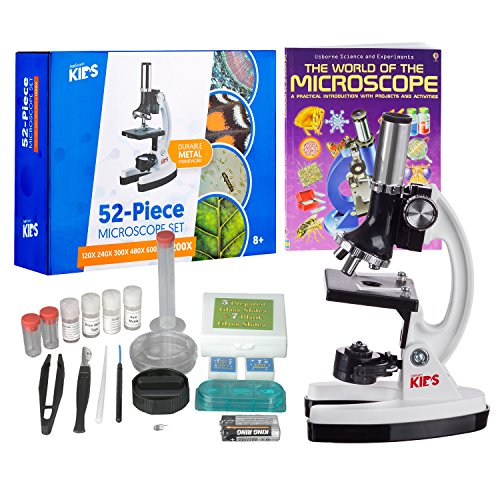
AmScope M30-ABS-KT2-W Beginner Microscope Kit
AmScope makes proper laboratory instruments, and this beginner kit brings real glass optics and a metal frame down to a level aimed at children. The kit matters as much as the scope, since it includes prepared slides, blanks, tools and a case so a child can start immediately rather than hunting for something to look at. Owners report the image is dramatically clearer than toy microscopes at similar magnification claims.
Pros
- Genuine optical quality rather than toy lenses
- Complete kit means it can be used on day one
- Metal body survives being knocked about
Cons
- Highest magnifications are hard for beginners to focus
- Setup needs an adult the first time
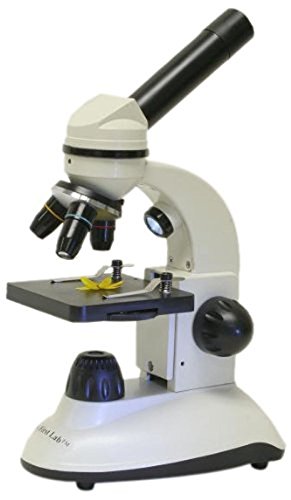
My First Lab Duo-Scope MFL-06
The Duo-Scope lights from both below and above, which means a child can view prepared slides in the usual way or place a leaf, coin or insect on the stage and look at the whole object. That second mode is what keeps younger children engaged, because it does not require slide preparation. Owners report it is the microscope that gets used most in the first few weeks.
Pros
- Top lighting lets kids view everyday objects
- Sensible magnification steps that stay focusable
- Runs on batteries for use away from a socket
Cons
- Lower maximum magnification than lab style scopes
- Plastic body feels less solid than metal frames

National Geographic Dual LED Student Microscope
This bundles a capable student microscope with a substantial accessory set, including slides, specimens and preparation tools, which is where the value lies. Dual LED illumination covers both slide and surface viewing. Based on the specifications it is best treated as a serious first microscope for a school aged child rather than a lab instrument.
Pros
- Generous accessory kit included
- Dual lighting covers both viewing styles
- Well matched to school science topics
Cons
- Build is lighter than laboratory scopes
- Focus knobs feel coarse at higher magnification

Educational Insights GeoSafari Jr. Talking Microscope
This is not a real microscope in the optical sense, and that is deliberate. It uses prepared slide discs and an audio narration to introduce very young children to the idea of looking closely at the natural world, with two eyepieces so no one has to close an eye. For a three to five year old, this succeeds where a genuine microscope would only frustrate.
Pros
- Genuinely usable by preschool children
- Narration adds facts and quiz modes
- Two eyepieces avoid the closed eye problem
Cons
- Cannot view your own specimens
- Not a real optical microscope

Swift SW150 Compound Microscope
Swift builds student microscopes with metal frames, glass optics and proper coarse and fine focus, which is the point at which a keen young scientist stops fighting the equipment. It is a compound microscope for slide work rather than a dual purpose toy. This is the choice for a teenager taking biology seriously rather than a curious eight year old.
Pros
- Fine focus makes high magnification usable
- Solid metal construction
- Suits school and college level work
Cons
- Slide preparation is required to see anything
- Too demanding for younger children

Omano JuniorScope Microscope
Omano designed the JuniorScope for the reality of shared use, with a robust frame, simple controls and a design that tolerates being carried between desks. Magnification steps are modest and focusable rather than exaggerated. Owners report it holds up to repeated handling far better than lightweight plastic microscopes.
Pros
- Built to survive shared and repeated use
- Simple controls suited to children
- Realistic magnification that stays sharp
Cons
- Lower maximum magnification than rivals
- Fewer accessories included

TELMU Microscope 40X-1000X
TELMU covers the basics at a low cost, with a metal arm, dual illumination and a phone adapter that lets a child photograph what they see. That adapter is a genuinely engaging feature, since sharing an image is often what sustains interest. Optical quality does not match the AmScope or Swift options, so keep expectations at the lower magnifications.
Pros
- Phone adapter lets kids capture images
- Dual lighting for slides and objects
- Inexpensive way to start
Cons
- Image quality falls off at high magnification
- Fewer prepared slides included
Before you buy
Ignore the headline magnification number Listings compete on maximum magnification because it is the easiest number to inflate, but useful magnification is limited by the quality of the glass and the amount of light reaching the eye. On an inexpensive microscope, 1000x typically produces a dim blur that a child cannot focus, while 100x to 400x gives crisp, genuinely interesting images of cells, fibres and pond water. A scope that does 400x well beats one that claims 2000x badly, every time.
Match the type of microscope to the age Under about six, a guided viewer such as the GeoSafari Jr. works because it removes focusing and slide preparation entirely. From roughly six to ten, a dual illumination scope that lets a child put a leaf or a coin on the stage sustains interest, since preparing slides is a skill that takes time to learn. From about eleven upward, a proper compound microscope with fine focus becomes worthwhile, particularly if school biology is involved.
Lighting and focus decide whether it gets used Two mechanical details cause most abandoned microscopes. The first is illumination: LED lighting from below is essential for slides, and lighting from above is what makes everyday objects viewable. Mirror based lighting, still found on cheap models, is fiddly and dim. The second is focus. A scope with only coarse focus makes the higher magnifications almost unusable, whereas a fine focus knob lets a child dial in a sharp image and keeps the frustration down.
Buy the accessories with the microscope A microscope with nothing to look at is a microscope that stays in the box. Prepared slides give an immediate reward, blank slides and coverslips let a child make their own, and tweezers, a dropper and a scalpel style tool cover the basics of specimen preparation. Kits from AmScope and National Geographic include these; if the scope you choose does not, budget for a slide set at the same time. Pond water, onion skin and a strand of hair are the classic first three specimens for a reason.
How they compare
| # | Model | Magnification | Best for | Score | Price |
|---|---|---|---|---|---|
| 1 | AmScope M30-ABS-KT2-W Beginner Microscope Kit | Around 120x to 1200x range | Best overall | 9.4 | Check price |
| 2 | My First Lab Duo-Scope MFL-06 | 40x, 100x and 400x | Best for young children | 9.2 | Check price |
| 3 | National Geographic Dual LED Student Microscope | Multiple objective settings up to several hundred times | Best value | 9.0 | Check price |
| 4 | Educational Insights GeoSafari Jr. Talking Microscope | Slide disc viewer with audio | Best for preschoolers | 8.7 | Check price |
| 5 | Swift SW150 Compound Microscope | Compound monocular microscope | Best for older students | 8.5 | Check price |
| 6 | Omano JuniorScope Microscope | Compound microscope for young users | Best for classroom use | 8.2 | Check price |
| 7 | TELMU Microscope 40X-1000X | 40x to 1000x range | Best budget | 8.0 | Check price |
Questions worth asking
What magnification does a child actually need?
For most subjects a child will look at, 40x to 400x covers everything from insect wings to plant cells and pond organisms. Higher settings are only useful with excellent optics and bright illumination. Focus on how sharp the image is at 100x and 400x rather than chasing four digit numbers on the box.
What age is right for a real microscope?
Around six to eight is when most children can manage a real microscope with some help, particularly one with top lighting so they can view whole objects. Younger children do better with a guided viewer. From about eleven, a compound microscope with fine focus becomes genuinely rewarding.
Do kids microscopes come with slides?
Some do and some do not, and it makes a large difference to the first week. The AmScope kit and the National Geographic set include prepared slides and preparation tools. If your chosen microscope does not, buy a prepared slide set alongside it so there is something to look at immediately.
Optical or digital microscope for a child?
Optical microscopes teach the actual skill of focusing and preparing specimens and tend to hold interest longer. Digital models that display on a screen are easier to share and photograph but often have lower true resolution. A middle option is an optical scope with a phone adapter, as the TELMU model provides.
What can kids look at first?
Onion skin, a hair, salt crystals, a piece of newspaper, a leaf underside and a drop of pond water are the classic starting set, because all are easy to prepare and visibly interesting. Pond water in particular is the specimen that most reliably produces genuine excitement, since things move.
Are toy microscopes worth buying?
Generally not, if the goal is real interest in science. Plastic lens toy microscopes produce dim, distorted images that discourage children quickly. A guided viewer such as the GeoSafari Jr. is honest about what it is and works well for preschoolers, but a plastic scope claiming laboratory magnification is a poor use of money.
How do I stop the image being blurry?
Start at the lowest magnification, get a sharp image there, then step up one objective at a time and refocus. Make sure the light is bright enough, since higher magnification needs more illumination. If the highest setting will not focus at all, that is usually the optics reaching their real limit rather than a fault.
Does a microscope need mains power?
Many run on batteries, mains power or both. Battery operation is useful for taking the microscope outside to look at pond samples on the spot. Check whether an adapter is included, since some models list it as a separate purchase and battery life at full brightness is often short.
The verdict
The AmScope M30-ABS-KT2-W is the microscope we would buy for a child who is genuinely curious, because real glass optics and a complete slide kit mean the first session actually works. For younger children, the My First Lab Duo-Scope MFL-06 and its top lighting keep things engaging without slide preparation, and the National Geographic Dual LED Student Microscope packs the most accessories into a starter budget.