8 Kites That Actually Fly in Light Wind
Prism’s Quantum Stunt Kite suits anyone learning dual line control, pairing carbon spars with a wide 5 to 25 mph wind range. aGreatLife’s Huge Rainbow Kite launches easily for young children. In the Breeze’s Colorwave Delta climbs reliably in light coastal wind.
Prism’s Quantum Stunt Kite ranks as the best all-round choice for stunt flying here. aGreatLife’s Huge Rainbow Kite suits young children best, and In the Breeze’s Colorwave Delta handles light wind better than most.
Wind range disappoints more flyers than any other spec, and packaging rarely lists it clearly. A kite rated from 8 to 25 mph sits uselessly on the grass during a 5 mph afternoon, no matter how hard you run. We compared published wind ranges, sail fabric, spar material, line rating and assembly time, then weighed what flyers report about durability after crashes.
Our top picks

Prism Quantum Stunt Kite
Pultruded carbon spars and ripstop nylon give this dual line delta the strength to survive crashes that come with learning. Wind range spans roughly 5 to 25 mph, covering most inland and coastal days. It ships fully assembled with wound lines, padded straps and a tail, so setup takes minutes.
Pros
- Wide wind range covers most flying days
- Carbon spars survive repeated nose down crashes
- Arrives assembled with lines already wound
Cons
- Needs an open field, not a small park
- Dual line control carries a real learning curve

Prism Synapse 140 Parafoil Kite
No spars means nothing to snap when a beginner drives this frameless parafoil into the ground. It packs down to the size of a water bottle, suiting travel and beach trips. Wind range runs from about 6 to 25 mph, with responsive turning once the sail loads up.
Pros
- Nothing to break in a crash landing
- Packs small enough for hand luggage
- Handles forgivingly for first time dual line flyers
Cons
- Needs steadier wind than framed kites to hold shape
- Bridle lines tangle if packed carelessly

HQ Kites Symphony Beach III 1.3
Consistent onshore coastal wind is what this 1.3 meter power foil was designed around. Pull feels engaging without becoming unmanageable for a teenager. Ripstop polyester and reinforced bridle attachment points hold up to sand and salt exposure.
Pros
- Generates satisfying pull in steady coastal wind
- Tolerates sandy landings thanks to its frameless design
- Includes wrist straps for control
Cons
- Pulls too hard for younger children
- Struggles in swirling inland wind

In the Breeze Colorwave Delta Kite
A delta shape and fiberglass frame let this kite climb in wind as light as about 5 mph, suiting calm afternoons. Ripstop polyester sail holds its color through a season of sun exposure. Assembly involves sliding two spars into sleeves and clipping a spreader.
Pros
- Climbs in genuinely light wind
- Assembles in under two minutes
- Sail fabric resists fading over a season
Cons
- Fiberglass spars bend more than carbon
- Single line offers no steering
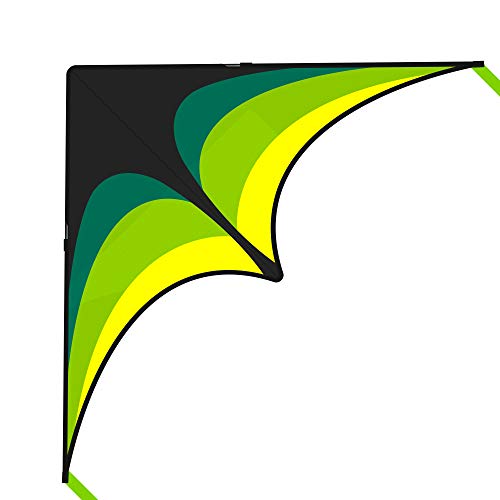
Mint’s Colorful Life Delta Kite
Long streaming tails add stability at very low wind speeds where smaller deltas stall out. Fiberglass rods and a lightweight polyester sail keep total weight down, which is what makes light wind flight possible. Line comes pre-wound on a winder, packed with a carry bag.
Pros
- Flies on the lightest wind of any kite here
- Long tails keep it steady without adjustment
- Line and winder come included ready to fly
Cons
- Becomes unstable above about 16 mph
- Thin sail tears if dragged across gravel

aGreatLife Huge Rainbow Kite
Bright rainbow panels on a large delta stay easy for children to spot at altitude. A short run in moderate wind gets it airborne, so a five year old succeeds without an adult sprinting. Fiberglass frame pieces snap together without tools and pack into an included sleeve.
Pros
- Launches with minimal running for small children
- High visibility panels stay easy to track
- Tool free assembly takes under a minute
Cons
- Included line runs short for high flying
- Frame joints loosen after many assemblies
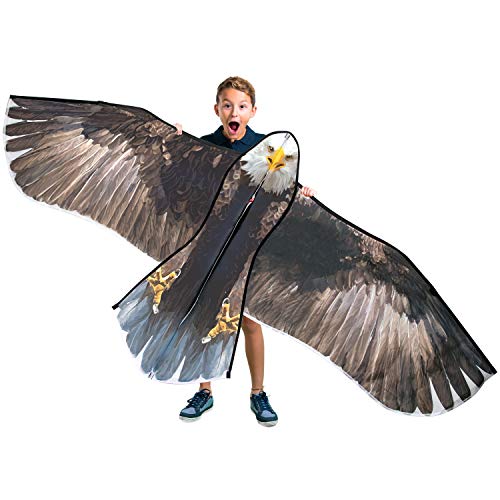
JEKOSEN Bald Eagle Kite
A large printed eagle profile draws attention at a park or beach, sold at an entry level price. Fiberglass spars and a polyester sail keep it flying in moderate wind without fuss. Some owners hang it near gardens as a bird deterrent when not flying.
Pros
- Large realistic profile stands out in a busy field
- Costs the least of any kite in this comparison
- Doubles as a garden bird deterrent
Cons
- Printed detail fades faster than woven color
- Needs more wind than the light wind deltas
How to choose
What should you look for when buying a kite? Wind range stands out as the first spec worth checking, and it should match where you fly, since coastal wind runs steadier and stronger than a suburban park. Sail material matters next: ripstop nylon and polyester resist tearing far better than plain sheeting. Carbon spars flex and recover on frames, while fiberglass runs heavier and takes a permanent set after hard crashes.
Single line or dual line kite, which suits you? Single line kites fly themselves once airborne, which suits children and relaxed afternoons well. Delta shapes like In the Breeze’s Colorwave launch in the lightest wind. Dual line kites get actively flown, tracing loops and dives through two control lines. Prism’s Quantum and Synapse 140 sit at that entry point, with the frameless Synapse absorbing beginner crashes.
Which kite works best for kids and first flights? Children need a kite that launches with a short run and stays visible at altitude. Large bright deltas such as aGreatLife’s Huge Rainbow Kite fit both criteria well. Keeping first sessions in 8 to 12 mph wind lifts the kite without overpowering small hands. A longer line only helps once a child holds a steady kite comfortably.
Where and when is it safe to fly a kite? Open ground matters more than kite quality. Power lines, roads and airports deserve a wide berth, and thunderstorms rule out flying entirely. Beaches and large fields give clean, unbroken wind, while parks ringed by trees create turbulence that destabilizes any kite. Wrist straps help with pulling foils like HQ’s Symphony Beach III, which generate real force in 20 mph wind.
Compared at a glance
| # | Model | Wingspan | Best for | Score | Price |
|---|---|---|---|---|---|
| 1 | Prism Quantum Stunt Kite | About 7.5 feet | Best overall | 9.4 | Check price |
| 2 | Prism Synapse 140 Parafoil Kite | About 55 inches | Best for learning dual line | 9.2 | Check price |
| 3 | HQ Kites Symphony Beach III 1.3 | 1.3 meters | Best for beaches | 9.0 | Check price |
| 4 | In the Breeze Colorwave Delta Kite | About 6.5 feet | Best value single line | 8.8 | Check price |
| 5 | Mint’s Colorful Life Delta Kite | About 61 inches | Best for calm days | 8.6 | Check price |
| 6 | aGreatLife Huge Rainbow Kite | About 63 inches | Best for young children | 8.3 | Check price |
| 7 | JEKOSEN Bald Eagle Kite | About 78 inches | Best budget | 8.0 | Check price |
Good to know
What wind speed works best for flying a kite?
Eight to fifteen miles per hour suits most kites and most flyers. Light wind deltas like Mint’s Colorful Life kite work from around 4 mph. Above 20 mph, only kites rated for it stay controllable.
What is the best kite for a beginner?
A delta such as In the Breeze’s Colorwave launches easily and needs no steering for single line flying. Prism’s Synapse 140 parafoil works as the forgiving choice for dual line, since there are no spars to break in a crash.
Which kite works best for young kids?
aGreatLife’s Huge Rainbow Kite launches with a short run and stays visible high up. Tool free assembly and a light frame matter most at this age. Power foils pull hard enough to drag a small child, so they are worth avoiding.
Delta vs parafoil kite, what is the difference?
Deltas use spars to hold a triangular sail and fly well in light wind. Parafoils carry no frame and inflate on the wind, packing small and surviving crashes. Parafoils need steadier wind to hold their shape than framed deltas do.
Can you fly a kite at the beach?
Beaches work well because onshore wind runs smooth and unobstructed. HQ Kites’ Symphony Beach III was built for exactly that setting. Rinsing salt from lines and rigging afterward, and keeping sand out of bridle knots, extends a kite’s life.
How long should kite line be?
One hundred to 300 feet covers most recreational flying. Included lines often run shorter than that, making an upgrade spool a common first purchase. Line strength should match kite pull, particularly with power foils.
Are carbon or fiberglass kite spars better?
Carbon runs lighter and springs back after flexing, which is why Prism uses it on the Quantum. Fiberglass costs less and forgives being stepped on, but it takes a permanent bend after hard impacts.
How do you launch a kite without running?
A helper holding the kite about 50 feet downwind, then pulling the line hand over hand as they release, works well. In steady wind, simply letting line out from a standing position works too. Running usually signals that the wind is too light.
The verdict
Prism’s Quantum Stunt Kite suits anyone who wants to actively fly rather than just watch, with carbon spars that forgive the learning process. Frequent travelers and crash prone beginners do better with the frameless Prism Synapse 140. Calm afternoons and young children call for In the Breeze’s Colorwave Delta or aGreatLife’s Huge Rainbow Kite, which launch with the least effort.