Lawn Spreaders Ranked by Spread Pattern and Capacity
The Scotts Turf Builder EdgeGuard DLX is the best broadcast spreader for most lawns thanks to its edge control, the EarthWay 2150 is the pick for accuracy on larger properties, and the Agri-Fab 45-0463 tow behind suits anyone with a ride on mower. Handheld options cover small yards.
The Scotts Turf Builder EdgeGuard DLX is the spreader most homeowners should buy, the EarthWay 2150 gives a more consistent pattern on larger lawns, and the Agri-Fab 45-0463 tow behind is the right answer once you are covering an acre or more. Chest mount and handheld options handle small or awkward areas.
Spreaders look interchangeable but the differences show up as stripes in your lawn six weeks later, because an inconsistent pattern or a poorly calibrated gate lays down uneven fertiliser. We compared hopper capacity, the consistency of the published spread pattern, edge control features, how precisely the rate setting adjusts, and the corrosion and gate wear problems owners report after a few seasons.
The best picks, ranked

Scotts Turf Builder EdgeGuard DLX Broadcast Spreader
The EdgeGuard feature blocks the right side of the spread pattern with a lever, so you can run along a driveway or flower bed without throwing product where it does not belong. It holds enough for a large suburban lawn and arrives mostly assembled with pre calibrated settings for Scotts products. Owners report it is the easiest spreader to get a clean result from first time.
Pros
- Edge control keeps product off paths
- Pre calibrated for common products
- Very little assembly needed
Cons
- Plastic gate wears with heavy use
- Rate numbers assume Scotts products

EarthWay 2150 Commercial Broadcast Spreader
EarthWay’s commercial line uses a three hole drop pattern and a well engineered gate that produces a noticeably more even spread than budget hoppers. Pneumatic tyres roll better over rough turf. It requires more assembly and more attention to calibration, which is why it rewards someone who cares about the result.
Pros
- Most even pattern of the push models
- Handles rough ground well
- Serviceable commercial build
Cons
- More assembly required
- Needs manual calibration for each product

Agri-Fab 45-0463 130 Pound Tow Behind Broadcast Spreader
Once a lawn passes an acre, pushing a spreader stops being sensible and a tow behind hopper hitched to a ride on mower takes over. The 45-0463 holds a large load and drives its impeller from the wheels, so the rate stays tied to ground speed. It needs storage space and a suitable towing vehicle.
Pros
- Covers large areas in one pass
- Large hopper reduces refills
- Rate tracks ground speed
Cons
- Needs a ride on mower or tractor
- Bulky to store
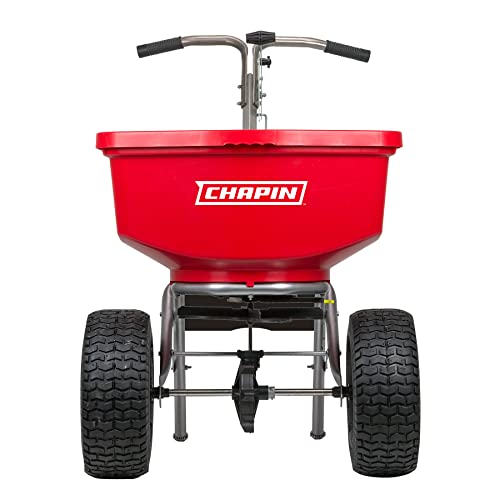
Chapin 8400C 100 Pound Professional Turf Spreader
Chapin uses stainless steel hardware and a heavier frame, which matters because fertiliser is corrosive and cheap spreaders seize after a couple of seasons. The large hopper and wide pattern suit larger residential lawns. It is heavier to push than budget models, especially fully loaded.
Pros
- Corrosion resistant hardware
- Large capacity for fewer refills
- Sturdy frame for rough ground
Cons
- Heavy to push when full
- Costs more than homeowner models

Solo 421 Portable Chest Mount Spreader
A chest mounted spreader with a hand crank goes where no wheeled hopper fits, including slopes, narrow side yards and areas broken up by beds and paths. The Solo 421 holds around twenty pounds and gives good control over the rate. Long applications are tiring, so it complements rather than replaces a push spreader.
Pros
- Works on slopes and tight areas
- Good rate control for its type
- Comfortable harness
Cons
- Tiring over large areas
- Pattern varies with crank speed
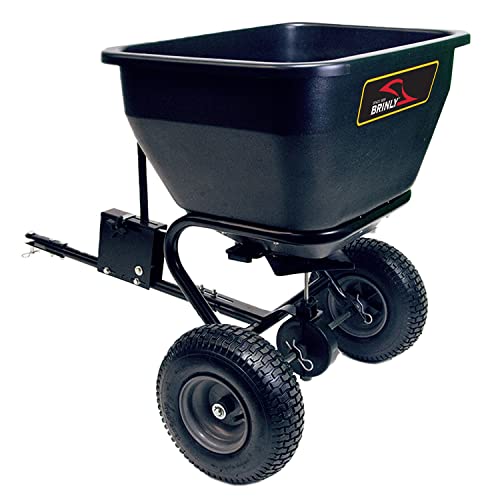
Brinly BS36BH-A Tow Behind Broadcast Spreader
Brinly’s tow behind sits between a push spreader and a full sized agricultural hopper, which suits properties too large to push but too small to justify the biggest units. The gate control reaches the mower seat so you can shut off at turns. Assembly is more involved than the push models.
Pros
- Sized for mid range properties
- Shut off reachable from the seat
- Fits most ride on mowers
Cons
- Assembly takes real time
- Pattern is wide and needs planning

Scotts Whirl Hand Powered Spreader
For a small lawn, a few patch repairs or spreading ice melt in winter, a handheld crank spreader is faster to grab and easier to store than anything on wheels. The Whirl has an adjustable rate control and a comfortable grip. Coverage is small, so it is not the tool for a full lawn feed.
Pros
- Takes seconds to grab and use
- Stores on a shelf
- Useful for ice melt in winter
Cons
- Too small for a whole lawn
- Pattern depends on a steady crank
What matters most
Broadcast, drop or handheld A broadcast spreader flings product outward in a wide arc, covering ground quickly and blending overlaps well, which makes it the right choice for most lawns. A drop spreader releases product straight down in a precise band, giving excellent control near beds and paths but demanding perfectly aligned passes or you get visible stripes. Handheld and chest mounted spreaders trade capacity for access, and they earn their place on slopes, narrow strips and small repairs. Most homeowners are best served by a broadcast spreader plus a handheld unit for touch ups.
Calibration is what actually prevents striping Every product has a different particle size and density, so the rate setting that works for a granular fertiliser will be wrong for grass seed. Start from the setting printed on the product bag, since manufacturers publish numbers for common spreader models. If your product does not list your spreader, measure a known area, weigh what you use, and adjust. Always err on the low side and make two passes at half rate in perpendicular directions, which evens out the pattern and makes over application far less likely.
Capacity, wheels and pushing effort A bigger hopper means fewer refills but also more weight to push, and a fully loaded hundred pound spreader is genuinely hard work on a slope. Match capacity to your lawn size rather than buying the largest available. Pneumatic tyres roll over rough turf and root bumps far better than hard plastic wheels, which skip and cause momentary rate changes. If your property exceeds about an acre, a tow behind unit behind a ride on mower is a better use of your time than any push spreader.
Cleaning is not optional with fertiliser Fertiliser salts are corrosive and will seize a gate mechanism and rust hardware within a season if left in the hopper. Rinse the spreader thoroughly after every use, work the gate open and closed under running water, and let it dry fully before storage. A light spray of dry lubricant on the pivot points helps. Never store product in the hopper between applications, and check the gate opens fully before each use, since a partially blocked gate is a common cause of uneven results.
How they compare
| # | Model | Type | Best for | Score | Price |
|---|---|---|---|---|---|
| 1 | Scotts Turf Builder EdgeGuard DLX Broadcast Spreader | Push broadcast spreader | Best overall | 9.4 | Check price |
| 2 | EarthWay 2150 Commercial Broadcast Spreader | Push broadcast spreader | Best spread accuracy | 9.2 | Check price |
| 3 | Agri-Fab 45-0463 130 Pound Tow Behind Broadcast Spreader | Tow behind broadcast | Best for large properties | 9.0 | Check price |
| 4 | Chapin 8400C 100 Pound Professional Turf Spreader | Push broadcast spreader | Best build quality | 8.8 | Check price |
| 5 | Solo 421 Portable Chest Mount Spreader | Chest mount crank spreader | Best for awkward areas | 8.6 | Check price |
| 6 | Brinly BS36BH-A Tow Behind Broadcast Spreader | Tow behind broadcast | Best mid size tow behind | 8.3 | Check price |
| 7 | Scotts Whirl Hand Powered Spreader | Handheld crank spreader | Best for small yards | 8.0 | Check price |
Frequently asked questions
What is the difference between a broadcast and a drop spreader?
A broadcast spreader throws product outward in a wide arc, covering ground fast and blending overlaps. A drop spreader releases straight down in a precise band, which is more accurate near edges but shows stripes if your passes are not perfectly aligned.
What setting should I use on my spreader?
Start with the number printed on the product bag, since manufacturers publish settings for common spreader models. If yours is not listed, apply at half the estimated rate in two perpendicular passes.
How do I avoid stripes in my lawn?
Apply at half rate and make two passes at right angles to each other. That evens out any inconsistency in the pattern and hides small errors in your walking line.
What size spreader do I need?
Match hopper capacity to lawn size so you are not constantly refilling or pushing unnecessary weight. Beyond about an acre, a tow behind spreader behind a ride on mower is the better option.
Can I use a lawn spreader for ice melt?
Yes, and handheld and push broadcast spreaders both work well for it. Rinse the spreader immediately afterward, since de icing salt is even harder on hardware than fertiliser.
How should I clean a spreader after use?
Rinse the hopper and impeller thoroughly, work the gate open and closed under running water, and dry it completely before storing. A dry lubricant on the pivots keeps the mechanism moving.
Should I spread fertiliser before or after mowing?
Applying after mowing is generally preferred so product reaches the soil rather than sitting on long clippings. Follow the guidance on the product label, which takes priority.
Do I need edge control?
It is genuinely useful if your lawn borders driveways, paths or planting beds, since it stops product being flung where it causes staining or damage. Without it, you shut the gate early and walk a border pass instead.
Our take
The Scotts Turf Builder EdgeGuard DLX is the spreader we would recommend for most suburban lawns, mainly because its edge control and pre calibrated settings remove the two things people usually get wrong. If your lawn is large or you care about pattern consistency, the EarthWay 2150 is worth the extra assembly and calibration effort. Beyond an acre, stop pushing and hitch an Agri-Fab 45-0463 to a ride on mower instead.