Which M.2 Enclosure Actually Matches Your SSD’s Speed
Sabrent’s EC-SNVE handles NVMe drives over USB 3.2 Gen 2 for reliable everyday external storage, Acasis’s Thunderbolt 4 enclosure reaches 40Gbps for editors moving large video files, and UGREEN’s USB-C 10Gbps model balances speed and cost for anyone upgrading a spare NVMe drive into a portable SSD.
Sabrent’s EC-SNVE, Acasis’s Thunderbolt 4 enclosure, and UGREEN’s USB-C 10Gbps model lead this list for matching real SSD speeds to real budgets.
M.2 hides two incompatible protocols and three USB speed tiers behind one slot shape, so we compared interface bandwidth, drive support, and thermal design across seven current listings before ranking them.
The shortlist, ranked
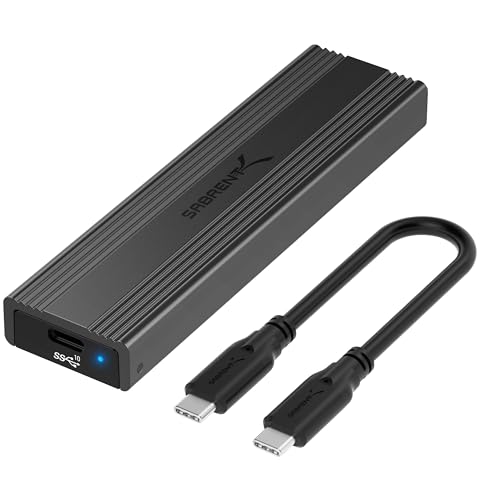
Sabrent EC-SNVE USB 3.2 Gen 2 NVMe M.2 Enclosure
A tool-free aluminum shell holds M.2 NVMe drives without screws or adhesive. USB 3.2 Gen 2 tops out at 10Gbps, matching what most NVMe drives can push through a USB port anyway. Windows, Mac, and Linux all recognize it without extra drivers, based on owner reports.
Pros
- Tool-free slide-in installation
- Aluminum body dissipates heat passively
- Recognized across Windows, Mac, and Linux without drivers
Cons
- No SATA M.2 support
- Caps out below Thunderbolt or USB4 speeds

Acasis Thunderbolt 4 NVMe M.2 SSD Enclosure
Thunderbolt 4 and USB4 support push this enclosure to 40Gbps with a compatible NVMe drive. A finned aluminum heatsink keeps sustained copies from throttling partway through. Video editors moving large project files off portable drives benefit most from that headroom.
Pros
- Sustained speeds well above USB-C 10Gbps enclosures
- Drops back to USB-C speed automatically on older ports
- Finned metal shell doubles as a heatsink
Cons
- Costs more than USB-C 10Gbps alternatives
- Needs a Thunderbolt 4 or USB4 port to hit full speed
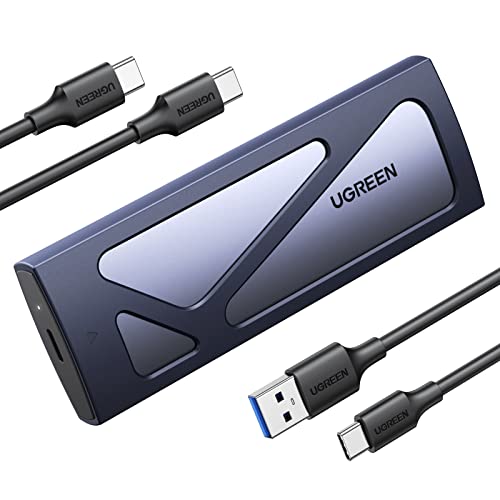
UGREEN NVMe M.2 SSD Enclosure USB-C
USB-C 10Gbps and tool-free installation keep this enclosure priced below Thunderbolt options. A silicone thermal pad presses against the drive and spreads heat into the aluminum shell. Both USB-C and USB-A cables ship in the box, covering older and newer laptops alike.
Pros
- Ships with both USB-C and USB-A cables
- Tool-free bracket needs no screwdriver
- Priced well below Thunderbolt enclosures
Cons
- No SATA M.2 support
- Shell runs warm during long transfers

Vantec NexStar SX NVMe/SATA M.2 SSD Enclosure
Few enclosures auto-detect both NVMe and SATA M.2 drives the way the NexStar SX does. That flexibility helps anyone repurposing an older SATA laptop drive alongside newer NVMe stock. USB 3.2 Gen 2 gives SATA drives their full 560MB/s and NVMe drives a lower but still usable ceiling.
Pros
- Works with both NVMe and SATA M.2 drives
- Auto-detects protocol without a manual switch
- Solid aluminum housing
Cons
- NVMe speeds sit below Thunderbolt enclosures
- Bulkier than single-protocol models

ORICO Tool-Free M.2 NVMe SSD Enclosure
Simplicity defines this enclosure: a tool-free clip holds the drive, and a USB-C 10Gbps port handles transfers. Skipping heatsink features common on pricier models trims cost but limits it to backup and archive duty. Sustained large file transfers push it closer to throttling than aluminum unibody designs.
Pros
- Among the least expensive NVMe enclosures
- Tool-free clip installation
- Compact enough to fit in a pocket
Cons
- Thinner heat dissipation than aluminum unibody designs
- No SATA M.2 compatibility

TEUTONS Explorer NVMe M.2 SSD Enclosure
Steam Deck and ROG Ally owners often have a spare M.2 drive sitting unused after an internal upgrade, and TEUTONS built the Explorer for exactly that. USB-C 10Gbps keeps load times short when the drive doubles as external game storage. A small shell clips to a strap for handheld use.
Pros
- Compact size suits handheld gaming setups
- Tool-free installation
- USB-C 10Gbps keeps game load times reasonable
Cons
- No SATA M.2 support
- Less sustained cooling than larger enclosures

JSAUX M.2 NVMe SSD Enclosure
A slim aluminum bar replaces the boxier shells found on most NVMe enclosures. USB-C 10Gbps covers real-world NVMe speeds, and a built-in cable removes one more loose dongle from a laptop bag. It suits anyone who wants external storage that travels light.
Pros
- Slim profile fits easily in a laptop bag
- Built-in cable means nothing extra to carry
- Tool-free installation
Cons
- No SATA M.2 support
- Thin design limits heat dissipation under heavy use
Compared at a glance
| # | Model | Interface | Best for | Score | Price |
|---|---|---|---|---|---|
| 1 | Sabrent EC-SNVE USB 3.2 Gen 2 NVMe M.2 Enclosure | USB 3.2 Gen 2 (10Gbps) | Best overall | 9.4 | Check price |
| 2 | Acasis Thunderbolt 4 NVMe M.2 SSD Enclosure | Thunderbolt 4 / USB4 (40Gbps) | Best for speed | 9.1 | Check price |
| 3 | UGREEN NVMe M.2 SSD Enclosure USB-C | USB-C 10Gbps (USB 3.2 Gen 2) | Best value | 8.8 | Check price |
| 4 | Vantec NexStar SX NVMe/SATA M.2 SSD Enclosure | USB 3.2 Gen 2 (10Gbps) | Best for NVMe and SATA compatibility | 8.6 | Check price |
| 5 | ORICO Tool-Free M.2 NVMe SSD Enclosure | USB-C 10Gbps (USB 3.2 Gen 2) | Best budget | 8.4 | Check price |
| 6 | TEUTONS Explorer NVMe M.2 SSD Enclosure | USB-C 10Gbps (USB 3.2 Gen 2) | Best for gaming handhelds | 8.2 | Check price |
| 7 | JSAUX M.2 NVMe SSD Enclosure | USB-C 10Gbps (USB 3.2 Gen 2) | Best for laptops and thin builds | 8.0 | Check price |
What matters most
NVMe vs SATA M.2: check your drive’s protocol first M.2 describes a slot shape, not a single protocol, so a drive that physically fits won’t necessarily work. NVMe M.2 drives run over PCIe lanes and reach gigabyte-per-second speeds. SATA M.2 drives use older SATA signaling and top out near 560MB/s. Check the drive’s label or spec sheet before buying an enclosure, since most support only one protocol. Dual-protocol models like the Vantec NexStar SX cover both, which helps when repurposing an older laptop drive.
USB-C 10Gbps vs Thunderbolt 4 and USB4: matching speed to your workload USB-C 10Gbps enclosures max out around 1000MB/s, already matching or beating many budget NVMe drives. Thunderbolt 4 and USB4 enclosures push past 2500MB/s, but only with a drive and port both rated for that speed. Video editors moving large project files gain the most from the higher tier. Everyday backups, documents, and game libraries rarely saturate a 10Gbps connection, so the cheaper tier covers most people.
Picking an enclosure for handhelds, laptops, and travel Gaming handhelds like Steam Deck and ROG Ally often free up a spare M.2 drive after an internal storage upgrade, and compact models such as the TEUTONS Explorer turn that drive into extra game storage. Thin laptops favor slim designs like the JSAUX enclosure, which skips a bulky shell in favor of a built-in cable. Portability trades off against cooling, since smaller shells hold less metal to pull heat away from the drive. Anyone moving between a laptop and a desktop benefits from a built-in cable over a separate one that gets left behind.
Why heat management affects sustained transfers NVMe drives throttle their own speed once internal temperatures climb during long copies. A metal body or thermal pad pulls heat away from the drive and delays that throttling. Plastic-heavy enclosures cool less effectively, which matters more for repeated large transfers than occasional small backups. Thunderbolt enclosures pair high bandwidth with heavier metal shells, since sustained speed only holds up if the drive stays cool.
Good to know
What is an M.2 enclosure used for?
It houses a bare M.2 SSD in a case with a USB port, turning a spare internal drive into portable external storage for backups, game libraries, or moving files between computers.
Can I put any M.2 SSD into any enclosure?
Only if the enclosure supports that drive’s protocol. NVMe drives need an NVMe-compatible enclosure, SATA M.2 drives need SATA support, and most enclosures handle just one, aside from dual-protocol models like the Vantec NexStar SX.
NVMe vs SATA M.2 enclosures, what’s the real difference?
NVMe enclosures pass PCIe signaling straight through to the drive, unlocking gigabyte-per-second speeds. SATA M.2 enclosures rely on the older SATA interface, capping near 560MB/s no matter which port the computer offers.
Do M.2 enclosures need a heatsink?
Not strictly, but sustained transfers run cooler and faster with one. Aluminum-bodied enclosures with a thermal pad resist throttling better than thin plastic shells during long copies.
Is USB4 or Thunderbolt 4 worth it over USB-C 10Gbps?
It pays off for large video or project files where transfer time adds up, but everyday backups and game storage rarely saturate a 10Gbps connection, so the cheaper option usually suffices.
Which M.2 enclosure works best for a Steam Deck or ROG Ally?
Compact USB-C 10Gbps models like the TEUTONS Explorer fit well, since handheld game libraries rarely need Thunderbolt-level speed and a smaller shell clips easily to a strap or bag.
Can I use an M.2 enclosure with a MacBook?
Yes, most USB-C and Thunderbolt enclosures work with Mac computers without drivers, though the drive should be formatted for Mac or exFAT for compatibility with both Mac and Windows.
How fast is an M.2 NVMe enclosure compared to internal storage?
A USB-C 10Gbps enclosure typically reaches 900 to 1000MB/s, somewhat below a drive’s internal PCIe ceiling. Thunderbolt 4 or USB4 enclosures close that gap, landing closer to internal NVMe performance.
Which M.2 enclosure is best for a laptop that travels often?
Slim designs like the JSAUX enclosure with a built-in cable pack easily into a laptop bag, while still delivering USB-C 10Gbps speeds for everyday file transfers.
Final word
Match the enclosure to the drive’s protocol first, since NVMe and SATA M.2 aren’t interchangeable. Sabrent’s EC-SNVE covers most NVMe needs at a fair price, Acasis’s Thunderbolt 4 model suits heavy video workflows, and Vantec’s NexStar SX is worth the extra cost for anyone unsure which protocol their spare drive uses.