Moisture Meters Ranked by Accuracy and Ease of Use
The General Tools MMD4E is the best moisture meter for most people because it is accurate, cheap and simple, the Wagner Meters Orion 930 is the pinless choice for finished surfaces, and the Klein Tools ET140 is the pick for tracing damp behind walls.
The General Tools MMD4E is the moisture meter that suits most homeowners and woodworkers, giving reliable pin readings for firewood, lumber and drywall without a complicated interface. Choose the Wagner Meters Orion 930 if you cannot leave pin holes in finished timber, and the Klein Tools ET140 if you are hunting a leak rather than checking stock.
Moisture meters are easy to misread because the number on the screen depends on the material setting, the wood species and even the temperature, so two meters can disagree while both work correctly. We compared pin and pinless sensing methods, published accuracy ranges, species and material correction options, scanning depth and display design, then weighed what owners report about pin durability and consistency between readings.
Our top picks

General Tools MMD4E
The MMD4E has been the default recommendation for years because it does the important things well at a modest outlay. It reads wood and building materials on separate scales, holds the reading and warns with colour coded LEDs. Owners report the replaceable pins are the only part that ever needs attention.
Pros
- Simple to operate with no menus
- Separate wood and building scales
- Replaceable pins are cheap
Cons
- Leaves visible pin holes
- No species specific correction

Wagner Meters Orion 930
The Orion 930 scans below the surface without piercing the wood, which is essential when checking finished flooring, furniture or expensive stock. It supports dual depth scanning and a broad species correction list, so readings translate properly across timbers. It is the tool flooring installers reach for before laying a floor.
Pros
- Leaves no marks on finished timber
- Two scanning depths for comparison
- Wide species correction library
Cons
- Significant price step up
- Needs a flat surface to read accurately

Klein Tools ET140
Klein’s pin meter is built for electricians and trades who need to identify damp in drywall, plaster and behind trim rather than measure lumber precisely. The audible alert lets you sweep a wall without watching the screen. Owners report the rugged case survives being carried loose in a tool pouch.
Pros
- Audible alert speeds up scanning
- Tough build for site use
- Clear material scales
Cons
- Not detailed enough for fine woodworking
- Pins bend if pushed into hard material

Calculated Industries 7440 AccuMASTER Duo Pro
The Duo Pro combines pinless scanning with a pin probe in one body, so you can sweep a surface to find a wet area then confirm with pins. That workflow suits anyone diagnosing damp in a home. The single unit also saves carrying two meters around a job.
Pros
- Two sensing methods in one tool
- Large clear display
- Useful for damp diagnosis workflow
Cons
- Bulkier than single mode meters
- Pinless mode less refined than dedicated units
Extech MO55
The MO55 targets restoration and inspection work, with both pin and pinless modes plus a remote pin probe for reaching into cavities and behind fittings. Data hold and min max functions help when documenting a drying job. It is more meter than a homeowner needs but earns its place in a survey kit.
Pros
- Remote probe reaches awkward spots
- Useful logging functions
- Covers inspection and restoration needs
Cons
- More complex than most users need
- Higher cost than DIY meters

Extech MO257
The MO257 brings pinless scanning within reach of serious DIY budgets, letting you check flooring and finished surfaces without leaving marks. It has a simple bar graph alongside the numeric reading, which speeds up comparison between spots. Depth and species correction are basic compared with dedicated professional units.
Pros
- Affordable pinless option
- Bar graph aids quick comparison
- No damage to finished surfaces
Cons
- Limited species correction
- Needs flat contact to read reliably
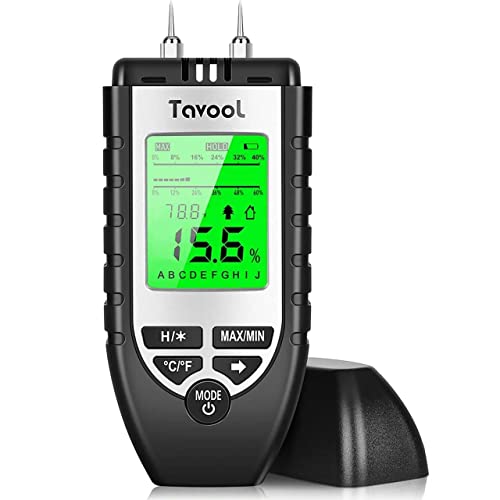
Tavool Wood Moisture Meter
The Tavool covers the common household questions of whether firewood is seasoned and whether a damp patch is still wet, at a very low outlay. Multiple material modes and a backlit screen make it usable in a woodshed. Consistency at the extremes of the range is where it trails the established brands.
Pros
- Very low cost entry point
- Four material modes
- Backlit screen for dark sheds
Cons
- Less consistent at range extremes
- Pins are less durable
Side by side
| # | Model | Type | Best for | Score | Price |
|---|---|---|---|---|---|
| 1 | General Tools MMD4E | Pin meter | Best overall | 9.4 | Check price |
| 2 | Wagner Meters Orion 930 | Pinless with dual depth | Best pinless meter | 9.2 | Check price |
| 3 | Klein Tools ET140 | Pin meter | Best for leak tracing | 9.0 | Check price |
| 4 | Calculated Industries 7440 AccuMASTER Duo Pro | Pin and pinless combined | Best dual mode meter | 8.8 | Check price |
| 5 | Extech MO55 | Pin and pinless with remote probe | Best for professionals | 8.6 | Check price |
| 6 | Extech MO257 | Pinless | Best value pinless | 8.3 | Check price |
| 7 | Tavool Wood Moisture Meter | Pin meter | Best budget pick | 8.0 | Check price |
What matters most
Pin or pinless depends on the surface Pin meters measure electrical resistance between two probes, which gives a reading at a specific depth and works well on rough lumber, firewood and drywall you do not mind marking. Pinless meters use a radio frequency field to scan a shallow layer without damage, which is essential on finished floors, furniture and veneers. Many people end up owning one of each.
Species and material correction change the number Wood species differ in density and electrical behaviour, so an uncorrected reading can be several percentage points off. Better meters let you select a species or species group, and building material scales are calibrated separately for drywall and masonry. Using the wrong scale is the single most common reason two meters disagree.
Know your target numbers Firewood should read below roughly 20 percent before burning, and ideally nearer 15. Interior joinery and flooring are usually installed somewhere around 6 to 9 percent depending on climate and season. Framing lumber is generally considered acceptable below about 19 percent. Drywall should read at the dry end of its scale, and anything wetter warrants investigation.
Reading technique matters as much as the meter Take several readings across a board or wall rather than trusting one spot, since moisture is rarely evenly distributed. On lumber, measure across the grain and away from the ends, which dry faster. Let the meter and the material reach a similar temperature, and remember that surface moisture from rain or condensation will skew a pin reading.
Good to know
What moisture level should firewood be?
Below about 20 percent, with 15 to 18 percent considered well seasoned. Split a log and measure the freshly exposed inner face, since the outside dries first and gives a misleadingly low reading.
Are pinless meters as accurate as pin meters?
They are accurate in different ways. Pinless meters average moisture across a scanned volume, while pin meters read at a specific depth between the probes. For finished surfaces, pinless is the only sensible option.
Do pin holes matter?
On framing, firewood and rough lumber they are irrelevant. On finished flooring, furniture or trim they are visible and difficult to disguise, which is the main reason pinless meters exist.
Why do two meters give different readings?
Usually because of different material or species settings, different measuring depths, or surface moisture affecting one and not the other. Check that both are set to the same material before assuming one is faulty.
Can a moisture meter find a leak?
It can narrow down where water is present by comparing readings across a wall or ceiling, which is how trades trace damp. It cannot see the source directly, so combine it with visual inspection and, where available, a thermal camera.
What moisture reading is safe for hardwood flooring?
Most installers look for flooring and subfloor within a few percentage points of each other and generally in the region of 6 to 9 percent, adjusted for local conditions. Check the flooring manufacturer’s stated range before installing.
Does temperature affect readings?
Yes. Resistance based pin readings shift with temperature, and some meters offer a correction. Letting the meter and material equalise before measuring avoids most of the error.
How do I look after a moisture meter?
Keep the pin cap fitted, replace bent or corroded pins, and store the meter dry. For pinless meters, keep the sensing plate clean and free of scratches, since surface contact affects the reading.
The bottom line
The General Tools MMD4E remains the meter most people should buy, since it answers the everyday firewood, lumber and damp questions accurately for a small outlay. Step up to the Wagner Meters Orion 930 if you work with finished timber and cannot leave pin holes, or the Klein Tools ET140 if leak tracing is the main job.