Digital Multimeters Ranked on Accuracy and Safety
For most users the Fluke 117 leads on trusted accuracy and safety for electrical work, the Fluke 87V wins for demanding professional and industrial use, and the Klein Tools MM600 offers strong value with dependable auto ranging performance based on published specifications and long standing user reports.
If you want the short version, the Fluke 117 is the strongest all round meter for electricians and serious DIYers thanks to reliable accuracy and a true safety rating, the Fluke 87V is the pick for demanding professional and industrial work, and the Klein Tools MM600 delivers excellent value without cutting corners on the essentials.
Choosing a digital multimeter is trickier than it looks because the safety category rating, true RMS capability and input protection matter as much as the headline features, and a cheap meter on a live circuit can be genuinely unsafe. We compared these meters on measurement accuracy, safety category rating, build quality, and useful extras like true RMS and non contact voltage, drawing on published specifications and patterns reported by long time users.
Our top picks

Fluke 117 Electricians Multimeter
The Fluke 117 hits the sweet spot for electricians and advanced DIYers who want trusted accuracy in a compact meter. Users highlight the built in non contact voltage detection and the low input impedance mode that helps avoid false readings from ghost voltage. The true RMS design handles nonlinear loads well.
Pros
- Trusted accuracy for electrical work
- Built in non contact voltage detection
- Low impedance mode reduces ghost voltage errors
Cons
- Higher point on the range than hobby meters
- No temperature measurement on this model

Fluke 87V Industrial Multimeter
The Fluke 87V is built for demanding industrial and professional environments where accuracy and durability are non negotiable. Users report dependable readings on motor drives and noisy circuits, helped by a low pass filter, and the meter adds temperature measurement and a high resolution mode for fine work.
Pros
- Very high accuracy and resolution
- Low pass filter suits motor drive work
- Rugged build for industrial use
Cons
- Premium point on the range
- More features than a casual user needs

Klein Tools MM600 Multimeter
The Klein Tools MM600 gives tradespeople a rugged auto ranging meter at a sensible point on the range. Users like the wide measurement span, including temperature and frequency, and the durable housing that shrugs off job site knocks. Auto ranging keeps operation quick in the field.
Pros
- Wide measurement range for the point on the range
- Rugged housing suits job site use
- Auto ranging speeds up readings
Cons
- Not true RMS on some measurement types
- Larger body than pocket meters

AstroAI DM6000AR Multimeter
The AstroAI DM6000AR packs a broad feature set into an affordable auto ranging meter that suits home and hobby use. Users appreciate the true RMS readings, wide range of functions and the clear backlit screen. Built in protection and a stand make it approachable for newcomers.
Pros
- True RMS at a very friendly point on the range
- Wide function set for home and hobby
- Clear backlit display and kickstand
Cons
- Not rated for heavy industrial circuits
- Leads are basic and may be upgraded later
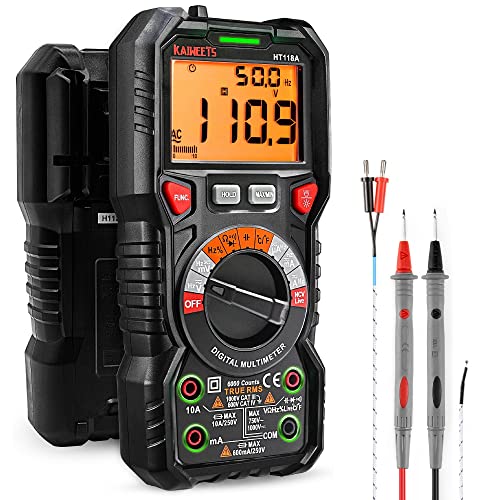
KAIWEETS HT118A Multimeter
The KAIWEETS HT118A is a well rounded meter aimed at homeowners and DIYers who want reliable everyday measurements. Users note the true RMS readings, sturdy feel and helpful features like a low battery indicator and screen backlight. A protective holster adds durability for casual use.
Pros
- True RMS with a solid feature set
- Sturdy feel and protective holster
- Clear display for everyday tasks
Cons
- Not aimed at heavy professional workloads
- Included leads are entry level

Amprobe AM-510 Multimeter
The Amprobe AM-510 is a commercial and residential meter that leans toward HVAC and general maintenance tasks. Users value the built in non contact voltage detection, temperature measurement and capacitance range, which cover common field checks. The compact body fits easily in a tool pouch.
Pros
- Covers common HVAC and maintenance checks
- Built in non contact voltage detection
- Compact and pouch friendly
Cons
- Lower voltage safety rating than pro meters
- Not true RMS on this model
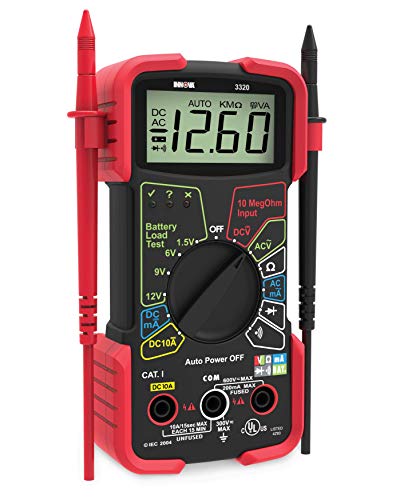
INNOVA 3320 Multimeter
The INNOVA 3320 is a straightforward auto ranging meter that suits basic automotive and household electrical checks. Users like the color coded LED battery test and protective corner guards, and the simple layout makes it approachable for first time owners doing occasional diagnostics.
Pros
- Very affordable for occasional use
- Simple layout suits beginners
- Color coded battery test is handy
Cons
- Lower safety rating limits it to light duty
- Not true RMS and fewer advanced functions
Compared at a glance
| # | Model | Safety rating | Best for | Score | Price |
|---|---|---|---|---|---|
| 1 | Fluke 117 Electricians Multimeter | CAT III 600V | Best overall | 9.4 | Check price |
| 2 | Fluke 87V Industrial Multimeter | CAT III 1000V and CAT IV 600V | Best for professionals | 9.2 | Check price |
| 3 | Klein Tools MM600 Multimeter | CAT III 1000V and CAT IV 600V | Best for electricians on a budget | 9.0 | Check price |
| 4 | AstroAI DM6000AR Multimeter | CAT III 600V and CAT II 1000V | Best value all rounder | 8.8 | Check price |
| 5 | KAIWEETS HT118A Multimeter | CAT III 1000V and CAT IV 600V | Best for home use | 8.6 | Check price |
| 6 | Amprobe AM-510 Multimeter | CAT III 600V | Best for HVAC and general use | 8.4 | Check price |
| 7 | INNOVA 3320 Multimeter | CAT II | Best budget automotive pick | 8.2 | Check price |
How to pick the right one
Safety category rating comes first Before features, check the CAT rating and voltage. The category indicates the transient energy the meter can safely handle, and higher CAT numbers with higher voltage suit work closer to the mains supply. For general electrical work a CAT III 600V or higher meter is sensible, while light automotive and battery tasks can use a lower rating. Never use an underrated meter on a circuit beyond its category.
True RMS versus average responding True RMS meters measure the real value of AC signals accurately, including the distorted, nonlinear waveforms common around motor drives, electronics and modern equipment. Average responding meters can read low or high on those signals. If you work on anything beyond clean sine wave circuits, based on specifications and user feedback a true RMS meter such as the Fluke 117 or 87V is the safer default.
Match the meter to your work A professional electrician benefits from a rugged, high category meter like the Fluke 87V or Klein MM600, while a homeowner is well served by a capable value meter such as the AstroAI DM6000AR or KAIWEETS HT118A. Automotive and battery tinkerers can use a simpler unit like the INNOVA 3320. Buying more meter than you need is fine, but the safety rating should always match your worst case circuit.
Features that earn their place Beyond the basics, a few features genuinely speed up work. Non contact voltage detection helps you confirm a circuit is dead before touching it, temperature and capacitance ranges cover HVAC and electronics tasks, and a backlit display plus a holster make field use easier. Auto ranging suits quick everyday checks, while manual ranging can be faster for repeated measurements once you know the value.
Questions worth asking
What does the CAT safety rating on a multimeter mean?
The CAT rating describes the transient energy a meter can safely handle and where it can be used relative to the mains supply. Higher categories and voltages suit work closer to the service entrance, so always match the rating to your worst case circuit.
Do I need a true RMS multimeter?
If you measure anything beyond clean sine wave AC, such as motor drives or electronics, true RMS gives accurate readings where average responding meters can drift. For simple household and battery checks a standard meter is usually fine, but true RMS is the safer default overall.
Is a Fluke multimeter worth the extra cost?
For professionals, the accuracy, durability and trusted safety rating of meters like the Fluke 117 and 87V often justify the outlay. Home users who measure occasionally can get reliable results from strong value meters without paying for industrial grade features.
Which multimeter is best for a beginner?
Beginners are well served by an affordable auto ranging true RMS meter like the AstroAI DM6000AR or KAIWEETS HT118A, which offer a wide feature set and a clear display. For light automotive work the simpler INNOVA 3320 is an approachable option.
What is the difference between auto ranging and manual ranging?
Auto ranging meters pick the correct range for you, which is convenient for varied everyday tasks. Manual ranging lets you lock a range, which can be faster and more stable for repeated measurements once you know the approximate value you expect.
Can I use a multimeter to test car electrics?
Yes, a multimeter can check battery voltage, continuity, fuses and basic circuits in a vehicle. A simple auto ranging meter like the INNOVA 3320 covers common tasks, while a more capable meter adds temperature and finer measurements for deeper diagnostics.
What features matter most in a multimeter?
Prioritize the safety category rating, accuracy and true RMS capability first. After that, non contact voltage detection, temperature and capacitance ranges, a backlit display and a protective holster add real convenience depending on the work you do.
How accurate are digital multimeters?
Accuracy is stated as a percentage of reading plus a number of counts, and better meters hold tighter specifications across ranges. Professional meters like the Fluke 87V offer high resolution modes, while value meters remain accurate enough for most home and hobby measurements.
Do I need non contact voltage detection?
It is a useful safety convenience that lets you confirm a wire is likely live before touching it. Meters like the Fluke 117 and Amprobe AM-510 build it in, though it should support rather than replace a proper direct measurement before you work.
How do I keep a multimeter accurate over time?
Store it in a dry place, use quality leads, replace the battery before it gets too low, and avoid exceeding the input limits. Professionals often recalibrate on a schedule, while occasional users can rely on periodic checks against a known reference.
Our pick
For most users the Fluke 117 is the safest all round pick thanks to trusted accuracy, a genuine safety rating and built in non contact voltage detection. If your work is heavy or industrial choose the Fluke 87V, and if you want the most capability for the money the Klein Tools MM600 is the sensible choice.