Multi Needle Embroidery Machines Compared by Needles
The Brother PR1055X leads for busy shops with ten needles and a large field, while the Brother PR680W is the sensible six needle entry point for a growing side business. The Ricoma EM-1010 offers ten needles at a lower entry level for home studios.
For a working embroidery business the Brother PR1055X is the strongest all round multi needle machine, with the Brother PR680W as the six needle starting point and the Ricoma EM-1010 as a lower cost ten needle alternative. Cap heavy shops should look at the Melco EMT16X.
Choosing here is difficult because the headline needle count hides the details that decide throughput, such as hoop range, cap frame support, tension design and how easily colours are changed mid run. We compared published embroidery fields, maximum stitch speeds, included frames, memory and connection options, then weighed what owners report about servicing and thread handling, and ranked the seven machines below.
The best picks, ranked

Brother PR1055X
Ten needles mean a full ten colour design can run without a single thread change, which is where production time is really saved. The PR1055X adds a large embroidery field, a camera positioning system and a bright touchscreen for on machine editing. Owners report it holds tension well across long commercial runs.
Pros
- Ten colours without stopping to rethread
- Large field handles jacket backs and blankets
- Camera placement reduces misaligned starts
Cons
- Needs a dedicated table and real floor space
- The most demanding option to learn from scratch

Brother PR680W
The PR680W is the machine most people move to when a single needle can no longer keep up with orders. Six needles cover the majority of logo work, and wireless design transfer removes the USB shuffle between computer and machine. It handles caps, bags and finished garments with the optional frames.
Pros
- Manageable size for a spare room studio
- Wireless transfer from design software
- Strong dealer and parts support
Cons
- Six colour limit means changes on complex designs
- Smaller field than the ten needle models

Ricoma EM-1010
Ricoma built the EM-1010 for home studios that want ten needles without a commercial footprint. It ships with several hoops and a cap driver in most bundles, so it is close to ready for logo work out of the box. Owners report the touchscreen interface is one of the easier ones to learn.
Pros
- Ten needles in a compact frame
- Generous accessory bundle
- Clear touchscreen menus
Cons
- Smaller field than the Brother ten needle machines
- Service network is thinner in some regions

Ricoma MT-1502
Two heads with fifteen needles each mean two identical garments stitch at once, which roughly halves the time on repeat orders. It is a floor standing commercial machine rather than a studio unit. Based on specifications it also runs at a higher top speed than most single head models.
Pros
- Two garments per run on repeat jobs
- Fifteen colours loaded at once
- Built for continuous production
Cons
- Requires dedicated commercial floor space
- Overkill for occasional or hobby work
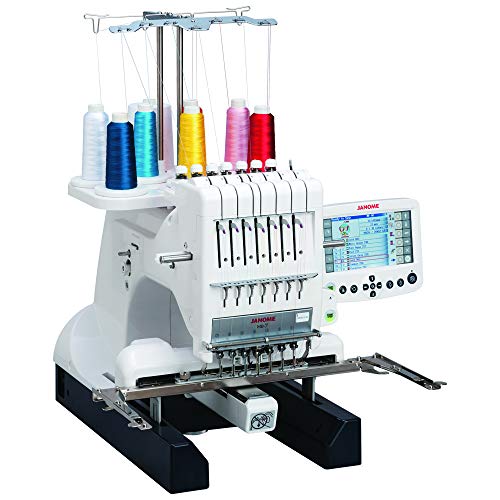
Janome MB-7
The MB-7 is unusually small for a multi needle machine, which makes it viable on a sturdy sewing table rather than a dedicated stand. Seven needles cover most logo palettes, and the machine reads standard design files from USB. Owners report it is quieter than larger commercial heads.
Pros
- Fits a normal craft room table
- Runs quieter than bigger machines
- Simple file handling
Cons
- Slower top speed than the Brother machines
- Smaller field limits jacket back work

Melco EMT16X
Melco takes a modular approach, so shops can run one machine now and add matching heads later without changing software. The EMT16X is known for its cap performance and its adjustable presser foot and thread feed system. It suits shops whose work skews toward hats and structured items.
Pros
- Excellent cap and structured item handling
- Very high top speed
- Add heads later without new software
Cons
- Learning curve on the control software
- Premium positioning in the market

Baby Lock Venture
The Venture pairs ten needles with one of the widest embroidery fields in this class, which matters for quilt blocks, jacket backs and blankets. A camera scanning feature helps place designs accurately on awkward items. It is a large machine that expects a dedicated stand.
Pros
- Very large field for oversized designs
- Camera assisted placement
- Strong dealer training network
Cons
- Large footprint
- Accessories add up quickly
Side by side
| # | Model | Needles | Best for | Score | Price |
|---|---|---|---|---|---|
| 1 | Brother PR1055X | 10 | Best overall | 9.4 | Check price |
| 2 | Brother PR680W | 6 | Best six needle machine | 9.2 | Check price |
| 3 | Ricoma EM-1010 | 10 | Best value ten needle | 9.0 | Check price |
| 4 | Ricoma MT-1502 | 2 | Best for high volume production | 8.8 | Check price |
| 5 | Janome MB-7 | 7 | Best compact seven needle | 8.6 | Check price |
| 6 | Melco EMT16X | 16 | Best for caps and specialty items | 8.3 | Check price |
| 7 | Baby Lock Venture | 10 | Best for large designs | 8.0 | Check price |
How to pick the right one
Needle count decides your workflow, not your quality Stitch quality on a well maintained machine is broadly similar whether it has six needles or fifteen. What changes is how often you stop. A six needle machine running a nine colour design means three thread changes on every garment, which on a batch of fifty shirts is where an afternoon disappears. Count the colours in the designs you actually sell most often, then buy the needle count that covers them without stopping.
Check the field size against your real orders Embroidery field is the maximum area the machine can stitch in one hooping, and it is more limiting than most buyers expect. Left chest logos need very little, but jacket backs, blanket monograms and towel borders can exceed a smaller field and force splitting a design across two hoopings. If large work is part of your plan, prioritise field size over headline speed.
Caps and tubular items need the right frames Hats are one of the most profitable embroidery items and one of the fussiest to stitch, because the curved surface needs a driver and cap frame rather than a flat hoop. Confirm whether a cap system is included or sold separately, and check the maximum sew field on the cap frame. Tubular arms also matter for sleeves and bag panels, which flat only setups cannot reach cleanly.
Support, parts and training matter more over time A multi needle machine is a long term piece of equipment that will need timing adjustments, new rotary hooks and occasional service. Before choosing, look at how close the nearest trained technician is, whether parts ship quickly and what training comes with the purchase. Owners report that a slightly less specified machine with strong local support usually outperforms a better specified one with none.
Frequently asked questions
Is a multi needle machine worth it over a single needle?
If you are stitching for customers, yes. The time saved on colour changes and the ability to hoop tubular items are the two things a single needle machine cannot match. For occasional personal projects the extra cost and space are harder to justify.
How many needles do I actually need?
Six covers most left chest logos and simple designs. Ten covers almost everything commercial without a thread change. Fifteen or sixteen is aimed at production shops running varied jobs back to back.
Can these machines embroider hats?
Most can with the correct cap driver and frame, but not all include one. Check whether the cap system is part of the package, since buying it separately adds meaningfully to the total.
What software do I need?
You need digitising software to convert artwork into stitch files, or a digitiser who supplies them. The machine reads finished files, so the software choice is separate from the machine choice unless the manufacturer uses a proprietary system.
How much space does a multi needle machine need?
Plan for the machine footprint plus room to swing hoops and reach the thread cones. Compact models like the Janome MB-7 sit on a strong table, while ten needle and multi head machines expect a dedicated stand with clearance on all sides.
Do multi needle machines also sew?
No. These are embroidery only machines. If you need regular sewing as well, you will need a separate sewing machine alongside.
What maintenance do they need?
Regular oiling of the rotary hook, cleaning lint from the bobbin case, changing needles on a schedule and periodic professional servicing. Keeping to the oiling interval is the single biggest factor in long term reliability.
Can a beginner start on a multi needle machine?
Yes, though the learning curve is steeper. Hooping technique, stabiliser choice and tension control matter more than the machine itself, so budget time for practice runs on scrap fabric before taking paid orders.
Final word
The Brother PR1055X is the machine to buy if embroidery is your business, since ten needles and a large field remove the two things that slow production most. The Brother PR680W is the more realistic first multi needle machine for a growing side business, and the Ricoma EM-1010 gives ten needles to studios with less room. Shops built around hats should look hardest at the Melco EMT16X.

