Portable Tire Inflators for Fast Roadside Top Ups
The VIAIR 88P is our top overall pick because its metal build and direct battery clamps fill a car tire quickly without overheating. The AstroAI 12V Tire Inflator is the best budget option for a glovebox, and the DeWalt DCC020IB is the best cordless choice for anyone on the 20V platform.
The VIAIR 88P is the inflator we would keep in a car boot, the AstroAI 12V unit is the cheap and cheerful choice that still gets you home, and the DeWalt DCC020IB suits anyone already carrying 20V batteries. All three take a car tire from soft to correct in a few minutes.
Inflators are hard to compare because advertised maximum PSI tells you almost nothing about how fast a unit fills a real tire, and cheap models often overheat before finishing four wheels. Duty cycle, power delivery and hose fittings decide whether the thing is actually useful at the roadside. We compared published fill rates, duty cycles, power sources and gauge behaviour, and we weighed what owners report about heat cutouts and leaking chucks.
How to choose
Fill rate matters more than maximum PSI Almost every inflator on the market claims 100 PSI or more, but a car tire only needs somewhere around 32 to 36 PSI. What actually matters is how much air the unit moves per minute at that working pressure. A compressor rated for high flow at 30 PSI will finish a tire in two or three minutes, while a small pump quoting 150 PSI maximum may take eight. Look for cubic feet per minute figures or reported real world fill times rather than the headline pressure number.
Duty cycle is what stops you halfway Duty cycle describes how long a compressor can run before it needs to cool. Small twelve volt pumps often manage ten to fifteen minutes, which is enough for one or two tires from a low starting point. Units like the VIAIR 88P are rated for continuous operation at car tire pressures, which is why they can do all four wheels without a thermal cutout. If you only ever top up monthly this matters little, but for a genuinely flat tire it decides whether you get home.
Power source shapes how you will actually use it Twelve volt socket inflators are cheapest and smallest but depend on a fuse that is often rated at ten or fifteen amps, and hard working pumps can trip it. Direct battery clamp units avoid that entirely at the cost of opening the bonnet. Tool battery inflators are the most convenient if you already own the platform, and self contained units need charging to stay useful. Pick the source that matches how disciplined you are about maintenance.
Gauges, chucks and getting the pressure right Digital gauges on portable inflators are usually accurate within a couple of PSI, which is fine for practical purposes, but they read high while the pump is running. Check pressure with the motor off, or trust the automatic shutoff and verify with a separate pencil or dial gauge afterwards. Screw on chucks seal better than clip on ones and lose less air when removed. Always set pressure to the figure on the driver door jamb sticker, not the number moulded into the tire sidewall, which is a maximum rather than a recommendation.
The shortlist, ranked

VIAIR 88P Portable Air Compressor Kit
The 88P is a proper small compressor rather than a plastic novelty, with a metal housing, a sand tray base and heavy battery clamps that bypass the weak twelve volt socket circuit. It fills a car tire quickly and keeps going long enough to do all four wheels without a heat cutout. The trade is bulk, since the clamps and hose need a bag rather than a glovebox.
Pros
- Fast, sustained filling without overheating
- Battery clamps avoid blowing socket fuses
- Long hose reaches every wheel from one position
Cons
- Bulky to store compared with cordless units
- Clamps mean opening the bonnet every time

AstroAI 12V DC Portable Air Compressor Tire Inflator
This AstroAI inflator plugs into the twelve volt socket, takes a target pressure on a digital display and shuts off automatically when it gets there. It is small enough to live in a door pocket and handles routine monthly top ups easily. Owners report it needs rest breaks if you inflate all four tires from very low, which is normal for this size and price class.
Pros
- Very compact and easy to store in the car
- Automatic shutoff at the set pressure
- Low outlay for a genuinely useful tool
Cons
- Needs cooling breaks during heavy use
- Depends on a working 12V socket fuse

DeWalt DCC020IB 20V MAX Cordless Tire Inflator
The DCC020IB runs from a 20V MAX battery, a twelve volt socket or mains power, which makes it the most flexible unit here for people who also carry DeWalt tools. A high volume hose attachment handles air beds and sports gear alongside the standard high pressure tire hose. It is heavier than a pure car inflator, and the battery is sold separately unless you already own one.
Pros
- Three power sources cover almost any situation
- High volume mode inflates rafts and air beds
- Rugged construction with tidy hose storage
Cons
- Bare tool needs a compatible battery
- Larger and heavier than pocket inflators

Fanttik X8 Apex Cordless Tire Inflator
The X8 Apex has its own rechargeable battery, so there are no cords, clamps or socket fuses involved at all. A bright display, preset vehicle modes and a quiet running mode make it pleasant to use in a driveway at night. Battery capacity limits it to roughly a full set of top ups per charge, so it needs charging periodically rather than living forgotten in the boot.
Pros
- Completely cordless and one hand operable
- Clear display with useful presets
- Quieter than most 12V compressors
Cons
- Needs periodic recharging to stay ready
- Limited runtime for filling from flat
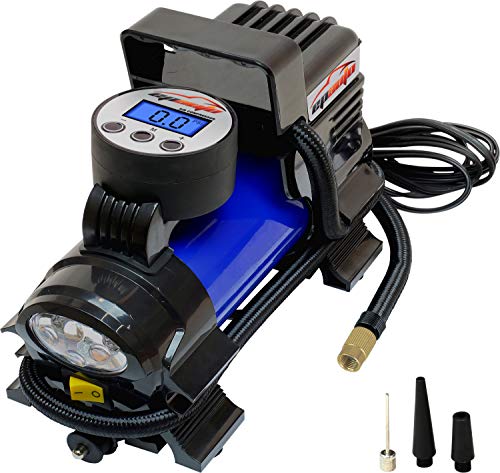
EPAuto 12V DC Portable Air Compressor Pump
The EPAuto pump is the straightforward option that has been in car boots for years, with a digital gauge, four preset units and an auto stop function. There is nothing clever about it, which is part of the appeal because there is less to fail. It runs from the accessory socket, so a blown fuse in an older car will stop it dead.
Pros
- Simple, proven design with few failure points
- Multiple pressure units for imported vehicles
- Compact carry bag included
Cons
- Lower maximum pressure limits truck use
- Noisier than newer cordless designs
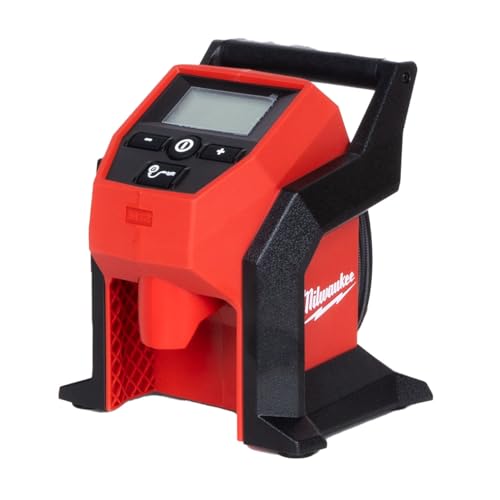
Milwaukee 2475-20 M12 Compact Inflator
The M12 compact inflator is built for people who already carry Milwaukee batteries in a work van and want one tool that also does trailers and equipment tires. It reaches high pressures and shuts off precisely at the set value, which suits trailer tires that need firm inflation. Fill speed on large car tires is moderate rather than rapid, so it rewards patience.
Pros
- Accurate shutoff at the target pressure
- Genuinely portable with no cords
- Handles trailer and equipment tires
Cons
- Bare tool requires an M12 battery
- Moderate fill speed on larger tires

Ryobi P737D ONE+ 18V Cordless Power Inflator
The P737D is the cheap way into cordless inflation if you already own Ryobi ONE Plus batteries, and it includes a digital gauge with automatic shutoff. It is a light duty tool best suited to top ups and bike tires rather than filling a fully flat car tire. Owners report the hose is short, so parking position matters when reaching rear wheels.
Pros
- Very affordable for existing Ryobi owners
- Compact and light to handle
- Digital preset shutoff included
Cons
- Short hose limits reach around the car
- Slow when filling from very low pressure
The lineup, side by side
| # | Model | Power source | Best for | Score | Price |
|---|---|---|---|---|---|
| 1 | VIAIR 88P Portable Air Compressor Kit | Direct battery clamps, 12V | Best overall | 9.4 | Check price |
| 2 | AstroAI 12V DC Portable Air Compressor Tire Inflator | 12V accessory socket | Best budget | 9.2 | Check price |
| 3 | DeWalt DCC020IB 20V MAX Cordless Tire Inflator | 20V MAX battery, 12V DC or 110V AC | Best cordless option | 9.0 | Check price |
| 4 | Fanttik X8 Apex Cordless Tire Inflator | Internal rechargeable battery | Best for one hand use | 8.8 | Check price |
| 5 | EPAuto 12V DC Portable Air Compressor Pump | 12V accessory socket | Best for simple reliability | 8.6 | Check price |
| 6 | Milwaukee 2475-20 M12 Compact Inflator | Milwaukee M12 battery | Best for trade vans | 8.3 | Check price |
| 7 | Ryobi P737D ONE+ 18V Cordless Power Inflator | Ryobi ONE+ 18V battery | Best for existing Ryobi owners | 8.0 | Check price |
Good to know
How long should filling a car tire take?
Taking a typical car tire from 20 to 35 PSI takes roughly two to four minutes with a strong compressor such as the VIAIR 88P, and five to eight minutes with a small socket powered pump.
Will a portable inflator fix a puncture?
No. It can refill a slow leak enough to reach a tire shop, but a puncture still needs a plug or patch repair. If a tire loses pressure within minutes of filling, drive to a repair shop rather than continuing a journey.
Why does my inflator keep blowing the socket fuse?
Twelve volt accessory circuits are usually fused at ten or fifteen amps, and a compressor working hard can exceed that. Use a unit with direct battery clamps, or run the engine and avoid other accessory loads while inflating.
Should I inflate to the number on the tire sidewall?
No. The sidewall figure is the maximum the tire can hold. Use the pressure listed on the sticker inside the driver door jamb or in the owner manual, which is set for your specific vehicle.
Do I need to check pressure when tires are cold?
Yes. Driving heats the air inside and raises pressure by several PSI. Check and set pressure before driving, or after the car has sat for at least three hours, for an accurate reading.
Are cordless inflators powerful enough for car tires?
Yes for top ups, and mostly yes for filling from low. Battery models like the DeWalt DCC020IB have the output but drain a battery quickly when filling multiple tires from flat.
Can these inflators handle bike tires and sports balls?
Most include needle and cone adapters. High pressure road bike tires suit units rated to 100 PSI or above, while air beds and rafts need a high volume mode like the one on the DeWalt.
How accurate are the built in digital gauges?
Typically within one to three PSI, which is acceptable for road use. Verify occasionally against a separate gauge, and always read with the compressor switched off, because running pressure reads higher.
Final word
The VIAIR 88P is the inflator we would rely on in a genuine roadside situation, because it fills quickly and does not stop to cool down halfway through the job. The AstroAI 12V unit is the sensible cheap insurance policy for routine top ups, and the DeWalt DCC020IB makes the most sense for anyone already carrying 20V MAX batteries.