Reptile Terrarium Thermometers Sorted by Probe and Zone Count
Exo Terra’s Digital Thermometer/Hygrometer combo suits most indoor tanks with one probe covering both temperature and humidity, though it tracks only a single zone. REPTI ZOO’s dual-probe gauge fits bioactive setups with separate warm and cool ends. Fluker’s combo delivers similar coverage at a lower cost, without a backlight.
Exo Terra’s Digital Thermometer/Hygrometer combo leads this list for most indoor keepers, since one LCD panel reads both temperature and humidity from a single external probe. Bioactive tanks with a clear warm and cool end do better with the REPTI ZOO dual-probe gauge. Keepers on a tighter budget get nearly the same coverage from Fluker’s combo, minus the backlight.
Heat behaves differently indoors than outdoors, so a probe six inches from a basking bulb can read ten degrees warmer than the substrate near the glass. We compared probe count, sensor type, humidity range, and mounting method across seven listings, separating single-zone gauges from setups built for bioactive or multi-zone tanks.
The best picks, ranked

Exo Terra Digital Thermometer/Hygrometer
Suction cups mount the display straight to glass without drilling into the tank. One internal sensor and one external probe feed a single LCD panel with both temperature and humidity. Readings refresh continuously, which helps catch overnight temperature swings.
Pros
- One display covers both temperature and humidity readings
- Temperature range spans 14 to 122 degrees F, wide enough for most species
- Suction-cup mount skips drilling into the enclosure
Cons
- No backlight makes nighttime readings harder to check
- Only one zone gets measured per unit

REPTI ZOO Reptile Thermometer Humidity Gauge Dual Probe
Separate probes track the warm and cool ends of an enclosure at the same time, while one shared sensor covers ambient humidity. A backlit LCD helps with low-light checks. Each probe cable runs about 3.3 feet, long enough for taller tanks.
Pros
- Two probes track both thermal zones at once
- Backlit display aids reading in dim rooms
- Switches between Fahrenheit and Celsius on demand
Cons
- Humidity still comes from a single shared sensor, not two
- Adhesive probe mounts can loosen after several months
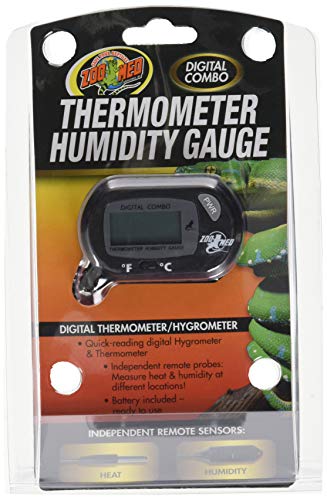
Fluker’s Digital Thermometer and Humidity Gauge
A compact housing keeps this combo gauge sized for nano tanks as well as standard setups. One probe and suction mount deliver both temperature and humidity to a single LCD. Skipping a backlight keeps the design simple and the unit priced below most dual-probe combos.
Pros
- Priced lower than most combo gauges with two probes
- Suction mount installs in seconds without tools
- Compact housing fits nano and standard tanks alike
Cons
- Single probe covers only one zone in the tank
- No backlight for checking readings after dark

Zoo Med ReptiTemp RT-600 Infrared Thermometer
A built-in laser targets a basking rock or lamp hotspot, returning a surface reading in under a second. No probe or wiring sits inside the enclosure at all. Range spans from well below freezing to over 700 degrees F, covering both cool substrate and hot basking spots.
Pros
- Instant surface reading with laser targeting
- No wires or probes cluttering the enclosure
- Range covers cool substrate through hot basking rocks
Cons
- Cannot log continuous readings the way a probe does
- Measures no humidity at all

Zacro Reptile Thermometer Humidity Gauge Digital
Two suction-mounted probes track opposite ends of an enclosure for less than most dual-zone gauges cost. Min/max memory recalls the lowest overnight reading without a manual check. Plastic housing feels less sturdy than the casings on pricier models.
Pros
- Two probes cost less than most dual-zone competitors
- Min/max recall flags overnight temperature drops
- Suction mounts install without any tools
Cons
- Humidity readings drift more than pricier combo units
- Plastic housing wears faster over long-term use

Zilla Digital Terrarium Thermometer
A single probe reports temperature only, with no humidity sensor to calibrate or eventually replace. Compact LCD housing suits small or nano tanks where space runs tight. Suction mounting matches the simple, single-purpose build.
Pros
- Fewer parts means fewer components that can fail
- Compact size fits small and nano enclosures
- Priced below most combo gauges
Cons
- No humidity reading of any kind
- No backlight for checking readings in low light
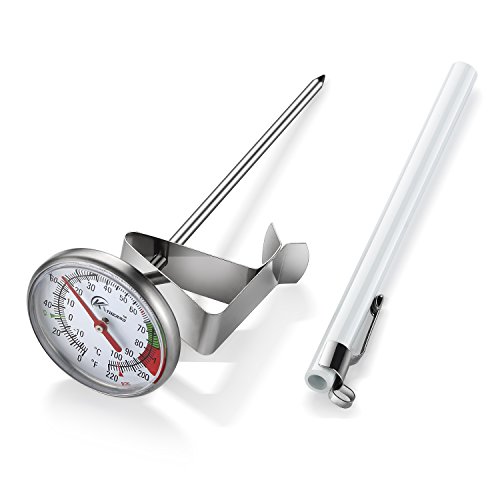
Habistat Dial Thermometer
A needle dial reads temperature with no battery or circuit board involved. Self-adhesive backing sticks directly to glass or wood vivarium panels. The reading updates instantly, though it takes a closer look than a backlit digital screen.
Pros
- Never needs a battery replacement
- Lowest price point among the gauges compared here
- Reads at a glance without pressing any buttons
Cons
- Less precise than digital probe readings
- No min/max memory or alarm function
How they stack up
| # | Model | Display | Best for | Score | Price |
|---|---|---|---|---|---|
| 1 | Exo Terra Digital Thermometer/Hygrometer | Dual LCD, temperature and humidity | Keepers who want one gauge for both temperature and humidity | 9.4 | Check price |
| 2 | REPTI ZOO Reptile Thermometer Humidity Gauge Dual Probe | Two temperature probes, one humidity sensor | Bioactive or larger tanks with separate warm and cool ends | 9.2 | Check price |
| 3 | Fluker’s Digital Thermometer and Humidity Gauge | Single LCD panel | Budget-conscious keepers who still want a combo reading | 8.9 | Check price |
| 4 | Zoo Med ReptiTemp RT-600 Infrared Thermometer | Non-contact infrared, no probe | Spot-checking basking surfaces without placing a probe | 8.7 | Check price |
| 5 | Zacro Reptile Thermometer Humidity Gauge Digital | Two temperature probes, suction-cup mounts | Keepers who need two zones tracked on a tight budget | 8.5 | Check price |
| 6 | Zilla Digital Terrarium Thermometer | Temperature only, no humidity reading | Keepers who already own a separate hygrometer | 8.2 | Check price |
| 7 | Habistat Dial Thermometer | Analog dial, no batteries required | Keepers who want a reading without batteries or wiring | 8.0 | Check price |
How to pick the right one
What to look for in an indoor reptile thermometer Probe placement affects accuracy more than the gauge itself. Check that the stated temperature range covers both the cool side and the basking spot, plus a humidity range if the species needs stable moisture. Suction-cup or adhesive mounts matter most indoors, where glass and screen lids limit probe placement. Battery type also matters, since backlit displays drain cells faster than basic LCDs.
Digital probes vs infrared: which reads faster? Probe-based gauges sit inside the tank and report a running reading, useful for catching overnight lows. Infrared units like the Zoo Med RT-600 skip the wiring entirely, reading surface temperature the moment you aim and click. That speed helps when checking a basking rock or lamp hotspot from across the room. Neither humidity tracking nor data logging comes standard on infrared models, so most keepers pair one with a probe gauge instead of replacing it.
Choosing a combo gauge for temperature and humidity Species that need steady humidity, such as tropical geckos or amphibians, do better with one combo unit than two separate tools. A single LCD panel showing both readings also cuts down on clutter in smaller tanks. Sensor placement still changes the number: a humidity sensor mounted near a water dish reads higher than one near a screen top. Check where the listing places its sensor before buying.
Dual-zone monitoring for bioactive or larger tanks Bigger tanks, especially bioactive setups with live plants, often show a wider gap between the warm and cool ends. A second probe, like the ones on the REPTI ZOO or Zacro units, tracks both zones without forcing a keeper to move one probe back and forth. This matters most for species with strict thermal gradients, where a few degrees off on either end can affect digestion or shedding.
Frequently asked questions
What is the best thermometer for an indoor reptile tank?
A digital combo like the Exo Terra Digital Thermometer/Hygrometer covers both temperature and humidity from one probe for most setups. Bioactive or large tanks benefit more from a dual-probe gauge that tracks two zones.
Do reptile tanks need a thermometer and a hygrometer both?
Species with strict humidity needs, including chameleons and tree frogs, need both readings tracked. Combo gauges handle this in one unit, while temperature-only species can skip the humidity sensor.
Digital vs analog reptile thermometer: which reads more accurately?
Digital probes generally track closer to the actual sensor location and respond faster to change. Analog dials like Habistat’s stay simple and battery-free but drift more over months of use.
Can a regular room thermometer work for a reptile enclosure?
Room thermometers read ambient air, not the surface or basking-spot temperature where reptiles regulate body heat. A probe placed at the basking site, or an infrared reading, gives a more useful number.
How many probes does a bioactive terrarium actually need?
Two probes, one at the warm end and one at the cool end, cover the thermal gradient most bioactive setups rely on. A single-probe gauge only reports one point in the tank.
Is an infrared thermometer accurate for basking spots?
Infrared units like the Zoo Med RT-600 read surface temperature instantly and work well for spot-checking a basking rock or lamp hotspot. They cannot log readings continuously the way a placed probe can.
Where should a reptile thermometer probe be placed?
Place one probe near the basking spot and, in larger tanks, a second probe at the cool end. Avoid mounting a probe directly under a heat lamp, since direct contact skews the reading.
How long do reptile thermometer batteries last?
Most digital units run for several months on a single AAA or 9V battery, longer with the backlight off. Analog dial thermometers need no batteries at all.
What temperature range do most pet reptiles need indoors?
Ranges vary by species, but many tanks run a cool end near 75 degrees F and a basking spot between 95 and 110 degrees F. Check the specific care sheet for the species kept, since gradients differ widely.
Are suction-cup reptile thermometers reliable over time?
Suction mounts hold well on clean glass but can loosen with humidity or heat cycling over several months. Wiping the glass and probe base before mounting extends how long the seal lasts.
Our pick
Exo Terra’s Digital Thermometer/Hygrometer remains the strongest all-around pick for indoor tanks needing both temperature and humidity from one gauge. Keepers running bioactive or larger enclosures should choose the REPTI ZOO dual-probe unit instead, since one sensor cannot cover two thermal zones. Anyone who only needs quick basking-spot checks without wiring a probe gets more value from the Zoo Med RT-600 infrared model.