Skis Compared for Beginners, Groomers, and Powder Days
Rossignol Experience 80 Ci is the overall pick for skiers who spend most days on groomed runs. Salomon QST 92 covers the widest range of conditions as an all mountain choice. Nordica Enforcer 94 rewards strong skiers who push hard through mixed terrain.
Piste days call for the Rossignol Experience 80 Ci, a sensible pick that still leaves room to improve. Salomon QST 92 covers mixed terrain when conditions change through the day. Nordica Enforcer 94 exists for stronger skiers who ski fast through chopped snow.
Choosing skis is genuinely difficult, since the numbers on a topsheet describe the ski rather than the skier standing on it. A stiff metal laminate that feels superb at speed becomes exhausting for someone still linking turns. We compared waist width, rocker profile, whether construction uses metal laminate or lighter composite layups, and turn radius, based on published manufacturer specifications and where each model consistently sits in category rankings.
The top picks, ranked

Rossignol Experience 80 Ci
Width lands right where a ski still carves cleanly on hard snow but does not fall apart cutting through a soft patch, describing most days at most resorts. A carbon alloy matrix construction damps chatter without demanding an expert to bend it. Put an intermediate who wants to improve, rather than fight their equipment, under this one.
Pros
- Forgiving enough for improving intermediates
- Holds an edge well on firm groomed snow
- Available in a wide range of lengths
Cons
- Too narrow for regular deep snow days
- Advanced skiers will find the limit at speed

Salomon QST 92
This is the archetypal one ski quiver for resort skiers who want to go wherever the day takes them. At 92mm underfoot it floats acceptably in soft snow while still carving on the way back to the lift, and a lighter layup keeps it manageable in trees and bumps. Owners report it is the ski they stop swapping out of.
Pros
- Genuinely capable across most conditions
- Light enough for trees and tight turns
- Suits a wide range of ability levels
Cons
- Less locked in on ice than a narrower carver
- Not enough float for deep powder days

K2 Mindbender 89Ti
A titanal frame runs along the edges rather than as a full sheet, so this gets the damping and edge grip of a metal ski without the full weight penalty. Skiers who drive the front of the boot and stay composed at speed get rewarded here. Less committed skiers will find it wants more input than they want to give.
Pros
- Strong edge grip on firm and icy snow
- Damp and stable at higher speeds
- Lighter than a full metal laminate ski
Cons
- Demands an active, forward stance
- Punishing for anyone still building technique

Atomic Bent 90
A looser, surfier feel takes priority over maximum edge hold, with a softer flex and generous rocker that make it easy to smear turns and pop off features. This suits people who treat the whole mountain as a terrain park and switch ride out of habit. Hard early season groomers show where it gives up ground to the carvers here.
Pros
- Easy to smear and pivot turns
- Twin tip shape for switch riding
- Forgiving flex in soft snow
Cons
- Less edge hold on ice
- Not built for high speed stability
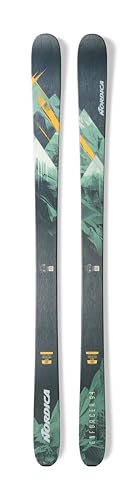
Nordica Enforcer 94
Two sheets of metal over a wood core have made this the benchmark hard charging all mountain ski for years, staying planted when afternoon conditions get chopped up. It carries speed through crud that unsettles lighter skis. Weight and a requirement to keep working come with that stability, so this is not a relaxed cruising ski.
Pros
- Exceptionally stable in chopped up snow
- Holds a line at speed without deflecting
- Enough width for soft snow days
Cons
- Heavy and tiring for less fit skiers
- Needs commitment to bend and turn
Elan Wingman 82 CTi
Elan’s Amphibio profile puts camber on the inside edge and rocker on the outside, which sounds like marketing until it becomes obvious how quickly the ski rolls edge to edge. At 82mm this is a front side carver first, with enough width to cope with a soft afternoon. Price usually sits below its rivals while carving comparably well.
Pros
- Quick and precise edge to edge
- Strong carving performance for the outlay
- Left and right specific shape aids turn initiation
Cons
- Skis are side specific so they cannot be swapped
- Limited float once snow gets deep

Head Kore 93
A light karuba wood core reinforced with graphene produces a ski that swings unusually easily yet still holds together at speed. Skiers who hike for turns or simply do not want a heavy ski on their feet all day tend to favor this build. Heavy chopped snow shows it getting deflected more than the metal skis here.
Pros
- Very light for its width
- Easy to swing in trees and bumps
- Works with touring bindings for uphill days
Cons
- Gets knocked around in heavy crud
- Less damp than metal laminate rivals
How they stack up
| # | Model | Waist width | Best for | Score | Price |
|---|---|---|---|---|---|
| 1 | Rossignol Experience 80 Ci | 80mm | Best overall | 9.4 | Check price |
| 2 | Salomon QST 92 | 92mm | Best all mountain | 9.2 | Check price |
| 3 | K2 Mindbender 89Ti | 89mm | Best for advanced skiers | 9.0 | Check price |
| 4 | Atomic Bent 90 | 90mm | Best for playful skiing | 8.8 | Check price |
| 5 | Nordica Enforcer 94 | 94mm | Best for charging | 8.6 | Check price |
| 6 | Elan Wingman 82 CTi | 82mm | Best value carver | 8.3 | Check price |
| 7 | Head Kore 93 | 93mm | Best lightweight | 8.0 | Check price |
What to look for
What waist width says about where a ski belongs Anything under about 85mm underfoot targets groomed runs, where quick edge to edge movement and grip on firm snow matter most. Roughly 85 to 100mm gives an all mountain ski that trades a little carving precision for float in soft snow. Above 100mm the ski becomes a powder tool that feels sluggish on hard pack. Pick the range matching where you actually ski, not where you hope to ski once a season.
How metal in the layup changes who a ski suits Titanal sheets make a ski damp, stable and grippy at speed, and also heavier and more demanding to bend. Wood, carbon and composite layups without metal stay lighter, more forgiving and easier in tight terrain, at the cost of stability once snow gets rough. Strong, fit skiers usually prefer metal, while improving skiers and anyone prioritising a long day tend to be happier without it.
Why length depends on weight and speed, not just height The old advice of skis reaching your chin or nose works only as a starting point. A heavier or faster skier benefits from more length, and a lighter or more cautious one from less. Rockered skis effectively ski shorter than their stated length since the tips are not in contact with the snow, so sizing runs a few centimetres longer than a fully cambered ski for the same person.
How bindings factor into the buying decision Some skis sell flat and some come as a system with a matched binding, and the two are not interchangeable. Bindings need adjustment to boot sole length and a release value set from height, weight, age and ability, work for a qualified shop technician rather than a garage job. Budget for that fitting when comparing options.
Common questions
What ski width should I choose?
Under 85mm for skiers who mostly stay on groomed runs, 85 to 100mm for all mountain use, and over 100mm if deep snow is a regular part of your season. Most resort skiers in variable conditions land somewhere in the 88 to 95mm range.
How long should my skis be?
Somewhere between your chin and the top of your head works as a rough guide, adjusted for weight, speed and ski type. Heavier and faster skiers size up, lighter and more cautious skiers size down, and heavily rockered skis usually run slightly longer since less of the ski touches the snow.
Do I need metal in my skis?
Only if you ski fast in variable snow and have the strength to work a stiffer ski. Metal adds damping and edge grip but also weight and effort. Many strong skiers happily use metal free skis for the lower weight and easier handling in trees and bumps.
Can beginners use all mountain skis?
Yes, provided the ski sits on the softer, narrower end of the category and is sized appropriately. Beginners should avoid a stiff, metal laminate ski designed for expert speed, since it makes learning harder rather than easier.
Are skis and bindings sold together?
It varies. Some models sell flat for you to choose bindings, and some come as a system package with an integrated binding. Check the listing carefully, since a flat ski at an attractive price still needs bindings and professional mounting.
How often should skis be tuned?
Edges and base structure degrade with use, and most skiers benefit from a tune every ten to twenty days on snow, sooner if you hit a rock. Waxing more frequently keeps the base healthy and the ski gliding, and it is easy to learn at home.
What is turn radius and does it matter?
This is the size of arc a ski’s sidecut naturally wants to make, quoted in metres. A short radius around 13 metres makes quick turns easy, while 18 metres or more suits long fast arcs. Match it to the turn shape you enjoy and the width of the runs you ski.
Should I demo skis before buying?
If possible, yes. Published specifications describe construction but not how a ski feels under your particular weight and technique, and most resorts run demo programmes that credit the cost against a purchase. A single day on a ski reveals more than any spec sheet.
What is the best ski for an intermediate skier?
Rossignol Experience 80 Ci suits intermediates well, since its forgiving flex and damp carbon alloy construction reward improving technique rather than punishing it.
All mountain skis versus carving skis, what is the real difference?
Carving skis run narrower, around 80mm or less, and grip hard snow precisely at the cost of float. All mountain skis widen to roughly 85 to 100mm, trading some edge precision for the ability to handle soft snow and variable terrain in the same run.
Final word
For most resort skiers, Rossignol Experience 80 Ci offers the most useful blend of edge grip, forgiveness and value, and it keeps up as technique improves. Move to Salomon QST 92 for splitting time between groomers and soft snow, and choose Nordica Enforcer 94 only when skiing hard and fast enough to want a ski that fights back.


