Speaker Selector Switches: How Many Zones Do You Need
Pyle’s PSPVC8 leads for whole-house coverage, routing one amplifier to eight rooms with individual volume sliders on each zone. Custom installers reach for the Niles SSVC4, which uses screw-down terminals built for equipment closets. Budget-focused buyers get built-in impedance protection from the Monoprice 4-Zone Speaker Selector without paying for extra zones.
Running speakers into more than one room from a single amplifier used to mean pulling new wire or adding a second amp. A speaker selector switch solves that by routing one amplifier’s output to several speaker pairs, room by room. Options here range from the eight-zone Pyle PSPVC8 down to a no-frills four-zone toggle box.
Overloading an amplifier becomes a real risk once more than two speaker pairs draw power from the same channel. We compared specification sheets, owner feedback, and impedance protection circuitry instead of marketing copy to find switches that actually protect connected gear.
How to choose
What a Speaker Selector Switch Does A speaker selector switch sits between one amplifier and several pairs of speakers. Pressing a button or flipping a switch routes power to whichever rooms you pick. Most units accept four to eight speaker pairs on a single amplifier channel. Wiring runs from each room’s speakers to the selector, then one pair of wires connects back to the amp.
Why Impedance Protection Matters Most home speakers carry an 8 ohm rating. Wiring four or more pairs to one amplifier channel can drop combined impedance below what the amp handles safely. Auto-sensing protection circuitry raises resistance automatically as more zones switch on. Skipping that feature risks tripping an amp’s protection circuit, or damaging output transistors on cheaper units.
How Many Zones Does Your Home Actually Need Apartments and single-floor condos rarely need more than two or four zones. Larger homes with a patio, garage, and several living areas benefit from six to eight zone models like the Pyle PSPVC8. Buying extra zones upfront avoids swapping selectors down the road. Unused zone switches simply stay off and draw no extra power.
Selectors With Volume Control vs Without Basic selector switches route audio through a toggle and nothing else. Models like the Monoprice 4-Zone Speaker Selector add rotary volume knobs so each room’s level adjusts on its own. That independence matters when one room needs background music while another runs at full volume. Selectors without volume control, like the Parts Express switch box, work fine when every zone plays at the same level.
The shortlist, ranked

Pyle PSPVC8
Eight speaker pairs pull from a single amplifier channel through the PSPVC8. Volume sliders on the front panel adjust each room without touching the amp itself. Auto-sensing impedance protection keeps the amplifier stable even when several zones play at once.
Pros
- Feeds up to eight rooms from a single amplifier channel
- Auto-sensing protection guards the amp against overload
- Sliders give each room independent volume control
Cons
- Chassis footprint runs larger than four-zone competitors
- Spring clips cap wire gauge at 16 AWG or thinner
Niles SSVC4
Installers mounting gear inside a wall cavity or closet reach for the SSVC4 first. Screw-down binding posts grip thicker wire than clip-style terminals allow. Each of the four zones gets an independent volume knob and its own on/off switch.
Pros
- Screw terminals accept heavier gauge wire than clips
- Compact chassis tucks into equipment closets easily
- Every zone switches on and off independently
Cons
- Wiring screw terminals takes longer than snapping in clips
- Four zones may fall short in larger homes
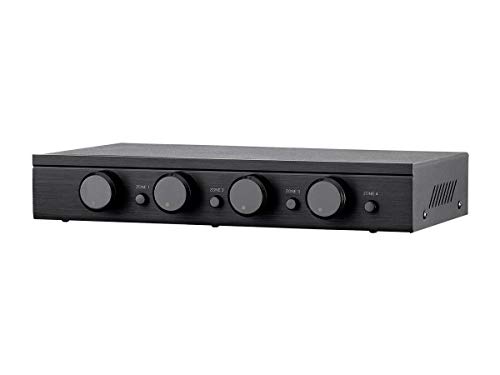
Monoprice 109438 4-Zone Speaker Selector
One amplifier’s signal splits across four rooms through this Monoprice selector. Built-in impedance protection keeps the amp’s load safe once multiple zones play together. Rotary volume knobs on the front panel adjust each room without touching the amplifier.
Pros
- Binding posts accept banana plugs or bare wire ends
- Impedance protection comes standard at this price point
- Rotary knobs allow fine volume adjustment per room
Cons
- Caps out at four zones with no larger version
- Plastic knobs feel less durable than metal alternatives

OSD Audio SS42SM
Two rooms pull audio from any of four connected components through the SS42SM’s source matrix. A black nickel faceplate mounts flush into a single-gang wall box. Push buttons select the active source per room instead of a rear toggle bank.
Pros
- Lets two rooms each choose from four different sources
- Low-profile mount keeps components out of sight
- Faceplate finish matches standard wall plate hardware
Cons
- Covers only two rooms versus four to eight elsewhere
- Needs an in-wall box unlike shelf-mounted selectors

Russound SW6
Six audio sources feed into a multi-room distribution amplifier through the SW6. Its rack-mountable steel chassis suits equipment racks alongside other Russound gear. The unit selects sources rather than speaker zones, pairing with a separate amplifier for room-by-room output.
Pros
- Manages six source components from one control point
- Steel chassis holds up well inside equipment racks
- Integrates with existing Russound multi-zone systems
Cons
- Requires a separate amplifier to handle room switching
- Rack mounting adds setup complexity for casual users

Pyle PSPVC4
Pyle trims the PSPVC8 down to four zones for smaller homes in the PSPVC4. Volume sliders and auto-sensing impedance protection carry over from the larger model. A compact chassis takes up less shelf space than six or eight zone units.
Pros
- Shares impedance protection with pricier Pyle models
- Compact size fits tight equipment shelves
- Every zone gets its own volume slider
Cons
- Four zones only, with no expansion beyond a second unit
- Spring clips limit wire gauge like the PSPVC8

Parts Express 4-Channel Speaker Selector Switch Box
Volume control and impedance protection both disappear from this switch box to keep the design simple. Four toggle switches turn each zone on or off, nothing more. Rear screw terminals accept standard 16 to 18 AWG speaker wire.
Pros
- Toggle operation needs no learning curve at all
- Fewer parts mean fewer potential failure points
- Screw terminals hold wire securely without soldering
Cons
- No impedance protection, so avoid running all four zones on a sensitive amp
- Every zone plays at the same volume with no independent control
Compared at a glance
| # | Model | Zones | Best for | Score | Price |
|---|---|---|---|---|---|
| 1 | Pyle PSPVC8 | 8 pairs | Best overall for eight-room whole-house audio | 9.4 | Check price |
| 2 | Niles SSVC4 | 4 pairs | Best for custom in-wall installs | 9.1 | Check price |
| 3 | Monoprice 109438 4-Zone Speaker Selector | 4 pairs | Best value for four-zone homes | 8.9 | Check price |
| 4 | OSD Audio SS42SM | 4 source x 2 zone matrix | Best for two-room installs with multiple source options | 8.7 | Check price |
| 5 | Russound SW6 | 6 inputs | Best for expanding source count in multi-zone systems | 8.4 | Check price |
| 6 | Pyle PSPVC4 | 4 pairs | Best budget pick for smaller homes | 8.2 | Check price |
| 7 | Parts Express 4-Channel Speaker Selector Switch Box | 4 pairs | Best no-frills pick for simple on/off zone switching | 8.0 | Check price |
Common questions
What does a speaker selector switch do?
It lets one amplifier or receiver feed multiple pairs of speakers spread across different rooms. Front-panel switches turn each room’s speakers on or off independently.
Can I run four pairs of speakers off one amplifier?
Yes, but only with impedance protection built into the selector. Four 8 ohm pairs wired directly to one channel without protection can overload many home receivers.
Do speaker selector switches lower sound quality?
A quality selector with active impedance protection adds negligible loss. Cheaper passive switches without protection can cause volume drops or distortion once multiple zones run together.
Is impedance protection necessary on a speaker selector?
It matters whenever more than two speaker pairs might play at the same time. Owners report fewer amplifier shutdowns and less distortion once protection circuitry is active.
How many zones do I need for whole-house audio?
Most single-floor homes cover their needs with four zones. Larger homes with outdoor areas, a garage, or multiple floors often step up to six or eight zone models such as the Pyle PSPVC8.
Speaker selector switch vs multi-zone amplifier: which is better?
A speaker selector switch uses one amplifier for every zone, keeping wiring simple and cost low. A multi-zone amplifier gives each room its own channel, adding flexibility at the cost of more equipment.
Can a speaker selector switch work outdoors?
Only if both the selector and connected speakers carry a weatherproof rating. Most models compared here, including the Pyle PSPVC8 and Monoprice 4-Zone Speaker Selector, are built for indoor cabinets or closets.
Does a speaker selector switch need its own power source?
No, a passive selector switch draws power from the connected amplifier rather than a wall outlet. It simply reroutes the amplifier’s existing output to whichever zones are switched on.
Which speaker selector switch handles the most rooms?
The Pyle PSPVC8 covers eight rooms from a single amplifier, the highest zone count in this comparison. Four-zone models like the Niles SSVC4 and Monoprice selector suit smaller homes instead.
Final word
A speaker selector switch remains the simplest way to send one amplifier’s output to multiple rooms at once. Models with impedance protection, like the Pyle PSPVC8 and Niles SSVC4, protect connected amplifiers when several zones play together. Match zone count and volume control features to how many rooms actually need independent audio control.


