Tile Cutters for Porcelain, Ceramic and Large Format
The QEP 10630Q manual cutter is our overall pick for its rigid rails and clean snap on ceramic and porcelain. RUBI’s TX-700-N handles large format tiles better than anything else here. For mosaics and awkward angles, the DeWalt D24000S wet saw is the tool to reach for.
The QEP 10630Q leads this roundup because its twin chrome rails and titanium coated wheel deliver consistent scores on porcelain, while the RUBI TX-700-N extends that capability to large format panels and the DeWalt D24000S wet saw takes over where snapping cannot go.
Choosing a tile cutter is tricky because tile hardness varies enormously and a cutter that snaps ceramic cleanly can crumble the edge of dense porcelain. We compared published cut lengths, scoring wheel specifications, rail construction and breaking mechanisms across current models, then weighed what tilers report about rail flex, wheel life and how each machine handles a full day of work.
The top picks, ranked

QEP 10630Q 24 Inch Manual Tile Cutter
This cutter pairs hardened chrome rails with a titanium coated tungsten carbide wheel, giving a score line that snaps cleanly on both ceramic and porcelain. The breaker foot spreads pressure evenly to reduce chipped edges. Owners report it holds accuracy well across a full bathroom or kitchen floor.
Pros
- Clean snaps on dense porcelain
- Rails resist flex under breaking pressure
- Replacement wheels are easy to source
Cons
- Too short for very large format tiles
- No curved or notched cutting

RUBI TX-700-N Manual Tile Cutter
RUBI builds the TX-700-N with an extruded aluminium structure and a separated breaking system that applies force directly over the score. It handles the long modern formats that defeat shorter cutters. The lateral stop and squaring guides make repeat cuts straightforward.
Pros
- Handles long format tiles other cutters cannot
- Very rigid frame keeps scores straight
- Accurate angle and repeat cut guides
Cons
- Bulky to transport between jobs
- Professional pricing

Sigma 3B4M Metric Series Tile Cutter
Sigma uses a pushing scoring action rather than pulling, which many tilers find gives better control on hard porcelain. The swivelling side arm handles repeat angle cuts without remeasuring. Build quality is aimed squarely at daily professional use.
Pros
- Excellent control on hard porcelain
- Repeat angle cuts are quick to set
- Built for continuous professional use
Cons
- Push action takes adjustment if you learned on pull cutters
- Costs well above DIY models

Montolit Masterpiuma P3 Evolution 3 Tile Cutter
Montolit’s scoring wheel and low friction rail system are designed for the dense, glazed porcelain that dulls ordinary wheels quickly. A shock absorbing breaker reduces the chipping that ruins visible edges. It is the specialist choice when the tile is fighting back.
Pros
- Handles the hardest porcelain confidently
- Wheel life is excellent under heavy use
- Smooth, low effort scoring stroke
Cons
- Premium price for occasional users
- Replacement parts are specialist items

QEP 10900Q 35 Inch Manual Tile Cutter
The 10900Q stretches the QEP formula to a longer bed, covering plank format floor tiles that shorter cutters cannot reach. Twin rails and a heavy duty breaker keep the score straight over the full length. It is a sensible middle ground between DIY and professional cutters.
Pros
- Long capacity for plank format tiles
- Padded base protects delicate glazes
- Solid value for the cutting length
Cons
- Long frame needs storage space
- Heavier to carry up stairs
DeWalt D24000S Wet Tile Saw
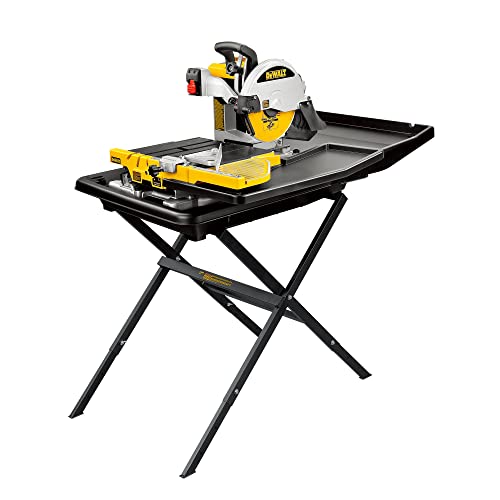
A wet saw handles the cuts a snap cutter cannot: L shapes, notches, mosaics and very hard stone. The D24000S uses a rail cart system for accurate straight cuts and includes a stand option for site work. Water cooling keeps the blade and tile edges clean.
Pros
- Cuts notches, curves and stone
- Accurate rail cart for straight cuts
- Water cooling reduces chipping and dust
Cons
- Messy to set up and clean down
- Heavy and needs a power supply
SKIL 3550-02 7 Inch Wet Tile Saw
This compact wet saw suits bathroom sized projects where a full professional saw is overkill. A sliding side extension supports larger tiles, and the water reservoir contains most of the spray. It is easy to carry and store between projects.
Pros
- Light enough to carry one handed
- Handles notches and curves affordably
- Sliding extension supports bigger tiles
Cons
- Small motor struggles with thick stone
- Slower cutting than professional saws
How they stack up
| # | Model | Cut length | Best for | Score | Price |
|---|---|---|---|---|---|
| 1 | QEP 10630Q 24 Inch Manual Tile Cutter | 24 inch straight, 16 inch diagonal | Best overall | 9.4 | Check price |
| 2 | RUBI TX-700-N Manual Tile Cutter | About 27 inch straight | Best for large format | 9.2 | Check price |
| 3 | Sigma 3B4M Metric Series Tile Cutter | About 21 inch straight | Best precision | 9.0 | Check price |
| 4 | Montolit Masterpiuma P3 Evolution 3 Tile Cutter | Model dependent, long format capable | Best for hard porcelain | 8.8 | Check price |
| 5 | QEP 10900Q 35 Inch Manual Tile Cutter | 35 inch straight, 24 inch diagonal | Best for long floor tiles | 8.6 | Check price |
| 6 | DeWalt D24000S Wet Tile Saw | 10 inch diamond blade | Best wet saw | 8.3 | Check price |
| 7 | SKIL 3550-02 7 Inch Wet Tile Saw | 7 inch diamond blade | Best budget wet saw | 8.0 | Check price |
How to choose
Manual cutter or wet saw depends on the cuts you need A manual snap cutter is faster, quieter and dust free for straight cuts, which covers most of a typical floor or wall. A wet saw is essential for L shaped cuts around door frames, notches for pipes, mosaics and natural stone. Many tilers own both and use the snap cutter for volume work, reserving the saw for the awkward pieces.
Measure your largest tile before choosing a cutter Cut length is the specification that will stop you dead. A twenty four inch cutter cannot handle a thirty two inch plank tile, and the diagonal capacity is always shorter than the straight capacity. Check both figures against the biggest tile in your order, including any diagonal cuts your layout requires.
Rail rigidity and wheel quality determine cut quality Flex in the rails lets the scoring wheel wander, producing a shallow or wavy line that breaks badly. Look for twin hardened rails or a reinforced extrusion, and a tungsten carbide wheel with a coating suited to porcelain. Owners report that replacing a worn scoring wheel restores cut quality more often than any other single fix.
Work safely and practise on offcuts Tile edges are sharp and porcelain shards travel, so eye protection and gloves are basic requirements. Wet saws add water near electricity, which makes a residual current device essential. Before cutting visible pieces, score and snap a couple of offcuts to check wheel pressure, because a single confident pass generally beats several light passes.
Frequently asked questions
Can a manual tile cutter handle porcelain?
Good ones can. Porcelain is denser than ceramic, so it needs a sharp titanium or tungsten carbide wheel, rigid rails and firm even breaking pressure. Very hard rectified porcelain is easier on a wet saw.
Why is my tile breaking off the score line?
Usually the score is too shallow, the wheel is worn, or the breaking pressure is off centre. One firm continuous scoring pass works better than repeated light passes, which can create parallel lines that confuse the break.
Do I need a wet saw for a small bathroom?
Not necessarily, but you will want one for pipe notches and outlet cutouts. A compact saw such as the SKIL 3550-02 covers those without the bulk of a professional machine.
How often should I change the scoring wheel?
Wheels wear gradually and the first sign is needing more pressure for the same score. Keeping a spare on hand is worthwhile because a fresh wheel transforms cut quality instantly.
What is the difference between a snap cutter and a rail cutter?
The terms overlap. Both score the glaze and then break the tile along that line. Better rail cutters use hardened twin rails and a separated breaking system that applies force directly over the score for cleaner results.
Can I cut natural stone with a manual cutter?
Generally no. Marble, granite and slate do not have the uniform structure that lets a score line propagate cleanly, so they need a diamond blade wet saw.
How do I cut a hole for a pipe?
Use a diamond hole saw for round holes, or nibble the shape with tile nippers after scoring the outline. A wet saw can also make relief cuts that let you snap out a notch.
Does wet cutting reduce dust?
Substantially. Water suppresses the silica dust that dry cutting produces, which is a genuine health consideration. Even so, good ventilation and a properly fitted mask remain sensible when cutting tile.
The bottom line
The QEP 10630Q is the cutter most home projects should start with because it snaps porcelain cleanly without professional pricing. Step up to the RUBI TX-700-N when large format tiles are involved, and add a wet saw such as the DeWalt D24000S once notches, curves and stone enter the job.