Under Sink Water Filters That Fit Real Cabinets
The Aquasana AQ-5200 Claryum is our top pick for straightforward carbon filtration with a compact footprint. The Waterdrop 17UB is the easiest to live with thanks to twist off cartridges, and the APEC ROES-50 Essence is the reverse osmosis system to choose when you want the deepest reduction claims.
For most kitchens the Aquasana AQ-5200 is the sensible starting point, with the Waterdrop 17UB winning on cartridge changes and the APEC ROES-50 Essence covering people who want reverse osmosis.
Under sink filters look interchangeable in listings but they differ enormously in what they actually reduce, how much cabinet space they eat and how often you are on your knees swapping cartridges. We compared these seven on published certification claims, stated cartridge life, flow rate, footprint and whether the system needs a drilled hole for a separate faucet, drawing on manufacturer specifications and the maintenance patterns owners report.
The top picks, ranked

Aquasana AQ-5200 Claryum 2-Stage Under Sink Water Filter
The AQ-5200 is a two stage carbon block system that connects to a dedicated faucet and publishes a long list of tested reduction claims. It does not use reverse osmosis, so it leaves naturally occurring minerals in the water and wastes nothing down the drain. Owners report the taste change is the most obvious benefit, particularly on chlorinated municipal supplies.
Pros
- Broad published contaminant reduction list
- No waste water and no storage tank
- Compact enough for a crowded cabinet
Cons
- Needs a hole drilled for the separate faucet
- Cartridges are proprietary and add up over time

Waterdrop 17UB Under Sink Water Filter System
Waterdrop’s direct connect design lets you swap the cartridge with a quarter turn and no tools, which is the single biggest quality of life difference in this category. It runs at a high flow rate so filling a pot does not feel slow, and the compact body leaves room for cleaning supplies. Filter life is long enough that most households change it once a year.
Pros
- Tool free twist off cartridge changes
- Small footprint under the sink
- Long stated cartridge life
Cons
- Single stage does less than multi stage rivals
- Replacement cartridges only come from Waterdrop
APEC Water Systems ROES-50 Essence Reverse Osmosis System
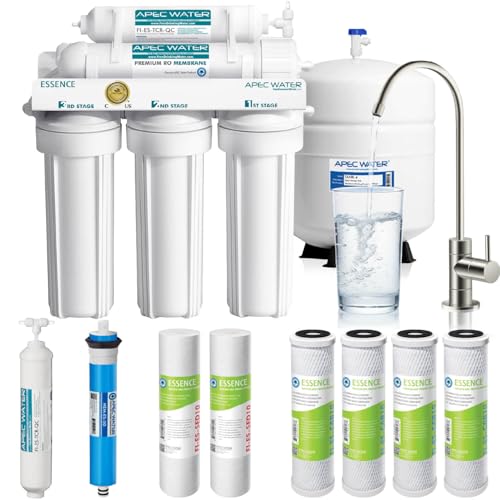
The ROES-50 is the reverse osmosis system most often recommended for first time buyers because the parts are standard sizes and the instructions are clear. Five stages plus a storage tank give it the strongest reduction claims here, at the cost of cabinet space and some water sent to the drain. Owners report that once it is plumbed in, upkeep is a straightforward annual cartridge change.
Pros
- Deepest reduction claims on this list
- Uses standard size replacement cartridges
- Well documented installation guide
Cons
- Tank and manifold take up most of a cabinet
- Sends water to the drain while producing

iSpring RCC7AK 6-Stage Reverse Osmosis System
Reverse osmosis strips minerals along with everything else, and some people find the result tastes flat. The RCC7AK adds a final alkaline remineralisation stage to put calcium and magnesium back, which softens that effect. It is otherwise a conventional RO setup with a tank, so budget the same cabinet space you would for any full system.
Pros
- Remineralisation stage improves flat RO taste
- Higher daily output than most home systems
- Clear stage by stage cartridge labelling
Cons
- Six stages means more cartridges to buy
- Installation takes longer than a carbon system

Frizzlife SP99 Under Sink Water Filter System
The SP99 mounts flat against the cabinet wall and uses a quick change cartridge that releases with a push button, so it suits sinks where a garbage disposal has already claimed the space. It is a two stage carbon design that feeds your existing faucet by default, which avoids drilling. Flow is strong enough that you will not notice a filter is fitted.
Pros
- No extra faucet hole needed
- Push button cartridge release
- Slim shape fits around a disposal unit
Cons
- Filters everything at the tap including hot water use
- Fittings need careful checking for drips after install

Culligan US-EZ-4 EZ-Change Under Sink Filtration System
Culligan’s EZ-Change is the low commitment option, a small three stage unit with a cartridge that clips in and out in seconds and an indicator light that tells you when to change it. Reduction claims are more modest than the systems above, focusing on chlorine taste and odour plus lead and cyst reduction. For renters and short stays it is hard to beat on effort.
Pros
- Fast clip in cartridge changes
- Change reminder takes the guesswork out
- Cheapest way into under sink filtration here
Cons
- Shorter cartridge life than rivals
- Fewer published reduction claims

Filtrete 3US-PS01 Standard Under Sink Water Filtration System
This 3M made system is about as simple as under sink filtration gets, a single housing that ties into the cold line and feeds the faucet you already have. There is no drilling, no tank and very little to go wrong. Reduction is limited to sediment, chlorine taste and odour and a few particulates, so treat it as a taste improver rather than a deep treatment system.
Pros
- Simplest installation on this list
- Very small cabinet footprint
- Widely stocked replacement cartridges
Cons
- Limited range of reduction claims
- Single stage clogs faster on sediment heavy supplies
How they compare
| # | Model | Type | Best for | Score | Price |
|---|---|---|---|---|---|
| 1 | Aquasana AQ-5200 Claryum 2-Stage Under Sink Water Filter | Two stage carbon block | Best overall | 9.4 | Check price |
| 2 | Waterdrop 17UB Under Sink Water Filter System | Carbon block, single cartridge | Best value | 9.2 | Check price |
| 3 | APEC Water Systems ROES-50 Essence Reverse Osmosis System | Five stage reverse osmosis | Best reverse osmosis | 9.0 | Check price |
| 4 | iSpring RCC7AK 6-Stage Reverse Osmosis System | Six stage reverse osmosis with alkaline stage | Best for taste after RO | 8.8 | Check price |
| 5 | Frizzlife SP99 Under Sink Water Filter System | Two stage carbon with sediment pre filter | Best for tight cabinets | 8.6 | Check price |
| 6 | Culligan US-EZ-4 EZ-Change Under Sink Filtration System | Three stage carbon | Best budget | 8.3 | Check price |
| 7 | Filtrete 3US-PS01 Standard Under Sink Water Filtration System | Single stage carbon | Best for simple installs | 8.0 | Check price |
How to choose
Start with what is actually in your water Municipal suppliers publish an annual water quality report, and well owners can send a sample for testing. That report tells you whether you need broad reverse osmosis reduction or just a carbon filter for chlorine taste and odour. Buying a five stage system for water that only tastes of chlorine means paying for cartridges you did not need, and buying a single stage carbon filter when you have a specific contaminant concern leaves the problem unsolved.
Measure the cabinet before you choose a type Reverse osmosis systems need room for a manifold, a four gallon pressurised tank and a drain saddle, and that is a real problem in a sink base already holding a disposal unit and cleaning supplies. Carbon systems are usually one or two canisters that mount to the side wall. Take a tape measure to the cabinet, note where the shut off valves and the disposal sit, and shop to that space rather than hoping it fits.
Decide whether you want a second faucet Systems that feed a dedicated faucet keep filtered water separate, so you are not sending expensive cartridge life down the drain washing dishes. The catch is drilling a hole in the countertop, which is straightforward in laminate and stainless but a job for a professional in granite or quartz. Inline systems that feed the existing tap avoid the hole entirely but burn through cartridges faster because every drop passes through the filter.
Budget for cartridges, not just the system The purchase is a one time event and the cartridges are forever. Check the stated life in gallons rather than months, since a household of four runs through capacity far faster than a couple, and confirm whether the system takes standard ten inch cartridges or proprietary ones. Standard sizes give you choice later, while proprietary designs usually trade that flexibility for faster, cleaner changes.
Questions worth asking
Do under sink water filters remove lead?
Some do and some do not. Look for a specific published lead reduction claim rather than assuming, since a basic carbon filter aimed at chlorine taste will not necessarily handle lead. Reverse osmosis systems and multi stage carbon block units like the Aquasana are the ones that usually carry that claim.
How often do the filters need changing?
Carbon cartridges typically run six to twelve months, and reverse osmosis pre filters are usually annual with the membrane lasting two to four years. Those are estimates based on average use, so a large household or sediment heavy supply will shorten them noticeably.
Will a filter reduce my water pressure?
A little, and it becomes obvious once a cartridge is near the end of its life. Reverse osmosis systems deliver from a storage tank, so the flow feels slower and can run out briefly if you fill several large pots in a row. Direct flow carbon filters are closer to normal tap pressure.
Can I install an under sink filter myself?
Carbon systems that tap the cold supply are within reach for most people with basic tools, especially the ones using push fit fittings. Reverse osmosis adds a drain saddle and a tank, which takes longer and is where mistakes tend to show up as slow leaks. Check under the sink for the first week either way.
Does reverse osmosis waste water?
Yes. RO systems send some water to the drain while producing filtered water, and typical home systems use several gallons for every gallon they make. Carbon only systems waste none, which is one reason they still make sense for households that just want better tasting water.
Do these filters soften hard water?
No. Softening is an ion exchange process that needs a separate appliance, usually plumbed in where the supply enters the house. Under sink filters improve taste and reduce specific contaminants but will not stop limescale in your kettle.
Should I get a filter with a separate faucet or one that uses my existing tap?
A separate faucet stretches cartridge life because only drinking and cooking water passes through the filter. Using your existing tap avoids drilling the countertop and is the practical choice for renters or stone worktops, but expect to change cartridges more often.
Is filtered water from these systems safe for babies and pets?
Filtered tap water is generally used the same way as the tap water it came from, so the answer depends on your local supply rather than the filter. If you have a specific health concern or an untested private well, get the water tested and speak to your doctor or vet rather than relying on a filter’s marketing claims.
The bottom line
The Aquasana AQ-5200 is the under sink filter we would fit in most kitchens, because it publishes serious reduction claims without a tank, a drain line or wasted water. Pick the Waterdrop 17UB if you want the lowest maintenance effort, and step up to the APEC ROES-50 Essence when your water report shows problems that only reverse osmosis will address.