Under Desk Footrests That Actually Ease Leg Strain
The ErgoFoam Ergonomic Foot Rest leads for its dense high rebound foam and washable cover. The Kensington SoleMate Comfort Footrest is the value pick thanks to its wide platform and easy height lever. For adjustable angles on a tight budget, the HUANUO Adjustable Under Desk Footrest is the one to shortlist.
If you want one footrest that suits most desks and most body types, the ErgoFoam Ergonomic Foot Rest is the safest choice, with the Kensington SoleMate Comfort Footrest and HUANUO Adjustable Under Desk Footrest close behind. All three lift your feet enough to take pressure off the back of your thighs.
Footrests look interchangeable in listings, but they are not. A cushion that feels plush on day one can flatten within weeks, and a platform that is too narrow forces your feet into one fixed position. We compared published dimensions, height and tilt ranges, foam type and cover material, then weighed those against what owners report about sagging, sliding and long term shape retention.
Our top picks
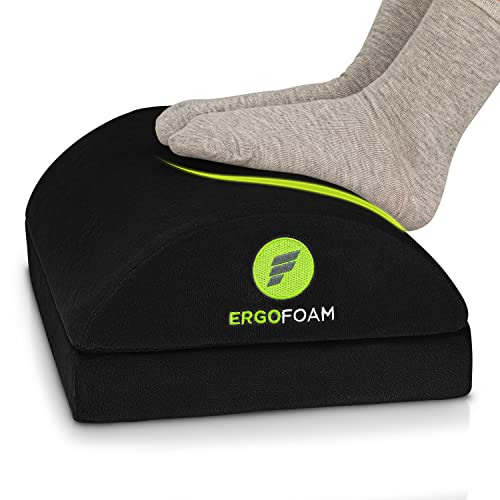
ErgoFoam Ergonomic Foot Rest
A large wedge of high rebound foam with a removable velvet cover, sized to hold both feet flat without crowding. The sloped top puts ankles at a relaxed angle rather than forcing a hard bend. Owners report it keeps its shape far longer than generic memory foam blocks.
Pros
- Foam resists flattening better than most rivals
- Wide enough for size 13 feet side by side
- Cover unzips for machine washing
Cons
- No height or tilt adjustment
- Bulky to store when not in use
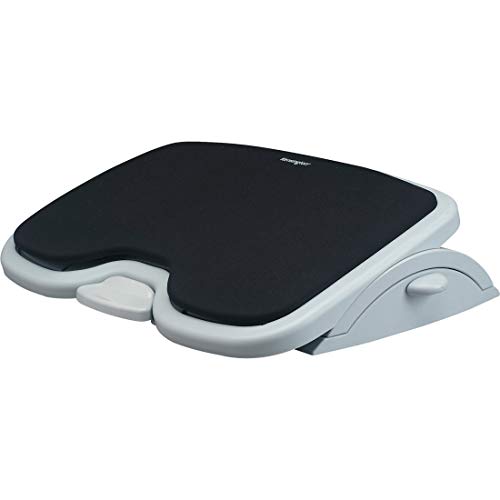
Kensington SoleMate Comfort Footrest
A rigid platform with a foot operated height lever, so you can change position without bending down. The surface is contoured and textured to keep shoes and socked feet from sliding forward. It suits shared desks where several people need different settings during the day.
Pros
- Height changes without reaching under the desk
- Textured deck grips both shoes and bare feet
- Sturdy enough to lean weight into
Cons
- Hard surface offers no cushioning
- Platform is shallower than foam wedges

HUANUO Adjustable Under Desk Footrest
A metal framed rest that swings through a wide arc of angles and locks at several heights. Rubber pads on the deck stop feet sliding when the tilt is steep. It is a good match for taller desks where a cushion alone does not lift feet far enough.
Pros
- Rocking action encourages ankle movement
- Lifts feet higher than most foam wedges
- Locks solid when you want a static angle
Cons
- Assembly required out of the box
- Frame can squeak on hard floors

Everlasting Comfort Foot Rest Under Desk
A memory foam wedge with a soft mesh cover that breathes better than velvet in warm rooms. The contour cradles the arch rather than sitting flat under the heel, which owners report helps on long stretches at a desk. It works best on carpet where the base has something to bite into.
Pros
- Mesh cover stays cooler than plush fabrics
- Contour supports the arch as well as the heel
- Light enough to move between rooms
Cons
- Memory foam softens in warm offices
- Can creep forward on smooth hard floors

Fellowes Standard Foot Rest
A no frills moulded platform with a fixed slope and a textured deck. There is nothing to adjust, break or reassemble, which is part of the appeal for a second desk or a home office that rarely changes. Based on specifications it is among the lightest rigid rests here.
Pros
- Nothing to assemble or adjust
- Very light to reposition
- Ribbed deck grips socks well
Cons
- One fixed angle only
- Plastic shell feels less substantial than metal rivals

3M Adjustable Foot Rest FR330B
This one focuses on precise angle control, with a tilt mechanism you set with your foot and a broad platform that stays put once locked. The rubberised surface handles bare feet better than most hard decks. It is a sensible pick if your discomfort is more about ankle angle than height.
Pros
- Angle changes without using your hands
- Comfortable underfoot without shoes
- Stable base resists tipping
Cons
- Limited overall height gain
- Rubber deck attracts dust and lint

StrongTek Under Desk Footrest Wooden Rocker
A curved plywood rocker that lets you flex your ankles continuously while you work. There is no foam and no height adjustment, so it suits people who want motion rather than cushioning. Owners report it doubles as a balance board away from the desk.
Pros
- Constant gentle ankle motion
- Solid wood build with no parts to fail
- Works as a standing balance board too
Cons
- No cushioning at all
- Rocks away if you push it too hard
How they compare
| # | Model | Type | Best for | Score | Price |
|---|---|---|---|---|---|
| 1 | ErgoFoam Ergonomic Foot Rest | Fixed wedge cushion | Best overall | 9.4 | Check price |
| 2 | Kensington SoleMate Comfort Footrest | Rigid adjustable platform | Best value | 9.2 | Check price |
| 3 | HUANUO Adjustable Under Desk Footrest | Metal frame with rocking deck | Best for adjustable angles | 9.0 | Check price |
| 4 | Everlasting Comfort Foot Rest Under Desk | Contoured foam wedge | Best for all day sitting | 8.8 | Check price |
| 5 | Fellowes Standard Foot Rest | Fixed slope platform | Best budget | 8.6 | Check price |
| 6 | 3M Adjustable Foot Rest FR330B | Tilt adjustable platform | Best for tilt control | 8.3 | Check price |
| 7 | StrongTek Under Desk Footrest Wooden Rocker | Curved wooden rocker | Best for active movement | 8.0 | Check price |
How to choose
Start with your chair, not the footrest A footrest only fixes a mismatch between your chair height and your leg length. Set the chair so your forearms sit level with the desk first, then measure the gap under your feet. If that gap is under three inches, a foam wedge is usually enough. Anything larger and you want a rigid platform with real height adjustment, because a thin cushion will simply compress under load.
Foam density matters more than thickness A tall block of soft memory foam feels great for a week and then bottoms out. High rebound foam keeps pushing back, which is why the denser options here score higher. If a listing quotes only dimensions and never mentions foam type, treat that as a gap. Owners report the clearest sign of cheap fill is a permanent heel dent that never recovers overnight.
Grip depends on your floor Rubber dots and textured bases work well on carpet but slide on sealed hardwood and laminate. If you sit on a hard floor or a plastic chair mat, favour a heavier rigid platform or a model with a full rubber underside rather than scattered grip pads. A rest that creeps forward every few minutes is more distracting than no rest at all.
Decide whether you want motion or support Rockers and tilting decks keep your ankles moving, which some people find keeps their legs from stiffening. Fixed wedges and cushions do the opposite and hold one supported position. Neither is universally better. If you fidget anyway, a rocker suits you. If you want your feet to stay planted while you concentrate, pick a wedge or a locking platform.
Common questions
How high should an under desk footrest be?
Aim for a height that leaves your knees at roughly a right angle with your thighs level or very slightly sloped down. For most desks that means somewhere between three and six inches of lift, which is why adjustable platforms suit more people than fixed cushions.
Do footrests help with lower back pain?
They can help indirectly. Raising your feet reduces the forward pelvic tilt that comes from dangling legs, which lets you sit further back in the chair. It is not a treatment, and persistent pain is worth discussing with a clinician rather than solving with accessories alone.
Foam wedge or rigid platform?
Foam is quieter, needs no assembly and feels softer underfoot. Rigid platforms lift higher, adjust in defined steps and never compress. If your desk is fixed height and clearly too tall, choose rigid. If you just want relief from pressure behind the knees, foam is fine.
Will a footrest slide on hardwood floors?
Lighter foam models often do. Look for a full rubber base rather than a few grip dots, or place the rest on a small area rug. Rigid metal framed models are heavier and tend to stay put better on smooth surfaces.
Can I use one with a standing desk?
Yes, though the job changes. When standing, a rocker or a low anti fatigue slope is more useful than a tall wedge. Several rockers here double as balance boards, which makes them the more flexible choice for a sit stand setup.
How do I clean a fabric covered footrest?
Check whether the cover unzips. Removable velvet and mesh covers usually go in a cold machine wash and air dry. Foam itself should never be soaked, so spot clean the core with a damp cloth and let it dry fully before refitting the cover.
Are footrests worth it for short desks?
Less so. If your feet already rest flat on the floor with your knees at a comfortable angle, a footrest mainly adds a place to shift position. A low rocker still has value for movement, but a tall wedge will push your knees up and undo the benefit.
Do these fit under a standard desk drawer?
Most do, but check the maximum height in the listing against your clearance. Metal framed adjustable models are the tallest at full extension, and a shallow keyboard drawer can limit how far you tilt the deck toward you.
Our take
The ErgoFoam Ergonomic Foot Rest is the pick for most desks because dense high rebound foam keeps working long after cheaper cushions have flattened. If your desk is genuinely too tall, step up to the Kensington SoleMate Comfort Footrest or the HUANUO Adjustable Under Desk Footrest for real height and tilt control. Anyone who fidgets while thinking should look at the StrongTek rocker instead.


