Which Washable Aquarium Air Pump Fits Your Tank Size
Tetra Whisper 60 Air Pump balances airflow and quiet running for most single-tank setups. Hygger Quiet Submersible Aquarium Air Pump suits nano tanks needing a fully rinseable housing. Uniclife Aquarium Air Pump adds dual adjustable outlets for less money. All three include washable filter components.
Tetra Whisper 60 Air Pump fits owners running a single 40 to 60 gallon tank who want quiet operation and a filter pad that rinses in seconds. It falls short for anyone needing two outlets or a fully submersible design.
Airflow, noise level and outlet count pull in different directions once tank size enters the picture. Manufacturer specs, owner feedback on noise and how each pump’s washable parts hold up to rinsing shaped this ranking.
Our top picks

Tetra Whisper 60 Air Pump
A piston-driven motor in the Whisper 60 handles tanks up to 60 gallons, pushing roughly 1.7 L/min of airflow at a claimed 35 dB. Its plastic housing wipes clean while the intake filter pad rinses under a tap. One barbed outlet connects straight to airline tubing without extra fittings.
Pros
- Rated for tanks up to 60 gallons
- Intake filter pad rinses clean under running water
- Claimed 35 dB keeps operation quiet per the listing
Cons
- Single outlet limits it to one air stone or sponge filter
- Housing itself is not submersible, only the filter pad washes

Hygger Quiet Submersible Aquarium Air Pump
Owners can pull this pump fully out of the tank and rinse the entire housing, not just a filter pad. Output lands near 600 mL per minute, matched to nano and desktop tanks between 1 and 15 gallons. A low 2.5W draw keeps claimed noise under 30 dB.
Pros
- Fully submersible housing rinses clean in the sink
- Compact size fits nano and desktop tanks
- Claimed noise stays under 30 dB per the listing
Cons
- Output runs too low for tanks over 15 gallons
- Single outlet leaves no way to run two air stones
Uniclife Aquarium Air Pump
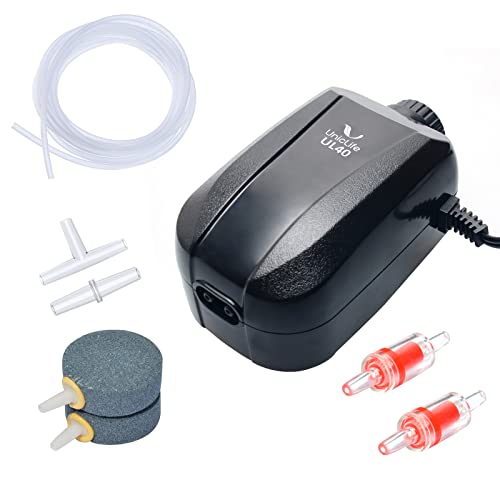
Two adjustable outlets on this pump split output for tanks up to 100 gallons combined, each with its own flow valve. Rated airflow reaches near 3.5 L/min at 5W of draw. A removable diaphragm cover and foam intake filter both rinse under a tap.
Pros
- Two independently adjustable outlets included
- Removable diaphragm cover and filter rinse clean
- Rated for tanks up to 100 gallons combined
Cons
- Noise climbs to about 40 dB at full flow
- Included airline tubing runs shorter than competing kits

EHEIM Air Pump 200
EHEIM rates this piston pump at 200 liters per hour, suited to aquariums around 50 gallons. Diaphragm and membrane parts are replaceable and washable, a design carried across EHEIM’s air pump line for years. One outlet feeds an air stone or sponge filter through standard 4mm tubing.
Pros
- Replaceable, washable diaphragm and membrane parts
- Compact housing tucks behind a stand or cabinet
- Claimed 32 dB keeps running noise low
Cons
- Single outlet only, no dual-tank option
- Replacement membranes require a separate purchase

Pawfly Aquarium Air Pump
Pawfly packs two outlets into a compact housing rated for tanks up to 30 gallons combined. Draw stays low at 2W, and the foam intake filter pulls out for rinsing. Rubber feet cut vibration noise against glass or wood stands.
Pros
- Two outlets on a budget-priced unit
- Low 2W power draw saves on running cost
- Rubber feet reduce vibration noise on stands
Cons
- Combined 1.5 L/min output is modest for larger tanks
- Only the intake filter washes, not the full housing

Aquaneat Commercial Air Pump
Four adjustable outlets route air from this commercial pump, built for fish rooms running several tanks or one aquarium over 150 gallons. Combined output reaches roughly 8 L/min at 8W. A metal-reinforced diaphragm assembly unscrews for cleaning, and the foam pre-filter rinses separately.
Pros
- Four outlets cover multiple tanks from one pump
- Rated for aquariums over 150 gallons
- Diaphragm assembly and pre-filter both rinse clean
Cons
- Noise climbs to about 45 dB, noticeable in a quiet room
- Bulkier housing takes up more cabinet space
VIVOSUN Aquarium Air Pump
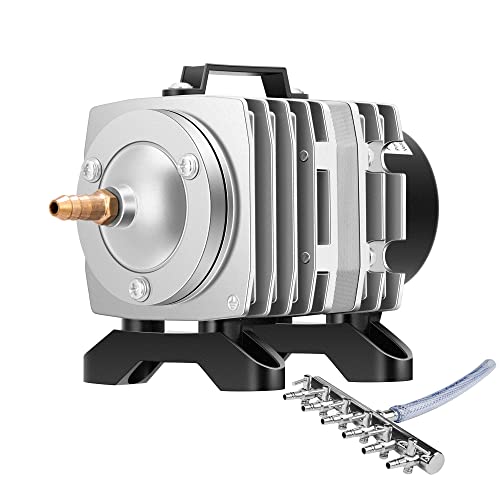
Independent flow adjustment on each side of this dual-outlet pump covers tanks up to 120 gallons combined. Sound-dampening rubber feet and an internal shock pad keep operation near a claimed 35 dB. An intake filter cartridge slides out for rinsing under a tap.
Pros
- Independently adjustable dual outlets
- Sound-dampening feet keep noise near 35 dB
- Slide-out filter cartridge rinses easily
Cons
- 6W draw runs higher than single-outlet competitors
- No submersible option, housing stays outside the tank
What to look for
What Washable Actually Means on an Air Pump Some pumps submerge fully, letting owners rinse the entire housing under a tap. Others keep the motor dry, with only an intake filter pad or diaphragm cover coming apart for cleaning. Both designs cut down on algae and mineral buildup that clogs airflow over time. Check which type a listing describes before assuming the whole unit can go underwater.
Matching Airflow to Tank Size A single-outlet pump rated near 1.5 to 2 L/min covers most tanks up to 30 gallons. Larger aquariums running a sponge filter alongside an air stone need a dual-outlet pump with 3 L/min or more combined. Undersized pumps struggle to keep a sponge filter’s biological media oxygenated, so rounding up beats rounding down.
Best Air Pumps for Quiet Bedrooms and Living Rooms Noise ratings on listings usually reflect a pump running on a hard surface, so actual bedroom noise depends on placement too. Setting a pump on a foam pad or towel cuts vibration noise further than the rated dB figure suggests. Pumps under 35 dB generally suit a nightstand, while units near 40 to 45 dB fit a garage, basement or fish room better.
Do You Need a Dual-Outlet or Multi-Tank Pump? Fish rooms or households running more than one tank benefit from a four-outlet commercial pump instead of several separate units. That convenience trades off against power draw, since larger commercial pumps run louder and pull more watts. Anyone keeping a single small nano tank should skip multi-outlet options and pick a compact submersible pump instead.
Compared at a glance
| # | Model | Airflow | Best for | Score | Price |
|---|---|---|---|---|---|
| 1 | Tetra Whisper 60 Air Pump | 1.7 L/min | Best overall | 9.4 | Check price |
| 2 | Hygger Quiet Submersible Aquarium Air Pump | 600 mL/min | Best for nano tanks | 9.1 | Check price |
| 3 | Uniclife Aquarium Air Pump | 3.5 L/min combined | Best value | 8.8 | Check price |
| 4 | EHEIM Air Pump 200 | 200 L/hr (3.3 L/min) | Best for washable diaphragm maintenance | 8.6 | Check price |
| 5 | Pawfly Aquarium Air Pump | 1.5 L/min combined | Best budget | 8.4 | Check price |
| 6 | Aquaneat Commercial Air Pump | 8 L/min combined | Best for multiple tanks or large aquariums | 8.2 | Check price |
| 7 | VIVOSUN Aquarium Air Pump | 5 L/min combined | Best for quiet bedroom use | 8.0 | Check price |
Frequently asked questions
How often should I wash an aquarium air pump filter?
Rinse the intake pad or foam filter every two to four weeks, sooner if airflow noticeably slows. A clogged filter forces the motor to work harder, which can shorten its lifespan.
What is a good noise level for an air pump?
Listings rated under 35 dB generally suit a bedroom or living room. Pumps near 40 to 45 dB fit better in a basement, garage or fish room.
Can submersible air pumps go fully underwater?
Yes, pumps marketed as submersible, like the Hygger Quiet Submersible Air Pump, run fully inside the tank. Non-submersible pumps should stay outside the aquarium, with only their filter pad or diaphragm cover getting rinsed.
Which air pump works best for a nano tank?
Hygger’s Quiet Submersible Air Pump suits nano and desktop tanks between roughly 1 and 15 gallons, since its output stays low enough to avoid overwhelming a small volume of water.
Are dual outlet air pumps better than single outlet pumps?
Dual outlet pumps let one unit run a sponge filter and an air stone at the same time, something single-outlet pumps can’t do. They typically draw more power and cost a bit more than single-outlet models.
Air pump vs powerhead, which one do I need for oxygenation?
Air pumps introduce oxygen through bubbles and agitate the surface, while powerheads move water without adding air directly. Tanks relying on sponge filters generally need an air pump, since the filter’s airlift depends on it.
What size air pump do I need for a 55 gallon tank?
A single-outlet pump rated for at least 60 gallons, like the Tetra Whisper 60, gives a 55 gallon tank airflow with some headroom. Pumps rated only for 20 or 30 gallon tanks won’t move enough air for that size.
How do I clean the diaphragm on an air pump?
Unscrew the housing per the manufacturer’s instructions, lift out the rubber diaphragm, and rinse it under lukewarm water without soap. EHEIM’s Air Pump 200 uses a replaceable diaphragm design that makes this swap straightforward.
Do washable air pumps work for saltwater tanks?
Yes, washable air pumps work in saltwater tanks the same way they do in freshwater, though salt creep around the outlet needs more frequent wiping. Rinse the filter pad or housing with fresh water, not saltwater, to avoid mineral buildup.
How long do aquarium air pumps typically last?
A well-maintained air pump with a washable or replaceable diaphragm often runs for several years. Regular rinsing of the intake filter and diaphragm, as with the EHEIM Air Pump 200, extends that lifespan.
Our pick
Tetra Whisper 60 Air Pump suits most single-tank owners who want quiet, reliable airflow and a filter pad that rinses clean in minutes. Nano or desktop tank owners should look at the Hygger Quiet Submersible Air Pump instead, since its fully rinseable housing fits smaller volumes better. Fish rooms running several tanks get more from the Aquaneat Commercial Air Pump and its four adjustable outlets.