Choosing an Adjustable Weight Bench for Home Training
The Rep Fitness AB-3000 ranks highest for its heavy-gauge steel frame and commercial-grade stability under load. Flybird’s Adjustable Weight Bench offers the best value, with a foldable design suited to moderate home training. Bowflex’s 3.1S Adjustable Bench provides the widest range of incline and decline angles among lower-priced options.
The Rep Fitness AB-3000 is the strongest all-around pick, thanks to its heavy-gauge steel frame and multiple back angles including decline. Flybird’s Adjustable Weight Bench delivers the best value for folding home use. Bowflex’s 3.1S Adjustable Bench stands out for its wide spread of incline and decline positions.
Weight bench specs can be misleading because listings rarely mention the seat-to-back pad gap or the folded dimensions. A bench rated for a high capacity can still rock under uneven loads if the frame gauge is thin. We compared these seven models on adjustability, weight capacity, frame stability and storage footprint, drawing on published specifications and patterns in owner feedback.
The best picks, ranked

Rep Fitness AB-3000
Heavy-gauge steel construction gives the AB-3000 a commercial feel that owners describe as steady under heavy barbell loads. Multiple back and seat angles, including a decline setting, cover most pressing and core exercises. Its fixed frame does not fold, so the tradeoff for that stability is a larger permanent footprint.
Pros
- Steady under heavy loads
- Wide range of back and seat angles
- Minimal seat-to-back pad gap
Cons
- Does not fold for storage
- Heavier to reposition than folding benches

Flybird Adjustable Weight Bench
Flybird’s bench folds flat for storage while still offering several incline and decline positions. Owners frequently note its stability relative to its light frame and low weight. Moderate loads suit it better than maximal barbell pressing.
Pros
- Budget-friendly price point
- Folds flat for storage
- Stable relative to its weight
Cons
- Best suited to moderate loads
- Shorter pad than fixed-frame benches
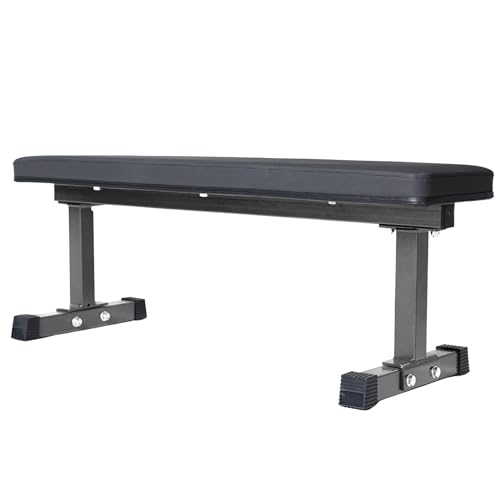
Rep Fitness FB-3000 alternative from FINER FORM
This FINER FORM bench adds a leg-anchor roller system for sit-ups and leg extensions alongside standard incline and decline pressing. Built-in rollers expand the exercise list beyond typical pressing benches. Extra hardware makes the frame bulkier than plain adjustable models.
Pros
- Covers a wider exercise range
- Leg rollers support core training
- Solid steel frame
Cons
- Bulkier than plain adjustable benches
- Rollers add setup steps

RitFit Adjustable Weight Bench
RitFit’s folding frame targets smaller home gyms where floor space is limited. A triangular base adds stability while the bench covers incline, flat and decline angles for dumbbell work. Like most folding designs, it favors moderate loads over maximal lifts.
Pros
- Compact folding footprint
- Stable triangular base
- Covers the main pressing angles
Cons
- Moderate load focus
- Pad firmness varies by preference

Bowflex 3.1S Adjustable Bench
Bowflex’s 3.1S spans a broad set of back-pad angles from decline through steep incline. A wide, cushioned pad supports pressing and shoulder work comfortably. Storage takes more planning since the frame does not fold as compactly as lighter rivals.
Pros
- Broad range of pressing angles
- Wide, cushioned pad
- Sturdy frame for home use
Cons
- Larger storage footprint
- Heavier to reposition
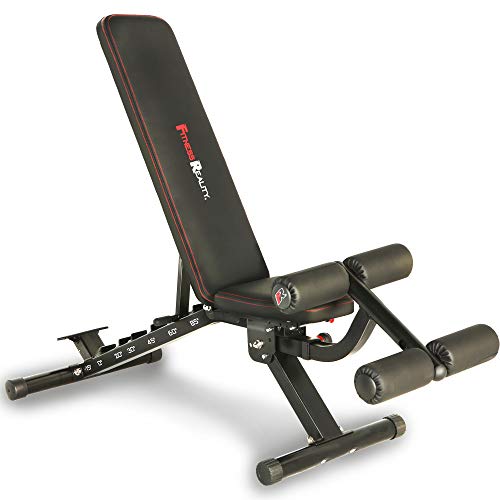
Fitness Reality 1000 Super Max Weight Bench
A longer, wider back pad and a high stated capacity make the 1000 Super Max reassuring for taller or heavier lifters. Numerous back and seat angles cover most dumbbell exercises, and detachable leg holds add sit-up options. It targets value-focused buyers rather than a commercial-grade build.
Pros
- Roomy pad for larger users
- High stated weight capacity
- Removable leg-hold accessory
Cons
- Larger overall footprint
- Adjustments feel less refined

ProForm Carbon Strength Adjustable Bench
ProForm’s Carbon Strength keeps setup simple, with owners noting how easily it repositions between exercises. Essential incline, flat and decline angles cover a starter dumbbell routine, and the frame folds away after use. Lighter and moderate training loads fit it best while a base of strength is built.
Pros
- Simple setup for beginners
- Folds away easily
- Covers essential pressing angles
Cons
- Suited to lighter loads
- Fewer premium refinements
Side by side
| # | Model | Type | Best for | Score | Price |
|---|---|---|---|---|---|
| 1 | Rep Fitness AB-3000 | Flat, incline and decline adjustable | Best overall | 9.4 | Check price |
| 2 | Flybird Adjustable Weight Bench | Incline and decline adjustable | Best value | 9.1 | Check price |
| 3 | Rep Fitness FB-3000 alternative from FINER FORM | Incline, decline and sit-up | Best for versatile workouts | 8.9 | Check price |
| 4 | RitFit Adjustable Weight Bench | Incline, flat and decline | Best for compact spaces | 8.7 | Check price |
| 5 | Bowflex 3.1S Adjustable Bench | Incline, flat and decline | Best for angle range | 8.5 | Check price |
| 6 | Fitness Reality 1000 Super Max Weight Bench | Incline, flat and decline | Best for taller users | 8.3 | Check price |
| 7 | ProForm Carbon Strength Adjustable Bench | Incline, flat and decline | Best for beginners | 8.1 | Check price |
How to pick the right one
How to choose an adjustable weight bench Back and seat angles determine how many exercises a bench supports. A flat-only design handles basic pressing, while incline positions add upper-chest and shoulder work. Decline settings open up lower-chest and core training. Check how many increments the back pad offers, since finer steps let you dial in a comfortable angle. A seat that also adjusts helps prevent sliding on steep inclines.
Weight capacity and frame stability Rated capacity should exceed your bodyweight plus the load you lift, with room to spare. Real-world stability depends on how little a bench rocks under uneven loads, not just the number on the spec sheet. Heavy-gauge steel frames and wider bases feel more planted during heavy sets. Light folding benches trade some rigidity for portability. Lifters pressing near their limits should prioritize a stouter frame over a lower price.
Folding bench vs fixed bench for storage Home gym space often decides this choice. Folding benches such as the Flybird or RitFit tuck into a closet or against a wall, which suits shared or small rooms. Fixed commercial-style benches like the Rep AB-3000 stay more stable but occupy permanent floor space. Moving a fixed bench also takes more effort due to its added weight. Measure the available area before deciding whether storage matters more than raw stability.
Pad comfort and the seat-to-back gap Pad density affects both comfort and performance during heavy pressing. Firmer padding resists sinking under load, while a longer, wider pad benefits taller users and broad shoulders. Gaps between the seat and back pad on adjustable benches can dig into the back or leave hips unsupported if too large. Owners frequently cite a small, well-designed gap as a sign of build quality. Checking pad dimensions before buying can prevent this issue.
Common questions
Is an adjustable bench better than a flat bench?
For most home gyms, yes, because it supports incline, flat and often decline work from a single piece of equipment. A dedicated flat bench can be cheaper and more stable, which suits lifters focused purely on heavy flat pressing. Adjustable models offer more versatility overall.
What weight capacity does a bench need?
Pick a bench whose rated capacity comfortably exceeds your bodyweight plus the weight you lift. Commercial-style benches list very high capacities, while budget folding models rate lower. Check the manufacturer’s figure and avoid loading a bench beyond it.
Are folding weight benches stable enough for lifting?
Quality folding benches handle moderate training well, and owners often note how steady models like the Flybird feel for their weight. Near-maximal barbell work is better suited to a heavy fixed-frame bench. Match the bench to training intensity and storage needs.
What angles should an adjustable bench cover?
A useful bench covers at least a flat position, a couple of incline settings for upper-chest and shoulder work, and ideally a decline. More increments allow finer control over pressing angle. An adjustable seat helps prevent sliding down on steep inclines.
Does the seat-to-back pad gap matter on a bench?
Yes. A large gap where the seat and back pads meet can dig into the back or leave hips unsupported during pressing. Smaller, well-designed gaps feel more comfortable, and owners often point to this detail as a sign of quality construction.
Can a weight bench be used with a barbell?
Many benches support barbell pressing, but the safest setup pairs a stable, high-capacity bench with a separate rack or spotter. Lighter folding benches suit dumbbell training better than heavy barbell work. Priority on barbell pressing calls for a heavy fixed-frame bench inside a rack.
How much floor space does a weight bench need?
Folding benches store in a closet or against a wall and move easily, which suits small rooms. Fixed commercial-style benches stay in place and need dedicated floor space plus room to load plates. Measuring the area beforehand confirms whether storage will be practical.
Are pricier weight benches worth the extra cost?
Higher-priced benches typically add heavier frames, higher capacities, smaller pad gaps and more durable padding, which matters most for heavy or frequent lifters. Casual dumbbell users can get strong value from a well-reviewed folding bench. Spending should match training frequency and intensity.
Do weight benches come already assembled?
Most benches ship flat and need some assembly, though owners generally report it stays straightforward with the included hardware. Heavier commercial-style benches involve more parts and weight to manage. Following the torque sequence in the manual keeps the frame tight and safe.
The bottom line
The Rep Fitness AB-3000 stands out as the strongest overall choice, combining a heavy-duty frame with a wide range of pressing angles. Flybird’s Adjustable Weight Bench remains the smartest pick for a tighter budget and easy storage. Bowflex’s 3.1S Adjustable Bench is worth a look for lifters who want the broadest spread of incline and decline positions.


