Wood Planers Compared by Width, Cutterhead and Cut Depth
For most home shops, the DEWALT DW735X handles thick hardwood with a three-knife cutterhead and two-speed gearbox. The WEN 6552T adds a granite table at a lower cost, and the WEN 6550 covers occasional projects on a tighter budget. All three cut cleaner than typical single-speed benchtop planers.
The DEWALT DW735X, WEN 6552T and WEN 6550 lead this comparison for different budgets and shop needs. Each planer trades speed, finish quality and price differently, so the right pick depends on how often you run stock through it.
Planer shopping gets tricky because listed specs like amperage rarely predict real-world snipe or finish quality. We compared cutterhead type, planing width, motor rating and included accessories from each manufacturer’s published specifications and common owner feedback patterns.
Before you buy
What Makes a Wood Planer Worth Buying A wood planer removes material evenly across a board’s face to bring it to a consistent thickness. Motor power, cutterhead type and planing width determine how thick a pass can be and how smooth the surface ends up. Benchtop models cover most home shop needs, while larger stationary planers suit high-volume milling.
Planing Width and Depth of Cut Explained Planing width sets the widest board a machine can surface in one pass, typically 12 to 13 inches on benchtop models. Depth of cut controls how much material comes off per pass, often up to 1/8 inch on faster settings. Taking shallower passes on hardwood reduces snipe and motor strain compared to forcing a full-depth cut.
Straight-Knife vs Spiral Cutterhead Straight-knife cutterheads use two or three full-length blades and cost less to buy but run louder. Spiral cutterheads space small carbide inserts around the drum, cutting noise and reducing tearout on figured grain. Replacing a single insert on a spiral head costs less than a full knife set, though the machine’s upfront price runs higher.
Matching a Planer to Your Shop Size and Workload Occasional hobby projects rarely need more than a steel-table benchtop planer with a two-blade head. Frequent furniture or cabinet work justifies a granite table or spiral cutterhead for consistent finish quality. Job-site trim carpenters benefit more from lighter portable models than from wider stationary machines.
The top picks, ranked

DEWALT DW735X
The DW735X pairs a three-knife cutterhead with a two-speed gearbox for finer or faster cuts. It handles boards up to 13 inches wide and 6 inches thick, and ships with an extra set of knives and folding infeed and outfeed tables.
Pros
- Two-speed gearbox adjusts cuts per inch for smoother finishes
- Extra knife set included reduces downtime
- Folding infeed and outfeed tables save bench space
Cons
- Heavier than single-speed benchtop planers
- Dust port needs an adapter for some shop vacs
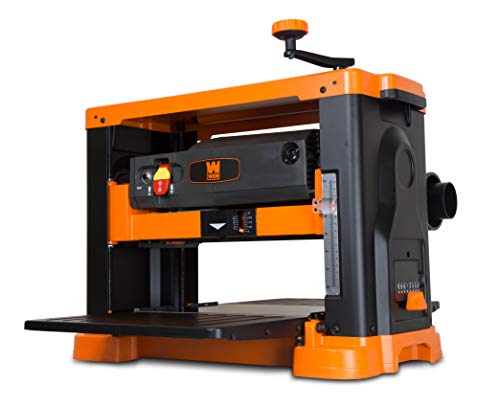
WEN 6552T
The 6552T adds a granite bed to WEN’s 13-inch benchtop planer, reducing feed friction compared to steel tables. A 15-amp motor drives a two-blade cutterhead, and a three-year warranty covers manufacturing defects.
Pros
- Granite table reduces feed friction versus steel
- Depth stops built into the fence for repeat cuts
- Backed by a three-year warranty
Cons
- Two-blade head leaves more visible knife marks than spiral heads
- Granite table adds weight versus WEN’s steel-table models
WEN 6550
The 6550 strips WEN’s planer line down to a steel table and two-blade cutterhead for occasional projects. It still covers 13-inch-wide boards up to 6 inches thick on a 15-amp motor, minus the granite bed of the 6552T.
Pros
- Lower cost entry into 13-inch planing
- Simple depth adjustment knob
- Compact enough for occasional benchtop storage
Cons
- Steel table needs more waxing to reduce feed friction
- No extra knife set included

Makita 2012NB
The 2012NB targets cabinet shops that need consistent surface quality across long production runs. A tool-less depth adjustment lever and a 12-inch planing width speed repeat passes, and reversible double-edged blades cut setup time.
Pros
- Tool-less depth adjustment speeds repeat passes
- Reversible blades cut replacement cost
- Consistent finish across long production runs
Cons
- Narrower than 13-inch competitors
- No granite or upgraded table surface

PORTER-CABLE PC305TP
The PC305TP trims planing width to 12.5 inches in exchange for a lighter housing that’s easier to move between job sites. A 15-amp motor and two-blade cutterhead cover general framing and trim stock.
Pros
- Lighter housing eases job-site transport
- Straightforward depth adjustment for quick setup
- Compact footprint for tight storage
Cons
- Narrower capacity than 13-inch shop planers
- Fewer accessories included than DEWALT or WEN kits
Cutech 40160H-CT
A spiral cutterhead with 26 carbide inserts replaces the straight knives found on most benchtop planers, cutting noise and tearout on figured grain. Each insert has four usable edges, so replacement cost stays lower than full-length knives.
Pros
- Spiral head reduces noise versus straight knives
- Individual inserts are cheaper to replace than full knives
- Less tearout on figured or interlocked grain
Cons
- Narrower 10-inch width limits board size
- Higher upfront cost than comparable straight-knife planers

Delta 22-590
The 22-590 targets users who mill rough-sawn lumber down fast rather than take light finishing passes. Cast construction adds mass that reduces vibration during aggressive cuts, and the 13-inch width matches standard rough stock.
Pros
- Added mass reduces vibration on aggressive passes
- Handles rough-sawn stock without stalling
- 13-inch width matches common rough lumber sizes
Cons
- Heavier and bulkier than compact benchtop models
- Two-blade head shows more knife marks than spiral heads
Compared at a glance
| # | Model | Planing width | Best for | Score | Price |
|---|---|---|---|---|---|
| 1 | DEWALT DW735X | 13 in | Best overall | 9.4 | Check price |
| 2 | WEN 6552T | 13 in | Best value | 9.0 | Check price |
| 3 | WEN 6550 | 13 in | Best budget | 8.4 | Check price |
| 4 | Makita 2012NB | 12 in | Best for a smooth professional finish | 8.9 | Check price |
| 5 | PORTER-CABLE PC305TP | 12.5 in | Best for portability | 8.5 | Check price |
| 6 | Cutech 40160H-CT | 10 in | Best for quiet, low-tearout cuts | 8.7 | Check price |
| 7 | Delta 22-590 | 13 in | Best for heavy stock removal | 8.2 | Check price |
Questions worth asking
What is the difference between a jointer and a planer?
A jointer flattens one face and squares one edge of a board, while a planer makes the opposite face parallel to the first. Most shops use both tools together, since a planer alone cannot remove twist or bow.
How thick a board can a benchtop planer handle?
Most benchtop planers accept stock up to 6 inches thick and 12 to 13 inches wide. Thicker stock generally requires a stationary or industrial planer.
Are spiral cutterhead planers worth the extra cost?
Spiral cutterheads cut noise and tearout on figured or interlocked grain compared to straight knives. Woodworkers who mill hardwood regularly often recover the added cost through fewer sanding hours.
Can a wood planer flatten warped boards?
A planer makes faces parallel but will not remove twist, bow or cup on its own. Running a warped board through a planer without first flattening one face on a jointer can produce an uneven final thickness.
How often do planer blades need replacing?
Straight knives typically last several hundred board feet in softwood before dulling, less in hardwood or with embedded grit. Spiral inserts last longer per edge and can be rotated to a fresh cutting edge instead of full replacement.
What size planer do I need for a home shop?
A 12 or 13-inch benchtop planer covers most home shop projects, including furniture parts and trim stock. Wider stock beyond 13 inches requires a larger stationary machine.
Do wood planers require dust collection?
Planers generate heavy chip volume and benefit from a shop vacuum or dust collector attached to the exhaust port. Running one without collection quickly buries the infeed and outfeed tables in shavings.
Is a 13-inch planer better than a 12-inch planer?
A 13-inch planer covers slightly wider boards in one pass, which matters for glued-up panels or wide trim. For narrower stock, a 12-inch model performs the same job at a smaller footprint.
Our take
A benchtop planer earns its keep once you start milling rough lumber instead of buying pre-surfaced boards. Match the cutterhead type and width to your typical stock size, and budget for extra knives or inserts as blades dull.