75-Inch TVs Built for a True Home Theater
For a dedicated home theater, the Hisense 75-Inch U8N leads on brightness and contrast, the Sony Bravia 7 75-Inch delivers the most film-accurate picture, and the TCL 75-Inch QM8 handles bright media rooms best. All three pair well with a proper seating distance and dim lighting.
For a home theater, the Hisense 75-Inch U8N is the pick most owners land on thanks to its high peak brightness and deep contrast, with the Sony Bravia 7 close behind for movie-first rooms and the TCL QM8 leading in rooms that get bright.
A 75-inch panel is trickier than a smaller set because seating distance, room light, and black-level performance all matter far more at cinema scale. We compared measured brightness, contrast, upscaling, and audio support based on specifications and what long-term owners report.
Our top picks
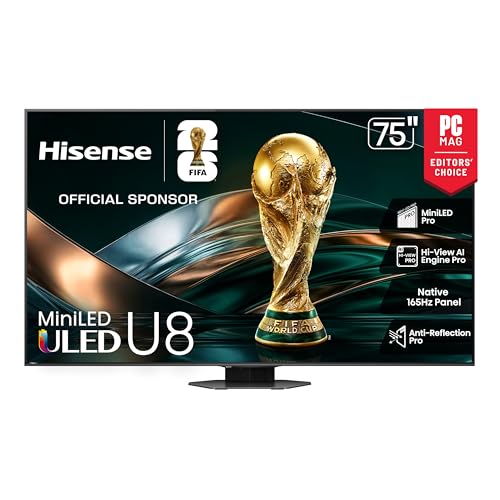
Hisense 75-Inch U8N Mini-LED
The U8N pushes very high peak brightness through a Mini-LED backlight with hundreds of local dimming zones, so bright highlights pop while black bars stay dark in a dim room. Owners report it holds up well for both HDR movies and daytime sports, making it a versatile centerpiece for a theater build.
Pros
- Very high peak brightness for HDR
- Deep contrast from many dimming zones
- Strong value versus premium brands
Cons
- Some blooming around bright objects
- Viewing angles narrower than OLED

Sony Bravia 7 75-Inch
Sony’s processing gives the Bravia 7 a natural, film-accurate look that owners consistently praise for movie nights, with smooth motion and restrained upscaling that avoids an overprocessed image. In a controlled-light theater room it renders skin tones and shadow detail with real finesse.
Pros
- Film-accurate color and tone mapping
- Excellent motion handling for film
- Clean upscaling of older content
Cons
- Priced above similar-brightness rivals
- Fewer dimming zones than the U8N

TCL 75-Inch QM8 QLED
The QM8 is built around brute-force brightness, so it stays punchy even when a media room has lamps on or windows nearby. With a huge zone count and a wide QLED color gamut, it delivers vivid HDR that owners say cuts through ambient light better than most sets at this size.
Pros
- Exceptional brightness for lit rooms
- High local dimming zone count
- Wide, saturated color gamut
Cons
- Menus can feel busy at first
- Off-angle color shift on a wide couch

Samsung 75-Inch Q80D QLED
The Q80D blends a bright QLED panel with a full slate of gaming features, so a console setup feels responsive with low input lag and high refresh support. For a theater that doubles as a game room, owners report a clean, colorful image with dependable smart platform performance.
Pros
- Low input lag for console gaming
- Bright, colorful QLED picture
- Wide viewing angle for its class
Cons
- No Dolby Vision support
- Contrast trails Mini-LED rivals

Vizio 75-Inch Quantum Pro
The Quantum Pro brings quantum-dot color and local dimming to a friendlier price, giving budget-conscious theater builders a bright, contrasty image without a premium badge. Owners note strong HDR pop for the money, with a straightforward smart interface that stays out of the way.
Pros
- Strong picture for the price
- Good HDR brightness and color
- Simple, quick smart platform
Cons
- Fewer dimming zones than flagships
- App selection is more limited

Samsung 75-Inch The Frame
The Frame hides as wall art with its matte anti-glare panel and customizable bezel, a fit for a living-room theater where the screen should disappear when idle. The matte finish tames reflections beautifully, though owners note it trades some peak punch for that glare-free surface.
Pros
- Matte screen kills reflections
- Blends into a room as art
- Slim flush-mount design
Cons
- Lower peak brightness for HDR
- Art features add to the cost

LG 75-Inch UT7570 4K
The UT7570 keeps things simple with a large 4K panel and LG’s easy smart platform, aimed at buyers who want big-screen scale without spending on Mini-LED. It works best in a controlled-light room since contrast is modest, but owners find it a solid entry into 75-inch viewing.
Pros
- Low cost for a 75-inch screen
- Friendly, responsive smart system
- Good upscaling of streaming content
Cons
- Modest contrast and brightness
- 60Hz limits fast motion clarity
Side by side
| # | Model | Panel | Best for | Score | Price |
|---|---|---|---|---|---|
| 1 | Hisense 75-Inch U8N Mini-LED | Mini-LED with local dimming | Best overall | 9.4 | Check price |
| 2 | Sony Bravia 7 75-Inch | Mini-LED with local dimming | Best for movies | 9.2 | Check price |
| 3 | TCL 75-Inch QM8 QLED | QLED Mini-LED | Best for bright rooms | 9.0 | Check price |
| 4 | Samsung 75-Inch Q80D QLED | QLED with Direct Full Array | Best for gaming | 8.8 | Check price |
| 5 | Vizio 75-Inch Quantum Pro | Quantum Dot with local dimming | Best value | 8.6 | Check price |
| 6 | Samsung 75-Inch The Frame | QLED with matte finish | Best for design | 8.4 | Check price |
| 7 | LG 75-Inch UT7570 4K | LED LCD | Best budget | 8.1 | Check price |
How to choose
Match seating distance to the screen A 75-inch panel rewards a seating distance of roughly nine to twelve feet for comfortable 4K viewing, where the image fills your vision without individual pixels or panel structure becoming visible. Sit too close and text or fine detail can look soft; sit too far and you lose the immersive scale that makes a big screen worth it. Measure your room before committing, because the right distance affects the picture more than any single spec.
Prioritize contrast and local dimming In a home theater with dim lighting, black-level performance defines how cinematic the image feels. Mini-LED sets with many local dimming zones keep letterbox bars dark while letting highlights shine, which is why they dominate this list. Fewer zones or edge-lit backlights tend to show blooming or gray-looking blacks in dark scenes, so the dimming system matters more than the marketing peak-brightness number alone.
Consider your room light If your theater is a fully darkened room, contrast and shadow detail carry the experience and a film-accurate set like the Bravia 7 shines. If lamps stay on or windows let daylight in, raw brightness from something like the QM8 helps the picture cut through glare. Matte-screen options reduce reflections in mixed-light spaces, so honestly assess how controlled your lighting really is.
Plan for sound and connections Even the best panel needs help with audio, so budget for a soundbar or receiver setup and check that the set has enough HDMI inputs with the eARC and high-bandwidth support your gear needs. Confirm Dolby Vision or HDR10+ support matches your streaming and disc sources, and verify refresh-rate features if you plan to game, so the TV anchors the whole system rather than bottlenecking it.
Good to know
How far should I sit from a 75-inch TV?
A common recommendation for a 75-inch 4K screen is roughly nine to twelve feet, which lets the image fill your field of view without revealing pixel structure. If your primary content is 4K you can sit toward the closer end of that range comfortably.
Do I need Mini-LED for a home theater?
Mini-LED is not mandatory, but its many local dimming zones deliver the deep blacks and bright highlights that make dark-room movie viewing feel cinematic. If your budget allows, a Mini-LED set will usually look more convincing than a standard edge-lit panel.
Is brightness or contrast more important for movies?
In a dark theater room, contrast and black-level control usually matter most for a filmlike look. Brightness becomes more important if your room has ambient light, since a brighter panel resists washout from lamps or windows.
Which of these is best for a bright room?
The TCL QM8 is built around very high brightness, so it holds up best when a media room has lights on or daylight nearby. Matte-screen options like The Frame also help by reducing reflections rather than out-muscling them.
Do these TVs have good built-in speakers?
Built-in speakers on any thin panel are a compromise, and a 75-inch theater setup benefits greatly from a soundbar or a receiver and speakers. Plan for external audio to match the scale of the picture.
What HDR format should I look for?
Dolby Vision and HDR10+ are dynamic formats that adjust scene by scene and are worth having for movies. Most sets here support at least one, so match the format to your streaming apps and disc player for the best result.
Are 75-inch TVs hard to mount?
A 75-inch panel is large and heavy, so use a mount rated for its weight and, ideally, a second person for installation. Confirm the VESA pattern and stud spacing on your wall before buying a mount.
Is a 75-inch TV too big for my living room?
It depends on seating distance rather than room size alone. If you can sit at least nine feet away, a 75-inch screen usually feels immersive rather than overwhelming, which is exactly what a home theater aims for.
The verdict
For most home theater builds the Hisense 75-Inch U8N is the strongest all-around choice, pairing high brightness with deep contrast for both movies and sports. Choose the Sony Bravia 7 if a film-accurate picture in a dark room is your priority, or the TCL QM8 if your media space stays bright.