What Baseball Gear Works in a Garage or Basement?
PowerNet 7×7 Practice Net solves the first indoor problem, which is containing the ball. Tanner Tee Heavy adds a weighted base that survives being clipped all winter. SKLZ Impact Balls cut ball flight enough for full effort swings in a garage.
PowerNet 7×7 Practice Net leads because a seven foot barrier converts a garage bay into usable hitting space. Tanner Tee Heavy pairs with it, since a weighted base stays put through hundreds of clipped swings. SKLZ Impact Balls complete the setup, keeping full effort contact away from drywall and windows.
Indoor training trades realism for space, and the honest first step is measuring the ceiling with a bat in hand. An eight foot garage ceiling stops many adult hitters from taking a full swing. We compared footprint, ceiling clearance, ball construction and flight distance, frame stability and setup time. Owner feedback across a full off season decided which nets and tees survive volume.
The best picks, ranked

PowerNet 7×7 Baseball Softball Practice Net
Seven feet square gives enough face to catch mishits that a smaller net would send into a wall. Its bow frame assembles in under five minutes and folds into a carry bag when the car comes back in. Netting takes repeated hard contact without splitting along the seams, though smooth concrete lets the base creep unless weighted.
Pros
- Wide face catches off centre contact
- Folds to a bag between sessions
- Netting survives repeated hard hits
Cons
- Base creeps on smooth concrete without weight
- Needs a clear floor run in front

Tanner Tee Heavy Batting Tee
Weight in the base is the whole point, because indoor tee work means clipping the stem constantly. A flexible rubber top barely resists the barrel, so contact feedback stays honest rather than jarring. Height adjusts across the strike zone for teenage and adult hitters, less so for very young players.
Pros
- Weighted base absorbs repeated clipping
- Flexible top keeps contact feedback honest
- Height range spans the full strike zone
Cons
- Costs well above folding starter tees
- Lowest setting is high for small children
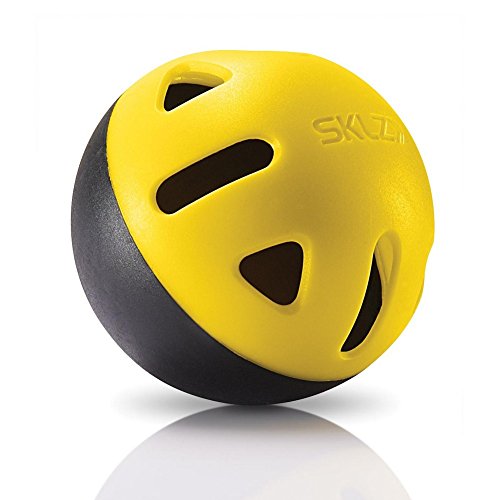
SKLZ Impact Balls Limited Flight Training Baseballs
Soft compression construction cuts carry to a fraction of a leather ball while keeping barrel feedback intact. Hitters can swing at full intent without risking a window or a car panel behind them. Machines, soft toss and tee work all accept them, and dents accumulate faster than on leather, so treat a pack as a seasonal consumable.
Pros
- Full effort swings without dangerous carry
- Contact quality still reads clearly
- Safe around younger players in tight rooms
Cons
- Dent and scuff faster than leather balls
- Flight does not match a real baseball

SKLZ Hit-A-Way Baseball Swing Trainer
A tethered ball spirals back after every swing, removing both ball retrieval and the need for a partner. Strapped to a garage beam or a post, it delivers a very high swing count in ten minutes. Clearance for the ball to rotate is essential, so a low cluttered ceiling rules it out.
Pros
- High swing count with no ball chasing
- Runs without a training partner
- Cheap way to add daily repetitions
Cons
- Needs solid overhead mounting and rotation space
- Ball path does not mimic live pitching

Jugs Small-Ball Pitching Machine
Smaller than regulation balls let this machine work at short throw distances inside a gym or a long garage. Tracking a small ball sharpens vision and contact accuracy, which shows up immediately with a normal baseball. Mains power and a second person to feed it make this a team or committed household purchase.
Pros
- Operates at short indoor distances
- Small ball drills sharpen tracking
- Built by a long established machine maker
Cons
- Serious outlay for home use
- Requires mains power and a feeder

Franklin Sports MLB Soft Strike Baseballs
Softer than limited flight balls, these suit basements, hallways and family catch with younger players. Missed catches sting far less, which keeps beginners willing to stay in front of the ball. That softness costs feedback, so older hitters chasing barrel contact will want a firmer training ball.
Pros
- Safe for young players in small rooms
- Removes fear from catching drills
- Low cost per ball in a multi pack
Cons
- Too soft for meaningful contact feedback
- Lose shape under heavy machine use

SKLZ Zip-N-Hit Pro Baseball Swing Trainer
A ball slides down a fixed cord toward the hitter, adding the timing element a tee cannot provide. Ball travel stays fully controlled, which is rare for anything indoors that moves. Two anchor points and a straight run are required, and the single fixed line limits how much pitch variation it can teach.
Pros
- Introduces timing that tee work misses
- Ball stays controlled in a small room
- Two people can run rapid rounds
Cons
- Needs two anchor points and clear run
- One fixed ball path limits realism
How they stack up
| # | Model | Size | Best for | Score | Price |
|---|---|---|---|---|---|
| 1 | PowerNet 7×7 Baseball Softball Practice Net | 7 by 7 feet | Best overall | 9.4 | Check price |
| 2 | Tanner Tee Heavy Batting Tee | Weighted, stays put on contact | Best batting tee | 9.2 | Check price |
| 3 | SKLZ Impact Balls Limited Flight Training Baseballs | Limited flight training balls | Best indoor safe balls | 9.0 | Check price |
| 4 | SKLZ Hit-A-Way Baseball Swing Trainer | Tethered swing trainer | Best for solo reps | 8.8 | Check price |
| 5 | Jugs Small-Ball Pitching Machine | Small training balls | Best pitching machine for tight spaces | 8.6 | Check price |
| 6 | Franklin Sports MLB Soft Strike Baseballs | Soft compression baseballs | Best budget balls | 8.3 | Check price |
| 7 | SKLZ Zip-N-Hit Pro Baseball Swing Trainer | Cord fed timing trainer | Best for timing drills | 8.0 | Check price |
What matters most
What to check before setting up indoor baseball practice Three measurements decide everything: ceiling height, floor length and the width of your swing path. Stand where you intend to hit, take a slow swing with the actual bat, and watch for lights, joists and garage door tracks. Floor surface matters next, since bare concrete chews bat knobs and ball covers within weeks. A rubber horse stall mat or interlocking foam under the hitting zone protects both. Hang a spare net or an old moving blanket behind the main net to catch the occasional escape.
How much ceiling height do you need for full swings? Nine to ten feet suits most adult hitters swinging a 33 inch bat comfortably. Eight feet, the standard garage ceiling, works for youth players and shorter training bats. Below that, change the drill instead of shortening the swing, because coaching a hitter to swing small builds a habit that follows them outdoors. Knob drills, one hand work with a short bat and tee work below shoulder height all fit under a low ceiling. Basements with duct runs usually need the drill adapted rather than the space fixed.
Which baseballs are safe to hit indoors? Ball choice, not swing effort, is what makes indoor hitting safe. Limited flight balls such as SKLZ Impact travel a fraction of the distance while still reporting where the barrel met the ball. Soft compression balls like the Franklin Soft Strike go softer again, which suits basements and young players but blurs feedback. Leather baseballs belong in a purpose built cage or outdoors, because even a tee swing sends enough energy to break drywall. Pair whichever ball you choose with a net rather than relying on the ball alone.
Best indoor setup for solo reps, timing and small spaces Solo practice fails on ball retrieval, so tethered trainers like the SKLZ Hit-A-Way solve the biggest problem first. Timing needs a moving ball, which is where a cord fed trainer or a small ball machine earns space. Tee work covers contact point and stays the highest value drill for any age. Gyms and long garages can add a Jugs Small-Ball machine for tracking, provided a net sits behind the hitter. Owners consistently report that whatever sets up in two minutes gets used, so leaving a tee and net standing beats owning better gear that stays boxed.
Questions worth asking
How much space do I need for indoor baseball practice?
Roughly ten feet of depth and eight feet of width covers tee work into a net. Ceiling height matters more than either figure. Measure with a bat in your hands, since swing planes travel higher than most people estimate.
Can I use real baseballs indoors?
Only inside a purpose built cage. Off a tee in a garage, a leather ball carries enough energy to crack drywall or a windscreen. Limited flight and soft compression balls give useful feedback without that risk.
What ceiling height do I need for full baseball swings?
Nine to ten feet leaves an adult hitter clear room. Eight feet works for youth players using shorter bats. Anything lower calls for drills that keep the barrel below shoulder height.
Is a batting tee useful for older players?
Yes, and professional hitters use tee work daily. It isolates contact point without pitch variables, which is exactly what repeating a swing thought requires. Tanner Tee Heavy suits that repetition because the base stays put when clipped.
Do pitching machines work indoors?
Small ball machines designed for short throw distances do, given a net and mains power. Full size machines firing regulation baseballs need cage length and clearance. Jugs Small-Ball is the practical option for a gym or long garage.
How do I stop my practice net sliding on concrete?
Weight the base with sandbags or plate weights, since ground stakes are not an option indoors. Setting the frame on a rubber mat adds friction as well. Both together keep a PowerNet 7×7 in position through a full session.
Are tethered swing trainers worth buying?
For solo volume, yes. The ball returns itself, so a player takes hundreds of swings without stopping. Pitch recognition is missing entirely, so run them alongside tee and timing drills.
What should I buy first for indoor baseball training?
Start with a net and a tee, which together cover most productive indoor work. Add limited flight balls immediately, because they are what makes full effort swings safe. Trainers and machines make sense once those three are in place.
Which is better indoors, a batting tee or a swing trainer?
A tee builds contact point accuracy and is the better first purchase. Tethered trainers deliver swing volume in less time and need no ball retrieval. Most home setups end up using both across a week.
Can you practise pitching indoors as well as hitting?
Yes, into a net at short distance. PowerNet 7×7 accepts pitching, soft toss and hitting on the same frame. Long toss and full mound distance still need outdoor space or a cage.
The bottom line
Buy the PowerNet 7×7 Practice Net first, because indoors the ball has to go somewhere before anything else matters. Add Tanner Tee Heavy for a base that survives hundreds of clipped swings, then stock SKLZ Impact Balls so hitters can work at full intent. Those three turn an ordinary garage bay into a winter hitting space.


