Charging Stations Compared: Multi-Device vs Single-Port
Mixed device households do best with the Anker 637 Magnetic Charging Station, which pairs a magnetic pad with wired ports and mains sockets. Apple users get full 15W wireless speed from the Belkin BoostCharge Pro 3-in-1, and the Ugreen Nexode 100W station charges laptops properly.
Households juggling iPhones, Android phones and laptops should start with the Anker 637 Magnetic Charging Station, an upright cube mixing a magnetic pad with USB and mains outlets. Apple only homes get more from the Belkin BoostCharge Pro 3-in-1, while the Ugreen Nexode 100W handles laptop duty.
Advertised wattage misleads more buyers than any other spec, because a big number is shared across every port and shrinks as devices are added. We compared single port maximums, wireless certification, watch and earbud compatibility and footprint, then factored in what owners report about heat buildup and coil alignment.
How to pick the right one
How much wattage does a charging station need? Total wattage is a shared pool, not a per port promise. Manufacturers publish distribution tables showing how output splits as devices are added, and reading one prevents most buyer disappointment. Phones fast charge at roughly 18 to 30W each, while laptops want a single port rated 65W or more. Add up your real device load, then check what each port delivers when everything is plugged in at once.
Is wireless charging as fast as a cable? No, and the gap matters for how you use a station. Certified MagSafe reaches 15W on compatible iPhones, generic magnetic pads sit near 7.5W, and any decent cable beats both. Wireless also wastes more energy as heat. Overnight charging suits pads perfectly because speed is irrelevant while you sleep; a twenty minute top up before leaving wants a cable every time.
Can a charging station charge an Apple Watch or a laptop? Only with the right hardware. Apple Watch refuses standard Qi pads and requires its own magnetic puck, which is why three in one stations carry a dedicated watch section, and some Samsung and Google watches have the same restriction. Laptops need a single USB-C port rated at 65W or higher, such as the 100W port on the Ugreen Nexode, plus enough leftover budget for whatever else is plugged in.
Which charging station format fits your space? Match the shape to the location. Upright cubes like the Anker 637 suit narrow nightstands, flat multi port bases like the Satechi Dock5 suit kitchen drop zones, and folding units like the Mophie travel charger live in luggage. Leave airflow around whichever you choose, because a station wedged behind a monitor or against a wall runs hot and quietly throttles its charging speed.
The shortlist, ranked

Anker 637 Magnetic Charging Station (MagGo)
Eight charging points share one upright cube: a magnetic phone pad, USB-C and USB-A ports and full mains sockets. Held at a viewing angle, an iPhone on the pad works as a bedside clock or desk stand. Vertical packaging saves desk width over flat multi pads, though the cube wants breathing room for airflow.
Pros
- Covers phones, laptops and mains devices
- Magnetic pad doubles as a viewing stand
- Small desk footprint for its capacity
Cons
- Magnetic pad trails wired speeds
- Needs clearance for airflow

Belkin BoostCharge Pro 3-in-1 Wireless Charger with MagSafe
Official MagSafe certification unlocks the full 15W an iPhone can accept wirelessly, double what generic magnetic pads deliver. A dedicated puck fast charges an Apple Watch and a third pad takes AirPods. Everything about it assumes Apple hardware, so Android owners should look elsewhere in this list.
Pros
- Full speed MagSafe charging
- Apple Watch fast charge supported
- Weighted base resists one handed grabs
Cons
- Little benefit for Android devices
- No spare wired ports
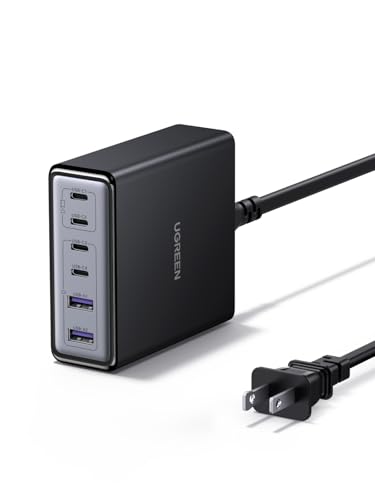
Ugreen Nexode 100W 4-Port Charging Station
Gallium nitride internals let this station push 100W through a single USB-C port, enough to run a demanding laptop at full speed. Three USB-C ports and one USB-A split that budget sensibly when phones join in. Wireless pads are absent by design, so it suits people who prefer cables anyway.
Pros
- Runs a laptop at full speed
- Compact for its output
- Sensible power split across ports
Cons
- No wireless charging pad
- Output drops sharply with four devices

Satechi Dock5 Multi-Device Charging Station
Five wired ports and 108W of combined output make this a family drop zone rather than a personal charger. Overnight, it tops up a household’s phones and tablets from one kitchen counter spot. Aluminium construction matches Apple gear cosmetically while charging anything with a USB port.
Pros
- Charges five devices at once
- Aluminium body over plastic
- Works as a shared counter drop zone
Cons
- Cables stay visible with no organiser
- Flat layout claims counter space

ESR HaloLock 3-in-1 Wireless Charging Station
Phone, watch and earbuds all charge on this folding magnetic station for far less than the Belkin costs. Folded flat, it packs into a bag, so one unit covers bedside and travel duty. Phone speeds sit at the standard magnetic rate rather than full MagSafe, which suits overnight charging better than quick top ups.
Pros
- Three devices covered affordably
- Folds down for travel
- Magnets grip through most cases
Cons
- Slower than certified MagSafe charging
- Watch pad fits tightly with thick bands

Anker Prime 250W GaN Desktop Charger
Built for desks running two laptops plus a phone and tablet, with 250W of headroom so nothing throttles. A small display reports live output per port, ending the guesswork about which device is actually fast charging. Bedside tables need a fraction of this capacity, so buy it for a workstation.
Pros
- Powers two laptops at once
- Live per port display removes guesswork
- Robust build quality
Cons
- Overkill for phone only households
- Bulky next to smaller stations

Mophie 3-in-1 Travel Charger with MagSafe
Folded into its pouch, this covers phone, watch and earbuds from carry on luggage with a single power adapter. MagSafe support means the phone snaps into alignment instead of hunting for a coil. Output stays modest, so treat it as the travel companion to a desk station rather than a replacement.
Pros
- Genuinely packable for trips
- Magnets align the phone every time
- One adapter runs three devices
Cons
- Lower output than desk stations
- Small hinged parts feel delicate
The lineup, side by side
| # | Model | Total output | Best for | Score | Price |
|---|---|---|---|---|---|
| 1 | Anker 637 Magnetic Charging Station (MagGo) | 67W combined | Best overall | 9.4 | Check price |
| 2 | Belkin BoostCharge Pro 3-in-1 Wireless Charger with MagSafe | 15W MagSafe, watch puck, AirPods pad | Best for Apple households | 9.2 | Check price |
| 3 | Ugreen Nexode 100W 4-Port Charging Station | 100W combined | Best for laptops and phones together | 9.0 | Check price |
| 4 | Satechi Dock5 Multi-Device Charging Station | 108W combined | Best for shared family charging | 8.8 | Check price |
| 5 | ESR HaloLock 3-in-1 Wireless Charging Station | Magnetic phone pad, watch and earbuds pads | Best value magnetic station | 8.6 | Check price |
| 6 | Anker Prime 250W GaN Desktop Charger | 250W combined | Best for heavy desk setups | 8.3 | Check price |
| 7 | Mophie 3-in-1 Travel Charger with MagSafe | MagSafe phone pad, watch and earbuds | Best for travel | 8.0 | Check price |
Frequently asked questions
Will a charging station damage my phone battery?
No. Every device negotiates the power it accepts, and modern phones manage their own charge rate and temperature. Leaving a phone on a station overnight is no harder on the battery than any wall charger.
Do I need a MagSafe certified charger for my iPhone?
Only for full 15W wireless speed. Uncertified magnetic pads still grip and charge an iPhone at roughly half that rate, which is plenty for overnight use. Pay for certification when daytime top up speed matters.
Can a charging station power a laptop?
Some can. Look for a single USB-C port rated 65W or higher; the Ugreen Nexode delivers up to 100W from one port. Confirm the station sustains that output with other devices connected, since shared budgets shrink fast.
Why does my phone get hot on a wireless charger?
Wireless transfer loses more energy than a cable, and the loss becomes heat. Misaligned coils and thick cases make it worse. Mild warmth is normal; a phone too hot to hold comfortably belongs on a cable instead.
Can any wireless pad charge an Apple Watch?
No. Apple Watch charges only from its specific magnetic puck, never from a standard Qi surface. Stations advertising watch support include that puck, which is the detail to verify before buying a three in one.
What does GaN mean on a charger?
Gallium nitride, a semiconductor that switches more efficiently and runs cooler than silicon. Chargers built with it pack the same wattage into a far smaller body, which is how a 100W GaN station undercuts an old laptop brick on size.
Does wireless charging work through a phone case?
Usually, up to a few millimetres of thickness. Metal plates, card holders and thick wallet folios block or weaken the field, and magnetic alignment fails unless the case carries its own magnet ring.
How many devices can one station charge at once?
As many as it has ports and pads, but each addition shrinks the power available per device. Four devices on a 100W station receive far less each than the single port maximum, so count wattage, not just sockets.
Is it safe to leave a charging station plugged in all the time?
Yes. Reputable stations carry overcurrent, overheat and short circuit protection and draw almost nothing when idle. Give the unit ventilation and skip damaged cables, and continuous operation is what it is designed for.
Final word
Pick the Anker 637 Magnetic Charging Station if your household mixes ecosystems, since no rival covers wireless, wired and mains devices from one nightstand cube. Committed Apple users should spend on the Belkin BoostCharge Pro 3-in-1 for full MagSafe speed, and anyone charging a laptop alongside phones needs the single port headroom of the Ugreen Nexode 100W.
You might also need
7 Multi Port Chargers That Power Every Device at Once

Portable Smart Speakers Compared for Sound and Battery Life

Portable Smart Speaker Batteries Compared for Runtime and Fit
