Which Crystal Growing Kit Actually Grows Visible Crystals?
The National Geographic Mega Crystal Growing Lab wins overall by growing seven crystals on staggered timelines, so results appear within days. Dan and Darci adds a light up display base for gifting, and the 4M kit is the cheap way to test a child’s interest first.
Most families do best with the National Geographic Mega Crystal Growing Lab, since seven crystals on different timelines mean something is always happening. Display matters more for a gift, so the Dan and Darci kit with its light up base is the stronger present. A cautious first purchase points toward the 4M Crystal Growing Experiment, which tests interest cheaply.
Kits fail for predictable reasons: a week of waiting before anything visible happens, boiling water steps no child can do alone, or crystals fragile enough to crumble on first handling. Instruction quality swings from genuinely educational to a single confusing sheet. We compared growing times, supervision needs, instruction depth, display options and result durability, then checked those against what parents report about kits that get finished versus abandoned.
Before you buy
How does a crystal growing kit actually work? Nearly every kit dissolves as much salt as hot water will hold, creating a supersaturated solution, then lets it cool. Cool water holds less dissolved material than hot water, so the excess comes out of solution and attaches to a seed crystal or rough surface. Slow, undisturbed cooling produces larger, better formed crystals than a quick cool on a sunny windowsill.
What supervision and safety steps matter? Nearly all kits need very hot or boiling water at the mixing stage, so an adult should handle that step regardless of the age printed on the box. The salts involved are simple but not edible, and hands need washing after handling. Keep containers away from younger siblings and pets, and label them so nobody mistakes a solution for a drink.
How long until a crystal is finished growing? Some crystals appear overnight, others take three weeks, so a child expecting a finished geode by bedtime will be disappointed. Kits that grow several crystals on staggered timelines, like the National Geographic lab, handle this best because something is always visible. Finished crystals are more fragile than they look, so handle them by the base and keep them out of humid rooms.
Which kit suits which age and interest level? For ages six to eight, pick a kit with fast visible results and simple steps, and accept lighter science content. Ages eight to eleven do well with a multi crystal kit that includes a proper booklet. Older kids or a school project call for the depth in the Thames and Kosmos manual. Parents report an adult present for the first session predicts a finished project more than the brand does.
Our top picks

NATIONAL GEOGRAPHIC Mega Crystal Growing Lab
Seven separate crystals grow at different speeds, so fast specimens appear within a day while others take weeks. Distinct colours make each one feel like its own experiment. The included booklet explains the underlying chemistry at a level a curious eight year old can follow, and a display stand plus a real specimen round out the box.
Pros
- Multiple crystals keep interest going
- Booklet explains the science clearly
- Display stand included for the results
Cons
- Requires adult help with hot water
- Takes several weeks to complete fully
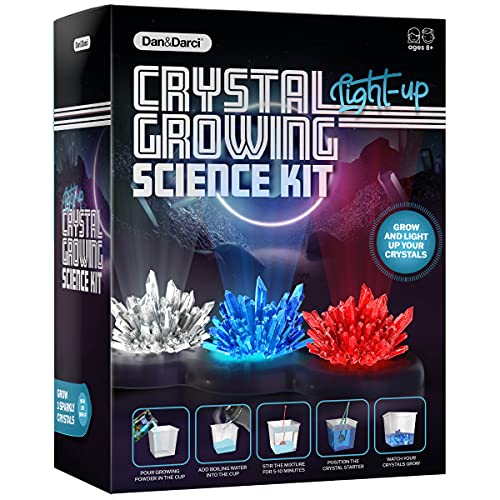
Dan and Darci Crystal Growing Kit
A light up display base turns finished crystals into something that stays on a shelf instead of a drawer. Several coloured crystals grow from the included chemicals, and instructions are written directly for kids rather than parents. Adult supervision is still required for mixing hot water, the same as any kit in this category.
Pros
- Light base makes results worth displaying
- Instructions written for children
- Presents well as a gift
Cons
- Needs batteries for the display base
- Hot water step requires an adult

Thames and Kosmos Crystal Growing Kit
Thames and Kosmos writes the most substantial manual here, covering saturation and why cooling rate changes crystal size. Multiple linked experiments build on each other rather than repeating the same steps. Younger children need an adult reading along, and the pace suits a curious ten year old more than a quick weekend project.
Pros
- Genuinely educational manual
- Experiments build understanding step by step
- Suits school project use
Cons
- Too involved for younger children alone
- Less immediately fun than gift style kits

4M Crystal Growing Experiment Kit
4M has sold this simple kit for years as the low risk way to find out whether a child enjoys growing crystals before spending more. A small number of specimens grow using basic instructions and a display cup. Results are modest in size, but the core process matches the larger, pricier kits.
Pros
- Lowest risk way to test the interest
- Simple instructions with few steps
- Compact box to store
Cons
- Small crystals compared with larger kits
- Instructions are brief

Discovery MINDBLOWN Crystal Growing Kit
Visible progress within days suits younger kids who lose interest when a week passes with nothing to see. Packaging and steps stay colourful and simple throughout. Scientific depth trails behind Thames and Kosmos, and results lean decorative rather than impressive, which makes this a first experience kit rather than a serious project.
Pros
- Visible results quickly
- Bright, approachable presentation
- Simple enough for a first kit
Cons
- Limited scientific explanation
- Crystals are small and fragile

Playz Crystal Growing Science Kit
Playz mixes crystal growing with related chemistry activities, so the box lasts beyond one project. A child who finishes tasks quickly gets extra mileage from the added experiments. Individual activities feel less refined than a specialist kit, and the booklet covers each one briefly rather than in depth.
Pros
- Many activities in one box
- Keeps a fast worker occupied longer
- Good value for the quantity included
Cons
- Individual experiments are less polished
- Instructions cover each activity briefly
Learn and Climb Crystal Growing Kit
This straightforward kit targets an affordable gift rather than a deep learning tool. Materials for several crystals ship with a simple guide, and the box presents reasonably well. Explanation stays minimal, and components feel lighter next to the National Geographic and Thames and Kosmos kits, which is what the lower price buys.
Pros
- Affordable as a small gift
- Grows several crystals rather than one
- Straightforward process
Cons
- Minimal scientific explanation
- Lightweight components
Side by side
| # | Model | Crystals | Best for | Score | Price |
|---|---|---|---|---|---|
| 1 | NATIONAL GEOGRAPHIC Mega Crystal Growing Lab | Seven separate growing experiments | Best overall | 9.4 | Check price |
| 2 | Dan and Darci Crystal Growing Kit | Multiple coloured crystals | Best for display | 9.2 | Check price |
| 3 | Thames and Kosmos Crystal Growing Kit | Structured science curriculum | Best for learning | 9.0 | Check price |
| 4 | 4M Crystal Growing Experiment Kit | Small number of specimens | Best value | 8.8 | Check price |
| 5 | Discovery MINDBLOWN Crystal Growing Kit | Several fast growing specimens | Best for younger children | 8.6 | Check price |
| 6 | Playz Crystal Growing Science Kit | Crystal growing plus related experiments | Best variety of experiments | 8.3 | Check price |
| 7 | Learn and Climb Crystal Growing Kit | Several specimens | Best budget gift | 8.0 | Check price |
Questions worth asking
What age are crystal growing kits suitable for?
Most are labelled for around eight and up, though a six year old can enjoy the process with an adult handling hot water and measuring. Older children get more from kits with detailed manuals. The age on the box reflects step complexity, not interest level.
How long does it take to grow a crystal?
Anywhere from overnight to about three weeks, depending on the kit and crystal type. Kits with several crystals on different timescales keep interest alive, since something appears early while larger specimens develop slowly.
Do these kits need adult supervision?
Yes, especially when very hot or boiling water dissolves the salts. That step belongs to an adult in every kit here. Once the solution cools, a child can handle most of the waiting and observing.
Are the chemicals in crystal kits safe?
They are generally simple salts chosen for classroom and home use, but they are not edible, so wash hands after handling. Keep solutions labelled and out of reach of small children and pets, and follow the safety notes supplied with each kit.
Why did my crystals not grow?
Usually the solution was not saturated enough, meaning too little salt dissolved or the water was not hot enough at the start. Disturbing the container, fast evaporation in a warm sunny spot, or a dirty container are the other common causes. Slow, undisturbed cooling gives the best results.
How do I keep the finished crystals from breaking?
Dry them gently on kitchen paper, then store them somewhere dry and out of direct sunlight, since many absorb moisture from humid air and lose shape. A closed display case or sealed container works well. Handle crystals by the base rather than the delicate points.
Can we grow more crystals after the kit runs out?
Yes, and it is one of the cheapest ways to extend the activity, since the same principle works with household salt and sugar. Refill chemicals for specific kits sometimes sell separately. Growing a sugar crystal alongside a kit crystal makes a good comparison.
Which kit is best for a school science project?
The Thames and Kosmos kit, since its manual covers the underlying chemistry in enough depth to support a written report rather than just producing a result. The National Geographic Mega lab works as a second choice, since growing several crystals under different conditions gives something to compare.
Crystal growing kit vs geode kit, what’s the difference?
A crystal growing kit dissolves salts and lets them recrystallize over days or weeks under your control. A geode kit typically involves cracking open a pre formed rock to reveal crystals already grown inside, which is instant but offers no growing process to observe.
The bottom line
The National Geographic Mega Crystal Growing Lab most reliably gets finished, since seven crystals on staggered timescales mean there is always something to check on. Pick the Dan and Darci kit for a gift where display matters, or Thames and Kosmos when real learning is the goal. Plan for an adult to handle the hot water regardless of which kit you choose.