How to Pick a Door Bouncer Babies Actually Enjoy
The Jolly Jumper with Door Clamp leads for its secure clamp and smooth spring suspension, a combination most babies respond well to. Graco’s Bumper Jumper is the value pick with padded frame protection. Evenflo’s ExerSaucer Door Jumper offers the simplest budget setup.
The Jolly Jumper with Door Clamp suits most families best, thanks to a secure clamp and genuinely smooth spring action. Graco’s Bumper Jumper delivers similar bounce with padded protection for the door frame. Evenflo’s ExerSaucer Door Jumper stays the straightforward budget option throughout.
Door bouncers depend entirely on your door frame, and many modern homes have trim that’s too thick, too narrow or simply not strong enough for a clamp. We compared clamp designs against typical trim dimensions, published weight and height limits, seat support and adjustment range, then weighed what owners report about safety and setup. Always follow the manufacturer’s instructions and your pediatrician’s guidance on jumper use.
How to pick the right one
Check your door frame before anything else Most doorway jumpers need a solid wooden frame with trim under a specified thickness, typically around six inches deep and less than about two inches thick at the clamping point. Hollow frames, metal frames, sliding doors and frames with thick decorative molding aren’t suitable. Measure against the manufacturer’s stated requirements first, since even the safest jumper turns unsafe on the wrong frame.
Know when a baby is ready, and when to stop Jumpers generally suit babies who can hold their head up unassisted and haven’t yet learned to walk or climb out, roughly four to nine months for most children. Manufacturers publish weight and height limits, and both matter equally. Discontinue use once a child can pull to standing or exceeds the stated limits, and check with a pediatrician about how jumpers fit that child’s development.
Spring versus strap suspension Spring-based jumpers give a smoother, more controlled bounce with less side-to-side swing, suiting younger babies with limited trunk control. Elastic strap systems weigh less and pack down smaller but tend to feel bouncier and less damped. Either way, look for a covering over the spring so small fingers can’t reach the coils.
Session length and supervision Common guidance limits jumper sessions to fifteen or twenty minutes, no more than a couple of times a day, so a child spends most of their time on the floor building crawling and core strength. Keep the baby in sight at all times, position the jumper away from walls and furniture, and check the clamp before every use.
The top picks, ranked

Jolly Jumper Baby Exerciser with Door Clamp
A heavy duty spring gives this jumper a smoother, less jarring bounce than elastic strap designs, and it’s been the reference doorway jumper for decades. The seat supports the back and hips properly. Owners report the clamp is the most secure on the market once fitted to a suitable frame.
Pros
- Smooth spring action rather than jerky elastic
- Supportive seat suited to younger babies
- Clamp grips securely on suitable trim
Cons
- Clamp will not fit thick or unusual door trim
- Bulkier to move between rooms
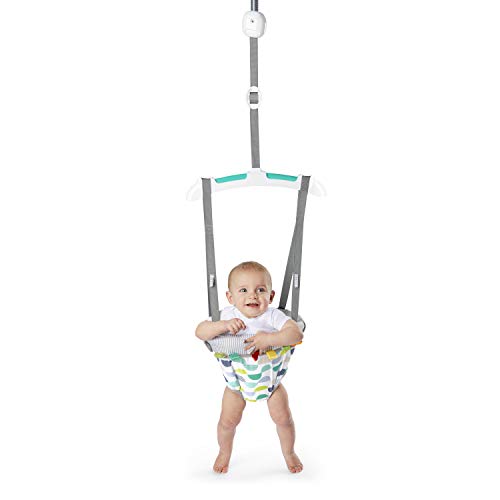
Graco Bumper Jumper
Padding wraps around every frame contact point here, protecting both the door casing and a baby’s hands. Adjustable straps let the seat grow with a child. Specifications list support up to 25 pounds for babies who can already hold their head up unassisted.
Pros
- Padding protects door frames from marks
- Height adjusts easily as baby grows
- Toy bar keeps babies engaged
Cons
- Elastic bounce runs less smooth than a spring
- Seat can twist without a stabilizing hand

Evenflo ExerSaucer Door Jumper
A fabric seat, adjustable straps and a basic clamp make this the simplest way to try a doorway jumper without a large outlay. Light weight keeps it easy to move and store. Owners report it works best for shorter sessions and lighter babies rather than daily extended use.
Pros
- Lowest cost entry point
- Light and easy to store between uses
- Washable seat handles inevitable messes
Cons
- Minimal padding on the frame clamp
- Less back support than premium seats

Bright Starts Bounce ‘N Spring Deluxe Door Jumper
Comfort takes priority here, with a well-cushioned seat and a spring-based bounce that feels more controlled than strap-only designs. Attached toys sit within easy reach. Specifications list support up to 25 pounds for babies who can already hold their head up.
Pros
- Comfortable deep seat for smaller babies
- Covered spring reduces pinch risk
- Toys built into the seat rim
Cons
- Deep seat can be awkward to lift baby out of
- Fabric cover needs frequent washing

Skip Hop Explore & More 2-in-1 Doorway Jumper
This model doubles as a doorway jumper and a portable seat, extending its useful life beyond the jumping stage. Design stays more restrained than most brightly colored baby gear. Owners report the conversion is genuinely practical rather than a marketing feature.
Pros
- Two genuine uses from one purchase
- Understated design suits living spaces
- Removable cover washes easily
Cons
- Bounce runs less energetic than spring models
- Conversion takes a few minutes each time

Jolly Jumper Exerciser with Stand
Many modern homes lack a door frame a clamp can safely grip, and this version solves that with its own steel stand. The same spring and seat as the doorway model carry over here. Specifications confirm the stand allows use in open plan rooms without any frame at all.
Pros
- Works in homes with unsuitable door frames
- Same proven spring and seat design
- Can be positioned anywhere in a room
Cons
- Takes up considerable floor space
- Heavier and slower to set up

Fisher-Price Rainforest Jumperoo
Skipping a clamp altogether, this stationary jumper surrounds a baby with toys, lights and sounds on a stable frame. It suits homes where doorways aren’t suitable for mounting. Owners report it takes up far more room than a doorway model but needs no installation.
Pros
- No door frame required at all
- Rotating seat gives access to all toys
- Very stable base
Cons
- Large permanent footprint in a room
- Bulky to store when not in use
How they stack up
| # | Model | Suspension | Best for | Score | Price |
|---|---|---|---|---|---|
| 1 | Jolly Jumper Baby Exerciser with Door Clamp | Heavy duty spring | Best overall | 9.4 | Check price |
| 2 | Graco Bumper Jumper | Adjustable elastic straps | Best value | 9.2 | Check price |
| 3 | Evenflo ExerSaucer Door Jumper | Adjustable straps | Best budget | 9.0 | Check price |
| 4 | Bright Starts Bounce ‘N Spring Deluxe Door Jumper | Spring with fabric cover | Best for a padded seat | 8.8 | Check price |
| 5 | Skip Hop Explore & More 2-in-1 Doorway Jumper | Adjustable straps | Best convertible design | 8.6 | Check price |
| 6 | Jolly Jumper Exerciser with Stand | Heavy duty spring | Best when no doorway works | 8.3 | Check price |
| 7 | Fisher-Price Rainforest Jumperoo | Free standing stationary jumper | Best stationary alternative | 8.0 | Check price |
Questions worth asking
At what age can a baby use a door bouncer?
Most manufacturers require a baby to hold their head up steadily without support, typically around four months. Use ends when the child can walk, climb out or exceeds the stated weight limit. Check the specific model’s guidance and ask a pediatrician if unsure.
How long should a baby stay in a jumper?
Common advice suggests short sessions of fifteen to twenty minutes, once or twice a day. The rest of the time is better spent on the floor, since crawling and tummy time build strength that jumpers don’t.
Will a door bouncer damage my door frame?
A properly fitted clamp can leave pressure marks on softer trim, especially with repeated use. Models with padded contact points reduce this considerably, and a thin cloth under the clamp helps protect painted or varnished wood.
What if my doorway won’t take a clamp?
Free standing options solve this. A Jolly Jumper with a stand keeps the same spring bounce without needing a frame, and stationary jumpers such as the Jumperoo need no installation at all. Never improvise a mounting point the manufacturer hasn’t specified.
Are door bouncers safe for a baby’s hips?
Look for a wide, supportive seat that holds the thighs rather than a narrow strap that concentrates weight in the groin. Keep sessions short and set the height so the feet rest flat with a slight knee bend. A pediatrician can advise on a specific child.
How high should the jumper be set?
A baby’s feet should sit flat on the floor with a gentle bend at the knee when at rest. Tiptoes mean the jumper sits too high, and deeply bent knees mean it’s too low. Recheck the setting every few weeks as they grow.
Can twins use one jumper?
No. Doorway jumpers are rated for a single occupant and a specific weight limit. Two children in one seat exceeds the design load and puts unsafe stress on the clamp and suspension.
How do I clean a door bouncer seat?
Most seats have removable fabric covers that machine wash on a gentle cycle and air dry. Wipe the straps and clamp with a damp cloth, and inspect the stitching and suspension for wear each time the seat comes off.
Door clamp jumper vs stationary jumper: which is safer?
Both are safe when used per the manufacturer’s guidance, but a stationary jumper like the Jumperoo removes any risk tied to a poorly fitted clamp. A door clamp jumper needs a suitable frame; a stationary model needs only floor space.
Our pick
The Jolly Jumper with Door Clamp remains the strongest choice where the door frame suits it, offering a smoother bounce and better seat support than most rivals. Graco’s Bumper Jumper is the value pick with useful frame padding. A home with no suitable doorway is better served by the free-standing Jolly Jumper with Stand.


