Which Notebook Suits the Way You Take Notes?
The Leuchtturm1917 Medium A5 is the strongest all round note taking notebook, with numbered pages and a built in index that make notes findable months later. The Moleskine Classic suits people who prefer a softer writing feel, and the Rocketbook Core is the pick for scanning notes to the cloud.
The Leuchtturm1917 Medium A5 is the notebook to buy if you want notes you can actually find again, with the Moleskine Classic for a softer writing feel and the Rocketbook Core for anyone who wants notes in the cloud.
Notebooks are surprisingly hard to compare because the only specifications published are page count and dimensions, while the things that decide daily satisfaction are paper weight, how flat the book opens and whether the pages are organised. We compared paper GSM against ink bleed, binding construction, layout options and indexing features, then weighed those specifications against what owners report about fountain pen feathering and spines cracking after a few months.
The top picks, ranked

Leuchtturm1917 Medium A5 Hardcover Notebook
Leuchtturm numbers every page and includes a blank table of contents at the front, which sounds trivial until you need something from a meeting three months ago. The 80 gsm paper takes fountain pens better than most and the sewn binding lets the book lie flat on a desk. Owners report the included sticker labels and two ribbon markers are the details that keep them buying replacements.
Pros
- Numbered pages with a proper index
- Lies flat from the first page
- Two ribbon markers and a rear pocket
Cons
- Heavier fountain pen inks still show through
- Costs more than most hardcover notebooks

Moleskine Classic Notebook Large Ruled
The Moleskine remains the notebook people picture, and the slightly softer, toothier paper is genuinely pleasant under a rollerball or pencil. The elastic closure and rear pocket handle the receipts and cards that accumulate around meetings. It has no page numbers or index, so organisation is on you.
Pros
- Pleasant writing feel with pencil and rollerball
- Elastic closure keeps it shut in a bag
- Widely available in many layouts
Cons
- Thinner paper shows through with wet inks
- No page numbers or index
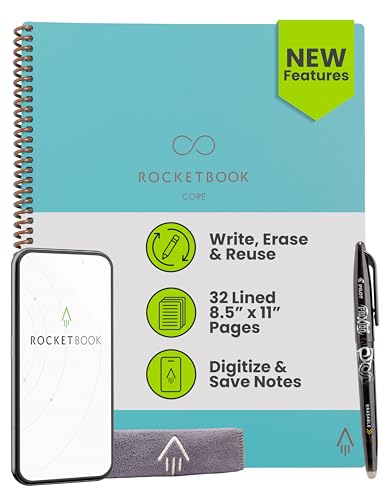
Rocketbook Core Reusable Notebook
The Rocketbook writes like paper with a compatible erasable pen, then the app scans and files each page to a chosen cloud destination based on a symbol you mark at the bottom. Wipe the pages with a damp cloth and the notebook is blank again. It suits people who want handwritten notes but live in a searchable digital archive.
Pros
- Notes reach cloud storage automatically
- Reusable indefinitely with the right pen
- Handwriting recognition makes notes searchable
Cons
- Requires specific erasable pens
- Ink smudges before it fully sets

Rhodia Webnotebook A5
Rhodia uses 90 gsm Clairefontaine paper, which is the reason fountain pen users recommend it so consistently. Lines stay crisp, feathering is minimal and even saturated inks rarely show through to the reverse. Based on specifications this is the highest quality paper in the group, with the fewest organisational extras.
Pros
- Excellent with fountain pens and wet inks
- Very smooth writing surface
- Opens flat without cracking the spine
Cons
- Smooth paper is less pleasant with pencil
- No page numbering or index

Maruman Mnemosyne N195 Notebook
Maruman builds the Mnemosyne for working notes, with a twin wire binding that folds fully back on itself and micro perforated pages that tear out cleanly. The paper handles gel and fountain ink well for a wirebound book. Owners report the layout suits action lists and meeting notes better than journaling.
Pros
- Folds completely flat or back on itself
- Pages tear out without ragged edges
- Header area suits dated meeting notes
Cons
- Wire binding catches in bags
- Less suited to long form writing

Five Star Spiral Notebook by Mead
The Five Star is built for the abuse of a school bag, with a reinforced spiral, plastic covers and pages that survive being crammed in beside textbooks. Subject dividers and pockets keep multiple classes separated in one book. The paper is basic, so anything wetter than a ballpoint will show through.
Pros
- Very durable covers and spiral
- Dividers organise multiple subjects
- Widely available and inexpensive
Cons
- Thin paper bleeds with gel and fountain pens
- Spiral makes left handed writing awkward on versos

Amazon Basics Classic Notebook
This covers the familiar hardcover format with an elastic band, ribbon marker and rear pocket at the lowest price here. The paper is adequate for ballpoint and pencil and unremarkable with anything wetter. It is the sensible pick when you get through notebooks quickly and do not want to think about it.
Pros
- Cheapest hardcover option here
- Familiar format with the usual extras
- Fine for ballpoint and pencil notes
Cons
- Paper shows through with wetter inks
- Binding is stiffer than sewn notebooks
How they compare
| # | Model | Paper | Best for | Score | Price |
|---|---|---|---|---|---|
| 1 | Leuchtturm1917 Medium A5 Hardcover Notebook | 80 gsm acid free | Best overall | 9.4 | Check price |
| 2 | Moleskine Classic Notebook Large Ruled | 70 gsm ivory | Best writing feel | 9.2 | Check price |
| 3 | Rocketbook Core Reusable Notebook | 36 reusable pages | Best for digital capture | 9.0 | Check price |
| 4 | Rhodia Webnotebook A5 | 90 gsm Clairefontaine | Best for fountain pens | 8.8 | Check price |
| 5 | Maruman Mnemosyne N195 Notebook | 80 gsm smooth | Best for meetings | 8.6 | Check price |
| 6 | Five Star Spiral Notebook by Mead | College or wide ruled | Best for students | 8.3 | Check price |
| 7 | Amazon Basics Classic Notebook | Ruled, lightweight | Best budget | 8.0 | Check price |
Before you buy
Paper weight decides which pens you can use Paper is measured in grams per square metre, and the number tells you a great deal about how a notebook will behave. Around 70 gsm is fine for pencil and ballpoint but shows through with gel and fountain pens. Eighty gsm handles most pens acceptably, and 90 gsm or above is where fountain pen users stop worrying about feathering and bleed. If you write with anything wet, this is the first specification to check.
Binding controls how the notebook behaves on a desk Sewn or thread bound notebooks open flat without you holding them down, which matters enormously during a long meeting or lecture. Glued spines crack and eventually shed pages. Wire bound books fold completely back on themselves, ideal on a crowded desk or standing up, at the cost of a wire that snags on bag contents and gets in the way for left handed writers.
Layout should match the type of notes Ruled lines suit prose and meeting minutes. Dot grid has become the default for people who mix writing with diagrams, tables and trackers, because the dots guide without dominating the page. Squared paper works for calculations and technical sketching, and plain pages suit sketching and mind maps. Most ranges here offer several layouts in the same body, so pick the format rather than the brand.
Systems beat notebooks The reason numbered pages and an index matter is that notes are only valuable if you can retrieve them. Whatever notebook you buy, date every page, keep a running contents list at the front and mark actions with a consistent symbol so they stand out on a skim. If retrieval is the whole point for you, a reusable scanning notebook that pushes pages into a searchable archive solves it directly.
Common questions
What paper weight is best for note taking?
Eighty gsm handles most everyday pens without significant show through and is the common standard for quality notebooks. If you use fountain pens or wet gel inks, look for 90 gsm or higher. Lighter 70 gsm paper is fine for pencil and ballpoint and keeps the notebook thinner.
Is dot grid better than lined paper?
It depends on what you write. Dot grid is more flexible, guiding handwriting while still letting you draw tables and diagrams cleanly. Lined paper is better for continuous prose since the lines are easier to follow at speed. Neither is objectively better.
Which notebook is best for fountain pens?
Notebooks using heavier, smoother paper handle fountain ink best, and the 90 gsm Clairefontaine paper in the Rhodia is the standard many fountain pen users measure others against. Look for minimal feathering and no bleed through as the two key behaviours.
Are reusable notebooks worth it?
If your notes need to end up searchable and backed up, yes. The scanning workflow is faster than photographing pages and the app files them automatically. If you like flipping back through physical archives, a conventional notebook is more satisfying.
How many pages should a notebook have?
Around 200 to 250 pages suits most people for several months of daily notes without becoming too thick to carry. Students taking heavy lecture notes often prefer separate thinner books per subject, since one enormous notebook makes retrieval harder rather than easier.
What size notebook is most practical?
A5, roughly 5.8 by 8.3 inches, is the most common compromise. It gives enough width for real notes while still fitting in a bag. Larger B5 or letter sizes suit desk based work, and pocket sizes suit capture on the move rather than sustained writing.
Does a hardcover matter?
It matters if you write standing up or in transit, since a rigid cover gives you a writing surface. It also protects pages in a bag. For desk use only, a softcover is lighter and lies flatter with less bulk.
How should I organise notes across notebooks?
Number the notebooks themselves and write the date range on the spine or first page, then keep an index in each. When a book is full, spend five minutes copying any live actions into the new one. That single habit does more for retrieval than any feature on the notebook itself.
The bottom line
The Leuchtturm1917 Medium A5 is the notebook that best supports actually using your notes, thanks to numbered pages, a real index and paper that copes with most pens. Choose the Moleskine Classic if the writing feel matters most to you, or the Rocketbook Core if every page should end up searchable in the cloud.