Portable Car Fridges for Road Trips and Overlanding
The Dometic CFX3 35 tops our list for its insulation, app control and low power draw on long drives. The ICECO JP40 offers similar compressor performance with a tougher shell, while the Alpicool C15 makes 12V cooling affordable for occasional weekend trips.
The Dometic CFX3 35 is our overall pick among portable car fridges, with the ICECO JP40 and Alpicool C15 covering the rugged and entry level ends. All three run from a 12V socket and cool without any ice at all.
These are tricky to compare because listed litre capacity ignores the compressor housing that eats into usable space, and power draw figures are quoted under mild conditions that a hot car never matches. We compared published consumption figures, insulation construction, battery protection behaviour and long term owner reports to rank these seven.
The top picks, ranked

Dometic CFX3 35
Dometic builds the CFX3 around its own variable speed compressor, which ramps rather than cycling hard and keeps average current draw low on a long drive. Thick insulation means the unit holds temperature for a long stretch after the engine stops. Owners report the app control and the deep drawn steel exterior are what separate it from cheaper units.
Pros
- Excellent insulation holds cold when unpowered
- Low average draw suits dual battery setups
- Rugged exterior built for vehicle use
Cons
- Sits at the top of the category for outlay
- Heavy to lift when fully loaded

ICECO JP40 Portable Refrigerator
The JP40 uses a Secop compressor, the same family found in far more expensive fridges, inside a metal cased body with a detachable insulated cover. It handles being tilted on rough tracks better than most units in its class. Based on specifications it reaches freezer temperatures rather than just chilling.
Pros
- Proven compressor with strong service record
- Tolerates tilt and vibration on rough roads
- Removable cover adds insulation and protection
Cons
- Single zone only at this size
- Bulky footprint in a smaller boot
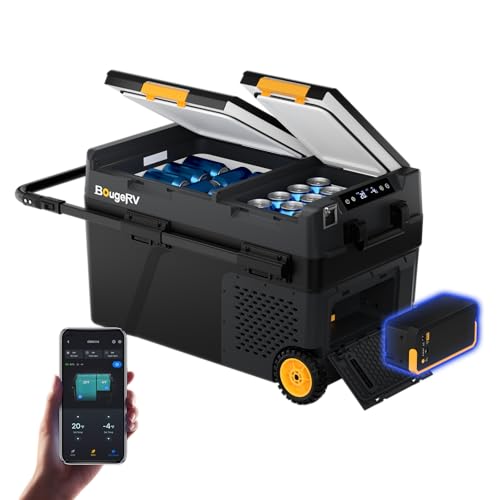
BougeRV CR45 12V Portable Refrigerator
BougeRV offers a dual zone layout at a mid range level, so one side can run as a freezer while the other holds drinks at fridge temperature. Three stage battery protection stops the unit from flattening a starter battery overnight. Owners report the divider is fixed, so plan your packing around the split.
Pros
- Two independent temperature zones
- Adjustable low voltage cutoff
- Strong capacity for the outlay
Cons
- Fixed divider limits packing flexibility
- Insulation is thinner than premium rivals

Alpicool C15 Portable Refrigerator
The C15 is the size of a large cool box and slots behind a front seat or in a small boot without argument. It still uses a real compressor, so it holds temperature in hot weather where a thermoelectric cooler would give up. Owners report it is best suited to drinks and a day of food rather than a week of provisions.
Pros
- Easiest entry into compressor cooling
- Fits in tight cabin spaces
- Light enough to move single handed
Cons
- Small capacity fills quickly
- Compressor noise is noticeable in a quiet cabin

Setpower AJ50 Portable Freezer
At fifty litres the AJ50 covers a family week rather than a weekend, and the interior takes tall bottles upright, which many similar units cannot. A digital panel sets the target down into freezer territory. Based on specifications it draws more current than smaller units, so a dual battery or portable power station is sensible.
Pros
- Genuine multi day capacity
- Tall interior takes bottles upright
- Reaches full freezer temperatures
Cons
- Higher current draw than compact models
- Needs a decent amount of boot space

Anker EverFrost Powered Cooler 40
Anker takes a different angle by building a removable battery into the cooler, so it keeps running for hours after the vehicle is switched off and can be topped up by solar. Wheels and a pull handle make it manageable across a campsite. Owners report the battery adds real weight but removes the anxiety of a flat starter battery.
Pros
- Runs independently of the vehicle
- Solar charging supported
- Wheeled body moves easily on hard ground
Cons
- Heavy once the battery is fitted
- Wheels struggle on soft sand
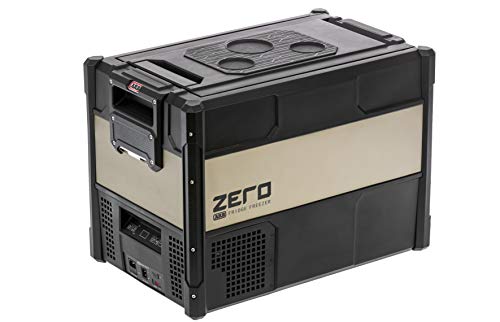
ARB ZERO Fridge Freezer
ARB designed the ZERO around a fully sealed compressor bay so dust and water cannot reach the electronics, which is the failure point on many fridges used off road. Build quality and the mounting hardware reflect its four wheel drive heritage. Owners report it is a long term purchase rather than a casual one.
Pros
- Sealed electronics resist dust and water
- Serious build quality for off road use
- Well supported mounting accessories
Cons
- Highest outlay in this roundup
- Heavier than comparable capacities
How they stack up
| # | Model | Capacity | Best for | Score | Price |
|---|---|---|---|---|---|
| 1 | Dometic CFX3 35 | 36 litres | Best overall | 9.4 | Check price |
| 2 | ICECO JP40 Portable Refrigerator | 40 litres | Best for rough travel | 9.2 | Check price |
| 3 | BougeRV CR45 12V Portable Refrigerator | 45 litres across two zones | Best value | 9.0 | Check price |
| 4 | Alpicool C15 Portable Refrigerator | 15 litres | Best budget | 8.8 | Check price |
| 5 | Setpower AJ50 Portable Freezer | 50 litres | Best for longer trips | 8.6 | Check price |
| 6 | Anker EverFrost Powered Cooler 40 | 43 litres | Best with built in battery | 8.3 | Check price |
| 7 | ARB ZERO Fridge Freezer | Fully sealed | Best premium build | 8.0 | Check price |
What matters most
Compressor coolers versus thermoelectric boxes A thermoelectric cooler only drops the interior a fixed number of degrees below ambient, so on a hot day it is barely cooler than the cabin. A compressor fridge works like the one in your kitchen and sets an actual target temperature regardless of outside heat. Every unit in this roundup is a compressor model, which is why they can freeze and why they cost more. If a listing quotes cooling as degrees below ambient, it is not the same category of product.
Power draw and protecting your battery Current draw varies enormously with ambient temperature and how often the lid is opened, so quoted figures are best case. What matters more is the low voltage cutoff, which shuts the fridge down before it drains the battery below starting voltage. Most units offer low, medium and high settings. Running from the starter battery calls for the most protective setting, while a dedicated leisure battery or power station allows a lower cutoff and longer runtime.
Capacity, shape and how you actually pack Listed litres include space the compressor housing intrudes on, so usable volume is always smaller than the number suggests. Interior height decides whether bottles stand upright or lie on their side, and a fridge that forces bottles down wastes a lot of space. Dual zone units are convenient but the divider is often fixed, which means a bulky item may not fit in either side. Measure the boot space and think about the shape of what you carry before choosing on litres alone.
Insulation and holdover time Insulation quality decides how long a fridge coasts after power is disconnected, which is what happens every time you park up. Thicker walls mean the compressor runs less often overall, cutting both noise and consumption. Some models offer removable insulated covers that add another layer for very hot conditions. Pre chilling the fridge on mains power at home before a trip also reduces the load the vehicle has to carry on the first leg.
Frequently asked questions
Can a portable car fridge drain my car battery?
It can if the low voltage cutoff is disabled or set too low. Every unit here has a battery protection setting, and using the high protection level means the fridge shuts off well before the battery is too weak to start the engine.
Do car fridges run when the engine is off?
Yes, as long as the 12V socket stays live and the battery holds voltage. Many vehicles cut power to accessory sockets with the ignition, so check yours or wire the fridge to a dedicated circuit.
How cold do portable car fridges get?
Most compressor models in this roundup reach true freezer temperatures, commonly around minus 18 degrees Celsius. Reaching the lowest settings takes longer and uses more power than running as a simple fridge.
What size car fridge do I need?
Around fifteen to twenty five litres suits day trips and drinks for two. Thirty five to forty five litres covers a weekend for a couple or a family day out, and fifty litres or more is the territory of week long trips and full food shops.
Do I need a dual battery system?
Not for short trips where the engine runs regularly. If you park for a full day or camp overnight without driving, a second battery or a portable power station removes the risk entirely.
Are portable car fridges noisy?
The compressor cycles audibly, roughly comparable to a small kitchen fridge. Variable speed compressors ramp gently and are quieter in practice than fixed speed units that switch hard on and off.
Can I run one from a portable power station?
Yes, and it is a common pairing. Compressor fridges are relatively efficient, and a mid sized power station will typically run one for a day or more depending on ambient heat and how often the lid is opened.
Should the fridge be pre chilled before a trip?
Running it on mains power at home for a few hours before loading is worth doing. Cooling an already cold box on the road takes far less energy than pulling warm food down to temperature while driving.
Our pick
The Dometic CFX3 35 is the portable car fridge we would choose for regular trips, since strong insulation and a variable speed compressor keep power draw manageable on long drives. The ICECO JP40 is the better answer where rough tracks and dust are part of the routine, and the Alpicool C15 is an easy way to find out whether 12V cooling suits your travel before committing further.