How to Catch Ammonia Spikes Before They Stress Your Fish
API Freshwater Master Test Kit covers the widest parameter range, using liquid reagents for the most accurate freshwater readings. Aquarium Co-Op Master Test Kit simplifies the color chart for easier beginner reading. API Saltwater Master Test Kit adds the high-range pH that reef tanks require.
API Freshwater Master Test Kit stays the most complete option, covering pH, ammonia, nitrite and nitrate with liquid reagents good for hundreds of tests. Its main drawback is speed, since each parameter needs separate drops and a short wait.
Freshwater and saltwater tanks need different parameter panels, and strip tests trade some accuracy for speed, a distinction easy to miss when skimming a listing. We compared published parameter counts, test formats, reagent shelf life and owner feedback on color-chart clarity across current kits.
What we recommend

API Freshwater Master Test Kit
Liquid reagent drops measure pH, high-range pH, ammonia, nitrite and nitrate from one box. Each vial supports roughly 800 individual tests before running dry. A printed color chart and instruction booklet guide new-tank cycling as well as routine maintenance.
Pros
- Covers every parameter needed during tank cycling
- Liquid reagents read more precisely than strips
- One kit lasts most hobbyists well over a year
Cons
- Each test takes several minutes to complete
- Color-chart reading varies with lighting conditions
Aquarium Co-Op Master Test Kit
Core parameters match a standard liquid kit, but a redesigned chart uses fewer, more distinct color blocks. A companion app logs readings and helps match colors under different lighting. Dropper caps on each reagent bottle are sized to cut down on measuring errors.
Pros
- Simplified chart reduces color-matching mistakes
- Companion app logs readings over time
- Dropper caps limit reagent measuring errors
Cons
- Costs more than comparable API kits
- Fewer total tests per bottle than some rivals
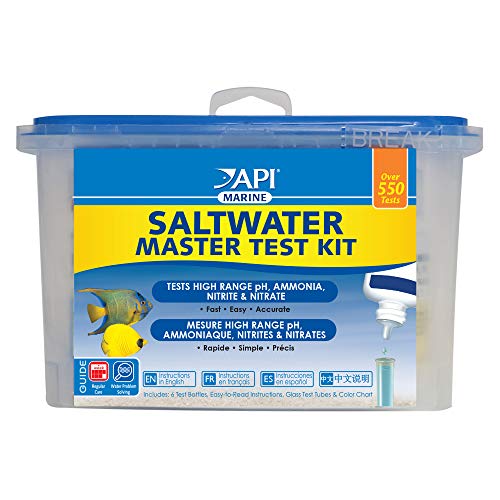
API Saltwater Master Test Kit
A high-range pH reagent matches the alkaline conditions typical of reef and saltwater systems. Ammonia, nitrite and nitrate tests use the same drop-count method as the freshwater version. Reagent volume covers roughly 130 to 480 tests, depending on the parameter.
Pros
- High-range pH suits alkaline reef water
- Same trusted drop-count method as freshwater kits
- Covers core cycling parameters for new saltwater tanks
Cons
- Does not test calcium, magnesium or alkalinity
- Fewer tests per bottle than the freshwater version

Tetra EasyStrips 6-in-1 Test Strips
One strip dip reads pH, hardness, alkalinity, nitrite and nitrate together in about a minute. Pad colors compare against a chart printed right on the bottle label. Quick weekly checks suit this format better than precise chemistry work.
Pros
- One dip covers multiple parameters at once
- Results read in about 60 seconds
- No reagent measuring or mixing required
Cons
- Strip colors fade faster than liquid reagent results
- Less precise than drop-based test kits

Salifert Reef Test Kit Calcium
Titration counts drops until a color change signals the exact calcium level, sharper than reading a color-block chart. Reef keepers dosing calcium for coral growth get real precision from this method. A compact vial and syringe kit fits into a small tank cabinet.
Pros
- Titration reading avoids color-chart guesswork
- Compact kit stores easily near the tank
- Precision matters for dosing coral calcium correctly
Cons
- Tests only one parameter per kit
- Requires steady hands to count drops accurately

JNW Direct 16-in-1 Test Strips
Sixteen pads on a single strip cover pH, hardness, alkalinity, nitrate, nitrite, chlorine, copper and more. This wide panel suits tap water checks before a water change as well as ongoing tank monitoring. A resealable canister keeps unused strips protected from humidity.
Pros
- Covers tap water metals alongside tank parameters
- Resealable canister keeps strips from degrading
- Large strip count lowers the cost per test
Cons
- Sixteen pads can be hard to read all at once
- Less precise than liquid reagent kits for ammonia

API 5-in-1 Test Strips
A single dip reads nitrate, nitrite, hardness, alkalinity and pH in under a minute. Strips fit in a pocket for checking water at a fish store or a friend’s tank. Ammonia is not included, so this works best alongside a liquid kit rather than replacing one.
Pros
- Fits in a pocket for testing away from home
- Fastest read time of any kit in this group
- Simple enough for quick weekly monitoring
Cons
- No ammonia test included on the strip
- Color fading over time reduces long-term accuracy
How they stack up
| # | Model | Parameters | Best for | Score | Price |
|---|---|---|---|---|---|
| 1 | API Freshwater Master Test Kit | pH, ammonia, nitrite, nitrate | Best overall | 9.4 | Check price |
| 2 | Aquarium Co-Op Master Test Kit | pH, ammonia, nitrite, nitrate | Best for beginners | 9.1 | Check price |
| 3 | API Saltwater Master Test Kit | High-range pH, ammonia, nitrite, nitrate | Best for reef and saltwater tanks | 8.8 | Check price |
| 4 | Tetra EasyStrips 6-in-1 Test Strips | pH, GH, KH, nitrite, nitrate | Best for quick strip testing | 8.6 | Check price |
| 5 | Salifert Reef Test Kit Calcium | Calcium | Best for precise reef chemistry | 8.4 | Check price |
| 6 | JNW Direct 16-in-1 Test Strips | 16 including chlorine, copper, iron | Best budget | 8.2 | Check price |
| 7 | API 5-in-1 Test Strips | Nitrate, nitrite, GH, KH, pH | Best for on-the-go dip testing | 8.0 | Check price |
What matters most
What to look for in an aquarium test kit Parameter coverage matters most during the first two months of a new tank, when ammonia and nitrite spikes can happen fast. Liquid reagent kits read more precisely than strips but take longer per test. Reef tanks need calcium, magnesium and alkalinity tests that freshwater kits skip entirely.
Best test kits for new tank cycling A full liquid kit like the API Freshwater Master Test Kit tracks ammonia and nitrite daily until both read zero. Strips work fine for quick spot checks but can miss small ammonia changes during this stage. Consistent testing through cycling prevents the stress spikes that harm new fish.
Best test kits for saltwater and reef tanks Reef systems need calcium and alkalinity tracked alongside the standard cycling parameters. Salifert Reef Test Kit Calcium adds titration precision that a color-chart kit cannot match. Pairing it with the API Saltwater Master Test Kit covers both coral health and basic water safety.
Can strip tests replace liquid kits for routine checks? Established tanks with stable parameters often only need a fast weekly strip test rather than a full liquid panel. Tetra EasyStrips and API 5-in-1 both suit this lighter monitoring schedule. A liquid kit still belongs in the cabinet for whenever a fish shows unexplained stress.
Good to know
How often should you test aquarium water?
New tanks need daily testing during the first six to eight weeks of cycling, while established tanks usually only need weekly checks.
Test strips vs liquid test kits, which is more accurate?
Liquid reagent kits read more precisely, since the color change is sharper, while strips trade some accuracy for a faster result.
Which parameters matter most for a new fish tank?
Ammonia, nitrite and nitrate matter most during cycling, since both ammonia and nitrite stay toxic to fish even at low levels.
Do saltwater tanks need different tests than freshwater tanks?
Reef tanks need calcium, magnesium and alkalinity tracked alongside the ammonia, nitrite, nitrate and pH tests freshwater tanks use.
How long do aquarium test kit reagents last?
Most liquid reagents stay accurate for one to two years when stored away from direct sunlight and heat.
Can tap water test strips work for an aquarium?
Strips covering chlorine, copper and iron, like the JNW Direct 16-in-1, work for both tap water checks and tank monitoring.
Is high-range pH testing necessary for a reef tank?
Reef water sits more alkaline than freshwater, so a high-range reagent reads accurately where a standard test would max out.
What does titration testing measure that a color chart cannot?
Titration counts exact drops to a color-change endpoint, giving a specific number instead of matching to the nearest chart block.
What is the best water test kit for beginners?
Aquarium Co-Op Master Test Kit suits beginners best, since its simplified color chart and companion app reduce reading mistakes.
Can one test kit cover both freshwater and saltwater tanks?
No single kit covers both well, since saltwater tanks need a high-range pH reagent that freshwater kits do not include.
Our pick
API Freshwater Master Test Kit remains the safest default for anyone running a freshwater tank through its first cycling period. Reef keepers should pair the API Saltwater Master Test Kit with a dedicated calcium test like the Salifert kit for coral-specific chemistry. Hobbyists who only need fast weekly spot checks on an established tank can rely on strip tests instead.