Reptile Heating Pads for Steady Overnight Warmth
The Zoo Med ReptiTherm Under Tank Heater is our top reptile heating pad for reliable, even belly heat. The iPower Reptile Heat Pad with Thermostat is the best value because control comes in the box, and the Fluker’s Ultra Deluxe Premium Heat Mat suits keepers who want a tougher adhesive backing.
For most keepers the Zoo Med ReptiTherm Under Tank Heater is the reptile heating pad worth buying, with the iPower Reptile Heat Pad with Thermostat as the best value bundle and the Fluker’s Ultra Deluxe Premium Heat Mat for a sturdier stick down option.
Heating pads are simple devices that become dangerous the moment they run without control, because an unregulated mat can push glass well past a safe surface temperature. We compared published wattage figures, recommended tank sizes, adhesive designs and thermostat compatibility, alongside what owners report about mats losing adhesion or running hot, then ranked the ones that hold a stable gradient overnight.
What we recommend
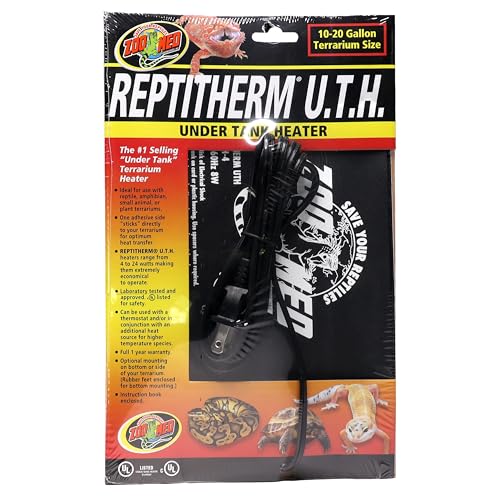
Zoo Med ReptiTherm Under Tank Heater
The ReptiTherm is the mat most reptile keepers end up recommending, largely because the heat spreads evenly instead of concentrating in a hot band across the middle. It sticks directly to the underside of a glass tank and raises the substrate above it by a modest, controllable amount. It ships without a thermostat, and running it without one is the single most common mistake, so budget for a controller alongside it.
Pros
- Even heat spread rather than a narrow hot band
- Sizing options match common tank footprints
- Thin profile leaves airflow clearance under the tank
Cons
- No thermostat included
- Adhesive backing makes removal difficult

iPower Reptile Heat Pad with Thermostat
Buying a mat and controller separately usually costs more than this bundle, which pairs a standard heat pad with a digital thermostat and probe. The controller does the important job of cutting power once the probe reaches your set point, which keeps the hot spot in range without constant checking. The thermostat is basic rather than proportional, so it cycles on and off rather than dimming smoothly.
Pros
- Thermostat and probe included in the box
- Digital set point is easy to dial in
- Cheaper than buying mat and controller separately
Cons
- On and off control cycles rather than dimming
- Probe cable is short for larger enclosures

Fluker’s Ultra Deluxe Premium Heat Mat
Fluker’s built this mat around a tougher backing that resists the peeling and bubbling that ends the life of cheaper pads. That makes it a sensible choice for a permanent enclosure you do not intend to reconfigure. Heat output sits in the same range as other quality mats, so the difference you are paying for is durability rather than warmth, and it still needs an external thermostat.
Pros
- Tougher backing resists peeling over time
- Consistent output across the mat surface
- Good size range for common enclosures
Cons
- Very difficult to remove once fitted
- No thermostat included

Zilla Heat Mat
Small enclosures are easy to overheat because a mat sized for a larger tank will cook a fifteen litre setup. Zilla’s smaller mats give a genuinely low wattage option for hatchling tubs, small geckos and quarantine setups. The build is simple and the cord is thin enough to run under a lid without gaps, though it is another mat that assumes you already own a thermostat.
Pros
- Low wattage options suit small tanks and tubs
- Thin cord routes easily under lids
- Simple build with few failure points
Cons
- Too small for larger adult enclosures
- No thermostat included

BN-LINK Reptile Heat Mat with Thermostat Controller
BN-LINK is better known for its plug in temperature controllers, and pairing one with a mat gives you more adjustment than the average bundle, including tighter differential settings and clear display readouts. That matters for species with a narrow tolerance band. The mat itself is conventional, so the reason to pick this package is the controller you get with it.
Pros
- Controller offers finer adjustment than most bundles
- Clear display makes checking the set point easy
- Controller can be reused with a future mat
Cons
- Controller occupies a full outlet space
- Mat itself is unremarkable on its own

VIVOSUN Reptile Heating Pad
VIVOSUN’s mat covers the basics for keepers setting up a second enclosure or a temporary quarantine tub without spending on a premium brand. Heat output is adequate and the adhesive holds well enough on clean glass. Owners report more variation between units than with the established reptile brands, which makes running it on a thermostat and verifying with an infrared thermometer even more important.
Pros
- Lowest cost way to add a second heat source
- Adequate output for small and medium tanks
- Multiple sizes available
Cons
- More unit to unit variation than premium brands
- Adhesive is less durable over repeated moves

Tikaton Reptile Heat Pad
Tikaton’s mats are thin and flexible enough to sit under plastic tubs in a rack system, where a rigid pad would rock the container. That flexibility also makes them easier to reposition during a setup change. Because plastic conducts heat differently from glass, verify the internal surface temperature after installing rather than trusting the thermostat probe placement alone.
Pros
- Flexible enough for tub and rack setups
- Thin profile avoids rocking containers
- Easy to reposition during setup changes
Cons
- Needs careful checking when used under plastic
- No thermostat included
How they stack up
| # | Model | Type | Best for | Score | Price |
|---|---|---|---|---|---|
| 1 | Zoo Med ReptiTherm Under Tank Heater | Adhesive under tank heater | Best overall | 9.4 | Check price |
| 2 | iPower Reptile Heat Pad with Thermostat | Heat pad with digital thermostat | Best value | 9.2 | Check price |
| 3 | Fluker’s Ultra Deluxe Premium Heat Mat | Adhesive under tank heater | Best adhesive design | 9.0 | Check price |
| 4 | Zilla Heat Mat | Adhesive under tank heater | Best for small enclosures | 8.8 | Check price |
| 5 | BN-LINK Reptile Heat Mat with Thermostat Controller | Heat mat with plug in controller | Best control features | 8.6 | Check price |
| 6 | VIVOSUN Reptile Heating Pad | Adhesive heat pad | Best budget option | 8.3 | Check price |
| 7 | Tikaton Reptile Heat Pad | Flexible heat pad | Best for tubs and racks | 8.0 | Check price |
How to choose
A thermostat is not optional An unregulated heating pad has one setting, which is full power, and glass under a mat can climb far past a safe surface temperature. Every mat in this list either includes a thermostat or expects you to buy one. Fit the probe against the surface the animal actually contacts, not floating in the air, and set the controller to the species specific hot spot rather than a general number you read online.
Match wattage and footprint to the enclosure A heating pad should cover roughly a third to a half of the tank floor. Cover more and you remove the cool end of the gradient, which is the part that lets a reptile regulate its own temperature. Cover much less and the animal cannot warm up properly. Size the mat by tank footprint, then verify the surface temperature at the substrate rather than at the glass.
Belly heat suits some species and not others Under tank heaters replicate warm ground, which fits many terrestrial snakes and geckos. Species that bask from above, including bearded dragons and most diurnal lizards, need an overhead heat source and often UVB as well. A heat mat is a supplement in those setups rather than the primary source, so check your species requirements before assuming a mat covers it.
Leave an air gap and check the surface temperature Most mats are designed with small standoff feet or a raised tank in mind, because trapping heat between the mat and a flat surface is how glass cracks and adhesive degrades. Raise the tank slightly so air can move underneath. After installation, take readings with an infrared thermometer at several points across the warm end so you know the real gradient rather than the number on a controller.
Frequently asked questions
Do reptile heating pads need a thermostat?
Yes. Without one the mat runs at full output continuously and can push the surface well beyond a safe temperature. A thermostat with a probe against the contact surface is the single most important accessory.
How much of the tank floor should the mat cover?
Roughly a third to a half. That leaves a genuine cool end so the animal can move away from the heat, which is how reptiles regulate their body temperature.
Can I put a heat mat inside the enclosure?
No. Under tank heaters are designed for the outside of the glass. Placed inside they create direct contact burn risk and the electrical insulation is not intended for substrate or humidity exposure.
Will a heating pad work under a plastic tub?
It can, and several keepers run rack systems this way, but plastic conducts heat differently from glass. Verify the internal surface temperature after installing and keep the thermostat set point conservative until you have readings.
Do heat mats provide UVB?
No. Heating pads produce heat only. Species that need UVB require a dedicated UVB lamp, and no under tank heater substitutes for it.
How long do reptile heating pads last?
Owners commonly report several years of continuous use. Failure usually shows as adhesive lifting or an area that stops warming, so check the mat during routine enclosure maintenance.
Should the heat mat run at night?
For species that need constant belly heat, yes, controlled by the thermostat. Others benefit from a night time drop. Check the temperature range your species needs across a full day rather than running the same set point around the clock.
Can I remove an adhesive mat once it is stuck?
It is difficult and often damages the mat. If you expect to reconfigure the enclosure, use a flexible non adhesive style pad or fit the adhesive mat to a removable panel rather than the tank itself.
Our pick
The Zoo Med ReptiTherm Under Tank Heater is the reptile heating pad we would fit first, because the even heat spread and sensible size range make it easy to build a proper gradient. Keepers who do not already own a controller will get better overall value from the iPower Reptile Heat Pad with Thermostat, and anyone building a permanent enclosure should consider the tougher backing on the Fluker’s Ultra Deluxe Premium Heat Mat.


