Which Smart Hub Actually Runs Your Whole House?
Our top pick is the Amazon Echo Hub for its wall mounted dashboard and broad Matter support. The Aqara Hub M3 is the value choice thanks to Zigbee, Thread and infrared control in one box. Hubitat Elevation C-8 suits anyone who wants automations that run entirely offline.
The Amazon Echo Hub leads this roundup because it combines a wall mounted control panel with Matter, Zigbee and Thread radios, while the Aqara Hub M3 delivers most of that coverage in a smaller unit and the Hubitat Elevation C-8 keeps every automation running locally.
Smart hubs are tricky because the box you buy decides which devices you can add for years, and the spec sheets rarely explain what happens when your internet drops. We compared published radio support, Matter and Thread certification, local automation capability and the size of each platform’s device compatibility list, then weighed what owners report about setup and reliability.
The top picks, ranked

Amazon Echo Hub
The Echo Hub is a wall mountable eight inch touch panel that doubles as a full smart home controller with Zigbee, Thread, Matter and Sidewalk radios built in. It shows live camera feeds, scenes and device tiles without hunting through a phone app. Owners report that the dashboard becomes the main way the household controls lights and locks.
Pros
- Broadest protocol support of any mainstream hub
- Wall panel makes shared household control simple
- Works with an enormous Alexa device library
Cons
- Most automations still depend on Amazon cloud services
- Needs a power run to the wall location

Aqara Hub M3
Aqara built the M3 as a bridge between ecosystems, pairing Zigbee 3.0, Thread border router duties and Matter output in a compact unit. It also includes a 360 degree infrared blaster so older air conditioners and televisions join the same routines. Local automation keeps schedules running when the network goes down.
Pros
- Infrared control brings legacy appliances into scenes
- Wired ethernet improves stability over Wi-Fi only hubs
- Bridges Aqara sensors into Matter for other platforms
Cons
- No Z-Wave radio
- Aqara app takes some learning for complex rules
Samsung SmartThings Station
The SmartThings Station is a wireless phone charger with a Matter controller and Thread border router inside, so it hides in plain sight on a nightstand. A single button triggers scenes such as good night or leaving home. It fits neatly if you already run Samsung televisions or appliances.
Pros
- Doubles as a bedside wireless charger
- Simple onboarding for Matter devices
- Tight integration with Samsung appliances
Cons
- No Zigbee or Z-Wave radio for older sensors
- Cloud dependent for many routines

Hubitat Elevation C-8
Hubitat processes automations on the hub itself, so lights and locks keep responding even with the router unplugged. The C-8 adds external antennas for Zigbee and Z-Wave plus improved range over earlier generations. It rewards people who enjoy building rules rather than tapping through wizards.
Pros
- Automations continue during internet outages
- No subscription for core features
- Very deep rule engine and community drivers
Cons
- Interface is technical rather than friendly
- No built in voice assistant

Home Assistant Green
Home Assistant Green ships with the open source Home Assistant operating system preloaded, which removes the usual Raspberry Pi assembly step. It connects to thousands of integrations and stores history locally rather than in a vendor cloud. Adding a Zigbee or Z-Wave stick expands it further.
Pros
- Unmatched integration coverage across brands
- Local dashboards, logging and energy tracking
- No forced subscription for local use
Cons
- Radios require separate USB dongles
- Steep learning curve for newcomers

Apple HomePod mini
The HomePod mini works as a Home hub for Apple Home, acting as a Thread border router and running automations while you are away. Sound quality is solid for a speaker this size, so it earns its shelf space twice. It suits families already living in iPhone and iPad.
Pros
- Effortless setup inside the Apple ecosystem
- Doubles as a capable small speaker
- Thread support strengthens mesh coverage
Cons
- Limited use outside Apple Home
- No Zigbee or Z-Wave
Aeotec Smart Home Hub
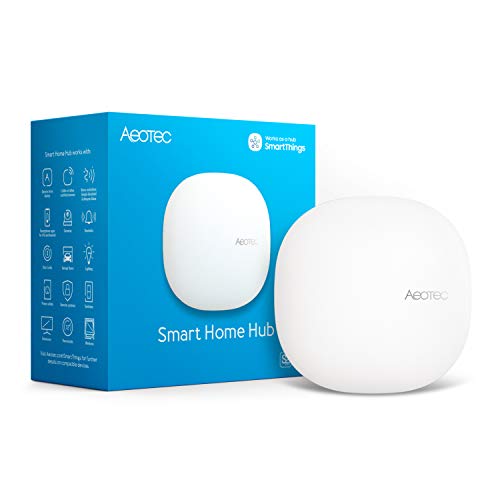
Built as the successor to the third generation SmartThings hub, the Aeotec unit keeps Zigbee and Z-Wave radios alive for households with older sensors and switches. It runs the SmartThings platform, so the app and automation tools stay familiar. Wired ethernet keeps the connection steady.
Pros
- Keeps large Z-Wave installations usable
- Familiar SmartThings app and automations
- Wired networking option
Cons
- Depends on the SmartThings cloud for many routines
- Plain design meant to stay hidden
Compared at a glance
| # | Model | Display | Best for | Score | Price |
|---|---|---|---|---|---|
| 1 | Amazon Echo Hub | 8 inch touchscreen | Best overall | 9.4 | Check price |
| 2 | Aqara Hub M3 | Zigbee 3.0, Thread, Matter, IR | Best value | 9.2 | Check price |
| 3 | Samsung SmartThings Station | Matter, Thread, Wi-Fi, Bluetooth | Best for Samsung households | 9.0 | Check price |
| 4 | Hubitat Elevation C-8 | Zigbee, Z-Wave Plus, Matter, LAN | Best for offline reliability | 8.8 | Check price |
| 5 | Home Assistant Green | Home Assistant OS preinstalled | Best for tinkerers | 8.6 | Check price |
| 6 | Apple HomePod mini | Thread, Matter, Wi-Fi, Bluetooth | Best for Apple users | 8.3 | Check price |
| 7 | Aeotec Smart Home Hub | Zigbee, Z-Wave, Wi-Fi, LAN | Best for Z-Wave collections | 8.0 | Check price |
What matters most
Start with the protocols your devices already speak A hub can only control what its radios reach. Zigbee covers many affordable sensors and bulbs, Z-Wave dominates older locks and in wall switches, Thread is the newer low power mesh behind Matter, and Wi-Fi devices connect over your router. Write down what you own before shopping, because a Matter only hub will not talk to a five year old Z-Wave deadbolt no matter how modern it looks.
Decide how much you care about local control Cloud based hubs are easier to set up and usually cheaper, but a broadband outage can leave motion triggered lights dead. Hubs such as Hubitat and Home Assistant run their rule engines on the device, so schedules and sensor triggers keep working. If your automations control heating, security lighting or accessibility features, local processing is worth the extra setup effort.
Match the interface to who lives in the house The most capable hub is useless if only one person can operate it. Wall panels and voice assistants make shared control obvious for guests and children, while app only hubs suit single users comfortable with menus. Owners report that a visible dashboard dramatically increases how much a family actually uses their smart home rather than reverting to wall switches.
Plan for range and placement Mesh protocols relay signals through mains powered devices, so a hub buried in a basement cabinet will struggle. Central placement, an ethernet run and a few always on smart plugs acting as repeaters solve most reliability complaints. Models with external antennas, such as the Hubitat C-8, give you more room to improve coverage later without replacing the hub.
Common questions
Do I still need a hub if my devices support Matter?
Yes in most cases. Matter devices need a controller to join and coordinate them, and Thread based accessories need a border router. Many people already have one inside a speaker or streaming device, but a dedicated hub gives you dashboards, richer automations and better coverage.
Can one hub control Zigbee, Z-Wave and Matter together?
A few can. The Hubitat Elevation C-8 and the Aeotec Smart Home Hub carry both Zigbee and Z-Wave radios alongside newer standards, and Home Assistant Green reaches everything once you add USB dongles. Most mainstream hubs cover only some of that list.
Will my automations keep working if the internet goes down?
That depends entirely on the hub. Locally processed platforms keep running schedules and sensor triggers offline. Cloud based hubs often lose voice control and remote access immediately, and some lose local routines too.
How many devices can a smart hub handle?
Published limits usually run well into the hundreds, but practical limits come from mesh density and interference. Owners report that adding mains powered repeaters matters far more than the headline device count.
Is a subscription required?
Core hub functions are typically free. Subscriptions usually appear for cloud video storage, professional monitoring or advanced remote features rather than for basic automation.
Should the hub be wired to my router?
Wired ethernet is preferable when the option exists. It removes Wi-Fi congestion from the equation and keeps the hub reachable even when the wireless band is busy with streaming.
Can I run two hubs at once?
Yes, and many households do. A common setup pairs a local rules hub with a voice friendly speaker hub, bridging the two so family members can still use voice commands.
What happens to my setup if the company stops supporting the hub?
Cloud dependent hubs can lose most functionality, which is the strongest argument for locally controlled platforms. Open systems such as Home Assistant continue to work regardless of vendor decisions.
Our take
The Amazon Echo Hub is the most complete pick for a typical household because it combines wide protocol support with a control panel everyone can use. Choose the Aqara Hub M3 if you want strong coverage in a smaller footprint, and the Hubitat Elevation C-8 if automations must keep running when the internet does not.