Smart Ceiling Fans Worth Wiring Into Your Smart Home
The Big Ass Fans Haiku L takes the overall pick for its airflow efficiency and near silent DC motor. The Hunter Dempsey Smart Ceiling Fan is the best mainstream option with built in Wi Fi, and the Carro Smafan Voyage is the value choice for most rooms.
The Big Ass Fans Haiku L is our top pick for smart ceiling fans, with the Hunter Dempsey Smart Ceiling Fan the best mainstream all rounder and the Carro Smafan Voyage delivering most of the benefit for a lot less.
Smart ceiling fans are tricky because a fan is a wiring job, not a plug in gadget, and many models need a neutral wire or a specific receiver in the canopy. We compared published airflow figures, motor types, platform support and installation requirements, plus what owners report about app reliability over time.
What matters most
Airflow matters more than the smart features A fan that answers a voice command but barely moves air is a bad fan with a chip in it. The figure to look for is CFM, which measures air moved per minute, alongside efficiency in CFM per watt. DC motors generally deliver more air per watt and run quieter than AC motors, which is why almost every premium smart fan uses one. Get the airflow right first, then worry about which assistant it speaks to.
Check the wiring before you buy Most smart fans need a constant power supply and many need a neutral wire in the ceiling box, which older homes may not have. Some rely on a receiver module in the canopy, which needs space above the mount. If the fan is replacing a light with a single switch, plan for the switch to stay permanently on so the fan can be controlled by app and remote instead.
Size the fan to the room and the ceiling A fan too small for the room runs at high speed constantly and gets noisy, while a large fan in a small room can feel like a wind tunnel. As a rough guide, rooms up to about a hundred and forty square feet suit a forty two to forty eight inch sweep, and larger open spaces need fifty two inches or more. Ceilings under eight feet call for a flush mount, and blades should sit at least seven feet from the floor.
Reverse mode is the underused feature Running the fan in reverse at low speed during winter pushes warm air trapped at the ceiling back down the walls without creating a draught, and it can make a heated room feel noticeably more even. Every fan here supports it, but many owners never switch it on. In a smart fan, the reverse setting can be automated seasonally through the app, which is where the integration genuinely earns its place.
The best picks, ranked

Big Ass Fans Haiku L
The Haiku L pairs an efficient DC motor with airfoil shaped blades, so it moves a large volume of air at settings where other fans are already whining. SenseME features can run the fan automatically from room temperature and occupancy. It is the most expensive fan here and the one owners are least likely to regret.
Pros
- Exceptional airflow relative to power drawn
- Genuinely quiet even at higher speeds
- Automation from temperature and occupancy sensing
Cons
- Costs far more than mainstream smart fans
- Minimal styling will not suit traditional rooms
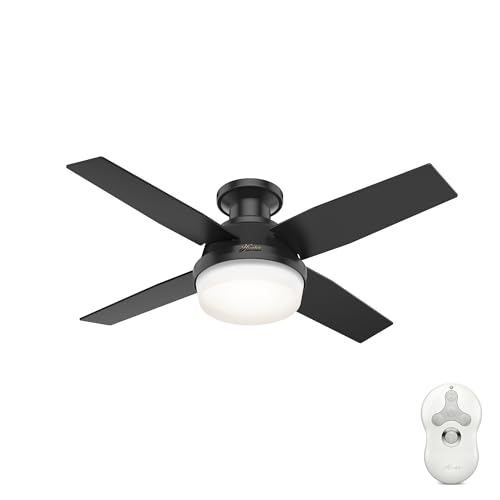
Hunter Fan Company Dempsey Smart Ceiling Fan
Hunter builds Wi Fi into the fan itself, so there is no separate hub or dongle to hide in the canopy. The Dempsey is a low profile design that suits standard eight foot ceilings and includes a dimmable LED light. Owners report the app is straightforward and voice control works without extra bridging.
Pros
- No hub or extra receiver needed
- Low profile suits standard height ceilings
- Established brand with easy parts availability
Cons
- AC motor is louder than DC alternatives
- Light output is modest for a large room

Carro Smafan Voyage Smart Ceiling Fan
Carro packs a DC motor, colour adjustable LED light and Wi Fi control into a fan that costs a fraction of the premium options. Ten speeds give fine control and reverse mode helps in winter. Build quality is decent rather than exceptional, which is the trade being made.
Pros
- DC motor efficiency at a mainstream price
- Ten speeds allow precise comfort tuning
- Adjustable colour temperature on the light
Cons
- Finish quality trails premium brands
- App occasionally needs a reconnect after outages

Modern Forms Aviator Smart Fan
Modern Forms builds fans that look like architectural fittings, and the Aviator uses a slim DC motor housing with three long blades. Control comes through the brand app with scheduling and adaptive learning. It is aimed at rooms where the fan is meant to be seen rather than ignored.
Pros
- Design quality well above typical ceiling fans
- Broad platform support including HomeKit
- Damp rated versions suit covered outdoor spaces
Cons
- Long blades need generous ceiling clearance
- Premium pricing across the range

Fanimation Slinger v2 Ceiling Fan
With a large blade sweep and a powerful DC motor, the Slinger v2 is built for open plan spaces and covered patios where smaller fans just stir the air near the ceiling. It works with a smart bridge for app and voice control. Owners report strong air movement at low, quiet speeds.
Pros
- Moves serious air in large open rooms
- Wet or damp rated for covered outdoor use
- Quiet at the speeds most people actually use
Cons
- Smart control needs a compatible bridge
- Too large for standard bedrooms

Reiga Smart Ceiling Fan
Reiga offers a DC motor fan with an integrated LED light and app control at a price that undercuts most name brands. Six speeds, reverse mode and scheduling cover the essentials. Instructions are the weak point, so allow extra time during installation.
Pros
- Cheapest route to a DC motor smart fan
- Reverse and scheduling included as standard
- Light is bright enough for medium rooms
Cons
- Installation instructions are poorly translated
- Long term app support is less certain
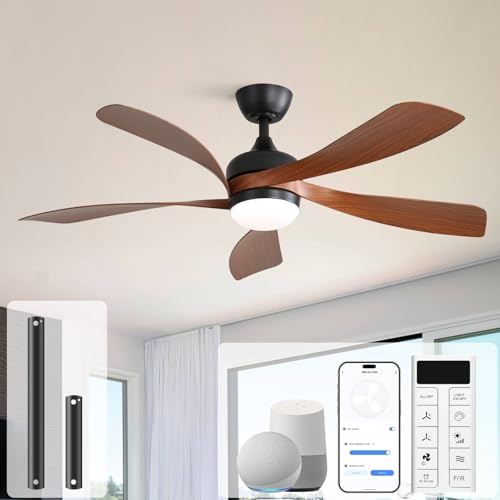
Sofucor Smart Ceiling Fan with Light
A compact flush mount fan aimed at bedrooms and smaller rooms, with a quiet DC motor and a dimmable light that shifts colour temperature. Sleep timers and schedules run from the app. Airflow is modest by design, which is exactly right for a room where noise matters more than raw output.
Pros
- Very quiet at bedroom appropriate speeds
- Flush mount suits low ceilings
- Warm to cool light shift helps evening use
Cons
- Airflow is limited in larger rooms
- Remote and app control occasionally disagree
Compared at a glance
| # | Model | Motor | Best for | Score | Price |
|---|---|---|---|---|---|
| 1 | Big Ass Fans Haiku L | Brushless DC | Best overall | 9.4 | Check price |
| 2 | Hunter Fan Company Dempsey Smart Ceiling Fan | Reversible with multiple speeds | Best mainstream choice | 9.2 | Check price |
| 3 | Carro Smafan Voyage Smart Ceiling Fan | DC with 10 speeds | Best value | 9.0 | Check price |
| 4 | Modern Forms Aviator Smart Fan | DC, six speeds | Best design | 8.8 | Check price |
| 5 | Fanimation Slinger v2 Ceiling Fan | Large diameter, indoor and outdoor rated | Best for large rooms | 8.6 | Check price |
| 6 | Reiga Smart Ceiling Fan | DC, six speeds | Best budget | 8.3 | Check price |
| 7 | Sofucor Smart Ceiling Fan with Light | Flush mount, low profile | Best for bedrooms | 8.0 | Check price |
Frequently asked questions
Do smart ceiling fans need a hub?
It varies. Hunter and Carro build Wi Fi into the fan so no hub is needed. Fanimation and some others use a bridge for smart control. Check the specific listing, because the same brand often sells both bridged and hub free models.
Can I install a smart ceiling fan myself?
Only if you are competent and permitted to work on fixed wiring where you live. It involves mains connections and secure mounting to a fan rated ceiling box. Many areas legally require a licensed electrician, and a fan falling from a ceiling is not a small failure.
What size ceiling fan do I need?
Match the blade sweep to room size. Around forty two to forty eight inches suits typical bedrooms, fifty two inches and up suits living rooms and open plan spaces. Blade tips should have at least eighteen inches of clearance from walls.
Is a DC motor worth the extra?
Usually yes. DC motors draw considerably less power for the same airflow, run quieter, and offer more speed steps for fine control. They also make reverse and soft start smoother. The main downside is a higher purchase price and more electronics that could eventually fail.
Will the fan still work if the internet goes down?
The physical remote and wall control keep working on every model here. What you lose is app control from outside the home and voice commands that route through a cloud service. Some fans with local control keep responding on the home network.
Do I need a neutral wire?
Most smart fans do, since the electronics need constant power. If your ceiling box has only a live and switched live, an electrician can often run a neutral or fit a suitable module. Check this before ordering, as it is the most common installation surprise.
Which direction should the fan spin?
Counterclockwise in summer to push a cooling breeze down, clockwise at low speed in winter to circulate warm air from the ceiling without a draught. Smart fans can automate this seasonal change through app schedules.
Can a smart fan work with a normal wall switch?
Yes, but the wall switch must stay on for the fan to receive commands. Many owners fit a switch guard or replace the switch with a compatible smart control so nobody cuts power to the fan and breaks the automation.
Final word
The Big Ass Fans Haiku L is the fan to buy when airflow and silence matter more than the outlay, and its sensing features are the most genuinely automatic here. The Hunter Dempsey is the easier mainstream choice with Wi Fi built in, and the Carro Smafan Voyage gets most of the way there for considerably less.


