Ultra Short Throw Projectors: Lumens, Lag, and Room Fit
Hisense PX3-Pro leads for picture quality with 4K Dolby Vision color, XGIMI Aura 2 suits gamers needing low input lag and built-in Android TV, and Epson LS800 delivers the strongest value with 4000-lumen brightness for daytime rooms. All three use laser light sources rated for over 20000 hours.
Hisense PX3-Pro stands out for home theater fans wanting 4K Dolby Vision color from a triple laser engine, though its 2200 ANSI lumen rating still trails brighter rivals in sunlit rooms.
Throw ratio, laser lumens, and built-in smart platforms vary widely across ultra short throw models, making side-by-side specs hard to compare directly. We selected these seven based on published lumen ratings, throw ratio, resolution method, input lag figures, and included streaming hardware from manufacturer listings.
Before you buy
What Makes a Projector Ultra Short Throw? Distance to the screen divided by image width is what throw ratio measures. Ultra short throw models sit inches from the wall, usually a 0.15:1 to 0.27:1 ratio versus 1.2:1 or higher on standard projectors. Placement under a window or shelf becomes possible since no ceiling mount or long cable run is needed. LG’s HU915QE holds the shortest ratio here at 0.19:1, letting a 120 inch image form from just inches away.
How Many Lumens Do You Need for Your Room? Blackout curtains let a room work fine with 2200 to 2500 lumens, the range covered by Hisense PX3-Pro and XGIMI Aura 2. Living rooms with windows or overhead lighting need 2800 lumens or more to keep contrast readable during the day. Awol Vision LTV-3500 Pro and Epson LS800 both clear 3000 lumens, better matches for family rooms without dedicated blackout shades. ANSI lumens and ISO lumens use different measurement standards, so specs across brands are not always directly comparable.
4K UHD vs Pixel-Shifted 1080p: Does It Matter? Every pixel gets placed independently on a native 4K chip, while pixel-shifting projectors like Epson LS800 flash two 1080p images in rapid succession to simulate 4K detail. Text and fine textures look sharper on native 4K panels such as the Hisense PX3-Pro or LG HU915QE. Streaming video compression already softens detail, so the gap narrows outside of gaming or 4K Blu-ray sources. Cost stays lower with pixel-shifting, one reason Epson’s model scores well for value despite skipping a native 4K chip.
Is a UST Projector Good for Gaming? Resolution matters less than input lag for competitive titles, and XGIMI Aura 2’s roughly 16ms game mode at 1080p 240Hz stands out in this group. Most UST laser projectors trade some responsiveness for image processing, so dedicated gaming monitors still edge out projectors in reaction-time-critical matches. Built-in smart platforms like Google TV or Android TV matter too, since switching between a console and a streaming app happens without swapping HDMI cables. Samsung LSP9T and Formovie Theater both ship with integrated smart interfaces, cutting down on remote control clutter.
What we recommend

Hisense PX3-Pro
A triple-laser light engine pairs with 4K UHD resolution and Dolby Vision HDR on this Hisense model, delivering accurate color without a separate AV receiver. Google TV is built into the chassis, so streaming apps load without an external dongle. Screen size scales from 90 to 130 inches at a 0.25:1 throw ratio.
Pros
- Built-in Google TV skips extra streaming boxes
- Dolby Vision and Dolby Atmos pass-through support
- Wide 90 to 130 inch screen size range
Cons
- 2200 lumens dims noticeably in rooms with open curtains
- Requires a compatible ALR screen for best contrast
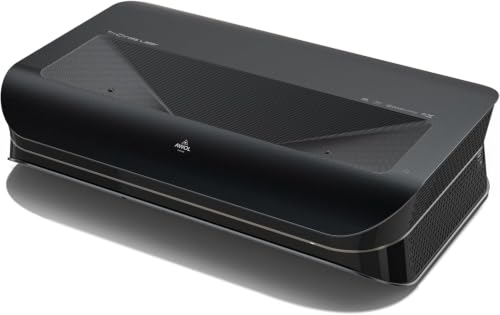
Awol Vision LTV-3500 Pro
Output reaches 3200 ANSI lumens from a triple RGB laser engine on this Awol Vision unit, the brightest rating in this roundup. Design targets ambient light rejecting (ALR) screens up to 150 inches for daytime viewing. No smart TV platform ships built in, so an external streaming stick or box is required.
Pros
- 3200 lumens is the brightest option for daylight rooms
- Wide 100 to 150 inch screen size support
- RGB laser produces wide color gamut coverage
Cons
- No built-in smart platform, needs an external streaming device
- Heavier chassis complicates shelf or cabinet placement
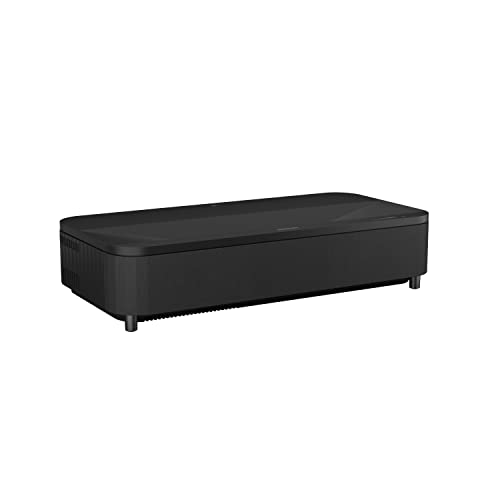
Epson EpiqVision Ultra LS800
A 3-chip 3LCD laser array rated at 4000 lumens gives this Epson model among the brightest specs in its class for daytime use. Pixel-shifting technology produces a 4K PRO-UHD image from 1080p panels rather than a native 4K chip. Android TV ships as an included external streaming device rather than built into the unit.
Pros
- 4000 lumen output handles moderate ambient light
- Three-chip 3LCD design avoids rainbow artifacts
- Android TV streaming device included in the box
Cons
- Pixel-shifted image looks softer than native 4K panels
- Streaming box is external, not built into the chassis

LG HU915QE CineBeam
A triple RGB laser engine combines with a 0.19:1 throw ratio on this LG model, the shortest distance-to-screen ratio in this lineup. WebOS smart platform ships built-in with LG’s ThinQ app ecosystem included. Dolby Vision and Filmmaker Mode target accurate color for scripted movies over sports broadcasts.
Pros
- Shortest throw ratio simplifies tight-room placement
- Filmmaker Mode preserves director-intended color
- WebOS built-in with no extra streaming hardware needed
Cons
- 2700 lumens is modest for rooms with windows
- Costs more than laser rivals from Formovie or Hisense

XGIMI Aura 2
A dual-light laser source pairs with a low-latency game mode rated near 16ms at 1080p 240Hz on this XGIMI model. Android TV 11 runs built-in, and Harman Kardon speakers handle audio without a separate soundbar. Throw ratio of 0.233:1 fits an 80 to 150 inch range depending on wall distance.
Pros
- Low input lag suits console and PC gaming
- Harman Kardon speakers built into the frame
- Android TV 11 built-in with wide app support
Cons
- 2450 lumens trails Epson and Hisense in brightness
- Autofocus can drift and need manual touch-up
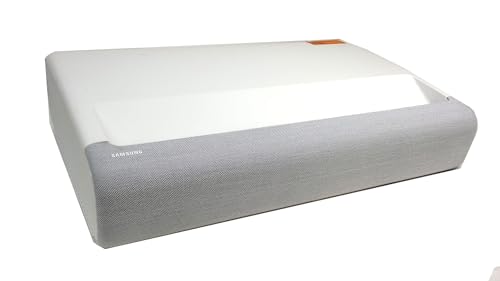
Samsung The Premiere LSP9T
Tizen Smart Hub runs on this Samsung model, the same interface found on Samsung’s QLED TVs, with SmartThings device control built in. Triple laser light source outputs 2800 ANSI lumens across a 100 to 130 inch range. Object Tracking Sound Lite simulates directional audio without needing external speakers.
Pros
- Tizen Smart Hub matches Samsung TV menus exactly
- SmartThings integration controls other Samsung devices
- Object Tracking Sound Lite adds directional audio cues
Cons
- No Dolby Vision support, HDR10+ only
- Older model line gets less frequent firmware updates

Formovie Theater
An ALPD triple-laser engine runs at 2900 ISO lumens on this Formovie model, which also includes Bowers & Wilkins-tuned speakers. Google TV comes integrated, and Dolby Vision HDR is supported for streaming apps. A 0.233:1 throw ratio keeps screen sizes flexible in small rooms without long cable runs.
Pros
- Integrated Bowers & Wilkins speaker system
- Built-in Google TV with Dolby Vision streaming
- Lower cost than most triple-laser competitors
Cons
- Fewer HDMI inputs than pricier rivals
- Owners report occasional firmware bugs in setup menus
Side by side
| # | Model | Light Source | Best for | Score | Price |
|---|---|---|---|---|---|
| 1 | Hisense PX3-Pro | Triple Laser (ALPD) | Best overall | 9.4 | Check price |
| 2 | Awol Vision LTV-3500 Pro | Triple RGB Laser | Best for bright rooms | 9.2 | Check price |
| 3 | Epson EpiqVision Ultra LS800 | Laser Array (3LCD) | Best value | 9.1 | Check price |
| 4 | LG HU915QE CineBeam | Triple RGB Laser | Best for home theater | 9.0 | Check price |
| 5 | XGIMI Aura 2 | Dual Light Laser | Best for gaming | 8.9 | Check price |
| 6 | Samsung The Premiere LSP9T | Triple Laser | Best for smart TV integration | 8.8 | Check price |
| 7 | Formovie Theater | Triple Laser (ALPD) | Best budget | 8.7 | Check price |
Questions worth asking
What is an ultra short throw projector?
An ultra short throw (UST) projector sits within inches of the screen or wall, using mirrors and a wide-angle lens to fill a large image without a long throw distance.
How close can a UST projector sit to the screen?
Most UST models require 4 to 14 inches of distance depending on throw ratio and target screen size, with LG HU915QE’s 0.19:1 ratio needing the least distance for a given image width.
Which projector works best for gaming?
XGIMI Aura 2 posts the lowest input lag in this lineup, around 16ms at 1080p 240Hz in game mode, making it the strongest pick for console or PC gaming.
Do ultra short throw projectors work in bright rooms?
Brighter models like Awol Vision LTV-3500 Pro at 3200 ANSI lumens and Epson LS800 at 4000 lumens hold up better in daylight, though an ALR screen still improves contrast.
Is native 4K resolution necessary?
Native 4K sharpens text and fine detail, but pixel-shifted 1080p models such as Epson LS800 still look sharp for streaming video, where compression already limits fine detail.
Can a UST projector be used without a special screen?
A UST projector will project onto any white wall, but an ambient light rejecting (ALR) screen improves contrast and color accuracy, especially above 2800 lumens.
How long do laser light sources last?
Manufacturers typically rate laser engines for 20000 to 25000 hours, far longer than the 3000 to 5000 hour lamps used in older bulb-based projectors.
Is a UST projector worth it compared to a regular TV?
A UST projector delivers a 100 inch or larger image that would cost far more as an equivalent flat panel TV, though brightness in sunlit rooms still favors an LED or OLED screen.
Which UST projector has the best built-in sound?
Formovie Theater includes Bowers & Wilkins-tuned speakers and XGIMI Aura 2 carries Harman Kardon speakers, both aiming to skip a separate soundbar.
ANSI lumens vs ISO lumens, what is the difference?
Both measure brightness but under different testing standards, so a 2900 ISO lumen rating on Formovie Theater is not directly comparable to a 2800 ANSI lumen rating on Samsung LSP9T without checking the underlying method.
Our take
Hisense PX3-Pro earns the top recommendation for most living rooms, balancing 4K Dolby Vision color, built-in Google TV, and a flexible 90 to 130 inch range without needing extra streaming hardware. Households with uncovered windows or all-day sun exposure should look at Awol Vision LTV-3500 Pro instead, since its 3200 lumen output holds contrast better against ambient light. Gamers chasing the lowest input lag are better served by XGIMI Aura 2’s roughly 16ms game mode.


