Choosing a Welding Machine That Matches Your Project
For most home shops, the Hobart Handler 140 MIG Welder offers the most proven all-around performance. Beginners do well with the Lincoln Electric Easy MIG 140 and its built-in settings chart. Buyers wanting MIG, stick and TIG in one machine should consider the YesWelder MIG-205DS.
Home fabrication and light auto body work point toward the Hobart Handler 140 MIG Welder as the most proven option. First-time welders often do better starting with the Lincoln Electric Easy MIG 140, which includes a built-in settings chart. Anyone wanting to try MIG, stick and TIG without buying three machines should look at the YesWelder MIG-205DS.
A welder rated for 140 amps on 120V power behaves very differently from a 205-amp inverter on 220V, and the process it runs, MIG, stick or TIG, changes what materials it can join. We compared amperage range, input voltage, duty cycle and process type, then checked owner reports on arc smoothness and long-term reliability.
What to look for
What should a first-time buyer compare on a welding machine? Process type, amperage range and input voltage decide what a machine can actually weld before brand matters. MIG suits beginners with its continuous wire feed, stick handles rusty or outdoor material better, and TIG gives the cleanest finish on thin metal. Duty cycle, the percentage of a ten-minute period a machine can weld before needing to cool, matters more on longer jobs. Check these four specs before comparing extra features.
MIG vs stick vs TIG, which process fits home use? MIG welders like the Hobart Handler 140 feed wire automatically and suit beginners working on car panels or light steel. Stick welders such as the Forney Easy Weld 261 need no shielding gas and handle outdoor, rusty or dirty material better. TIG, available on the Amico Power TIG-205, produces the cleanest weld but demands more hand coordination and practice. Multi-process machines like the YesWelder MIG-205DS let a buyer try more than one before committing to a single setup.
What safety gear does welding at home require? A welding helmet with auto-darkening lens, flame-resistant gloves and long sleeves are the minimum for any process listed here. Stick and MIG welding both throw sparks, so a clear, non-flammable work area matters as much as the machine itself. Ventilation becomes important indoors, since welding fumes vary by metal and electrode type. Read the specific electrode or wire manufacturer’s safety sheet before welding galvanized or coated metal.
Which welder suits a specific job, like auto body or farm repair? Thin auto body panels favor a MIG machine with fine amperage control, such as the Lincoln Electric Easy MIG 140. Farm equipment repair, often outdoors on thicker or rusty steel, suits a stick welder like the Forney Easy Weld 261. Fabricators working with aluminum trailers or fuel tanks need the AC output on a machine like the Amico Power TIG-205. Mobile or job-site work benefits from a compact, dual-voltage option like the YesWelder ARC-205DS.
The top picks, ranked

Hobart Handler 140 MIG Welder
Hobart rates this wire-feed welder for material from 24-gauge up to quarter-inch mild steel on a 115V household circuit. A 5 to 140 amp output range covers most home fabrication and light auto body repair. Owners cite smooth wire feed and easy tension adjustment as reasons it holds up over years of use.
Pros
- Runs on standard household 115V power
- Smooth wire feed reported over years of use
- Strong parts and support network
Cons
- MIG only, no built-in stick or TIG mode
- 140-amp ceiling limits thicker material work

Lincoln Electric Easy MIG 140
Lincoln built in a setup chart on the machine that matches wire size and material thickness to a dial position, cutting down guesswork. It runs on a 120V outlet and handles up to quarter-inch steel in a single pass. An included gas regulator and gun make it ready to weld shortly after unboxing.
Pros
- Built-in chart removes most setup guesswork
- Includes gas regulator and gun in the box
- Runs on common 120V household outlets
Cons
- Limited to MIG and flux-core processes
- Duty cycle drops on thicker, longer welds

YesWelder MIG-205DS Multi-Process Welder
This inverter runs on either 110V or 220V and switches between MIG, flux-core, stick and lift TIG without swapping machines. A synergic mode auto-adjusts voltage and wire speed based on entered material thickness. Output tops out near 205 amps, well above typical entry-level 140-amp machines.
Pros
- Four welding processes in one machine
- Dual voltage works on garage or shop outlets
- Higher amperage ceiling than basic 140A welders
Cons
- Arc reported rougher than Hobart or Lincoln at low settings
- Newer brand with less long-term reliability data

Forney Easy Weld 140 MP Multi-Process Welder
At around 24 pounds, this Forney packs MIG, stick and DC TIG into a machine light enough to carry one-handed. It plugs into a standard 120V outlet and reaches up to 140 amps. Compromises show up in duty cycle compared to heavier multi-process machines, but the price point covers three processes most single-process welders don’t.
Pros
- Covers three processes at a budget price point
- Light enough to carry to a job site
- Runs on standard 120V household power
Cons
- Lower duty cycle than higher-amperage machines
- TIG mode lacks foot pedal support

Amico Power TIG-205 AC/DC TIG Welder
AC output lets this machine weld aluminum, while DC handles steel and stainless, covering two material families in one unit. Pulse function helps control heat input on thin sheet metal, reducing warping. It also includes a stick welding mode, giving a fabricator a second process without an extra machine.
Pros
- AC output enables aluminum welding
- Pulse function helps prevent warping thin sheet
- Stick mode adds a second process
Cons
- Requires a 220V circuit, not household 120V
- TIG torch technique has a steeper learning curve
Forney Easy Weld 261 100ST Stick Welder
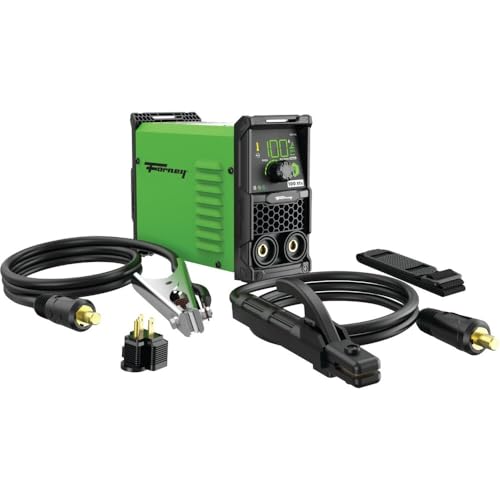
This stick welder skips shielding gas entirely, which suits outdoor and windy repair jobs on a farm or job site. It plugs into a 120V outlet and welds up to roughly 1/8-inch steel with common electrode sizes. Fewer parts and no gas tank make it simpler to maintain than a MIG setup.
Pros
- No shielding gas needed for outdoor jobs
- Runs on standard 120V household power
- Fewer parts than a MIG setup to maintain
Cons
- Thinner material capacity than the 140-amp MIG machines
- Stick welds require more cleanup grinding than MIG

YesWelder ARC-205DS Stick Welder
An IGBT inverter design keeps this stick welder compact and light enough to move between job sites without a cart. Dual voltage input covers both 110V and 220V outlets, useful when shop power varies. Hot start and anti-stick functions help a less experienced hand keep the arc going.
Pros
- Compact inverter design travels easily
- Dual voltage adapts to different outlets
- Anti-stick function helps less experienced users
Cons
- Single process limits it to stick welding only
- No included cart or storage case
The lineup, side by side
| # | Model | Input power | Best for | Score | Price |
|---|---|---|---|---|---|
| 1 | Hobart Handler 140 MIG Welder | 115V household circuit | Best overall | 9.4 | Check price |
| 2 | Lincoln Electric Easy MIG 140 | 120V household circuit | Best for beginners | 9.1 | Check price |
| 3 | YesWelder MIG-205DS Multi-Process Welder | 110V or 220V, dual voltage | Best value multi-process | 8.8 | Check price |
| 4 | Forney Easy Weld 140 MP Multi-Process Welder | 120V household circuit | Best budget multi-process | 8.5 | Check price |
| 5 | Amico Power TIG-205 AC/DC TIG Welder | 220V circuit | Best for TIG and aluminum work | 8.3 | Check price |
| 6 | Forney Easy Weld 261 100ST Stick Welder | 120V household circuit | Best for farm and general repair welding | 8.1 | Check price |
| 7 | YesWelder ARC-205DS Stick Welder | 110V or 220V, dual voltage | Best for portability | 8.0 | Check price |
Frequently asked questions
What is the best welding machine for a beginner?
The Lincoln Electric Easy MIG 140 includes a built-in settings chart that removes most of the guesswork around wire speed and voltage. The Hobart Handler 140 is a close alternative with a strong reputation for smooth wire feed.
MIG vs stick welding, which is easier to learn?
MIG welding feeds wire automatically and is generally considered easier for a first-timer to control. Stick welding requires more hand-eye coordination to maintain arc length but needs no shielding gas, which suits outdoor work.
What amperage do I need to weld quarter-inch steel?
Most machines in this range, including the Hobart Handler 140 and Lincoln Easy MIG 140, reach up to 140 amps, enough for a single pass on quarter-inch mild steel. Thicker material may need multiple passes or a higher-amperage machine.
Can I weld aluminum with a standard MIG welder?
Standard MIG welders in this list are set up for steel and are not built for aluminum wire feed. The Amico Power TIG-205 offers AC output specifically for welding aluminum.
Do I need 220V power to weld at home?
No. Machines like the Hobart Handler 140, Lincoln Easy MIG 140 and Forney Easy Weld 140 MP all run on standard 120V household outlets. Higher-amperage machines like the Amico Power TIG-205 require a 220V circuit.
What does duty cycle mean on a welder?
Duty cycle is the percentage of a ten-minute period a machine can weld continuously at a given amperage before it needs to cool down. A lower duty cycle means more frequent pauses on long welds.
Is a multi-process welder worth it over a single-process machine?
A multi-process machine like the YesWelder MIG-205DS or Forney Easy Weld 140 MP lets one buyer try MIG, stick and TIG without buying separate machines. Dedicated single-process machines sometimes offer a smoother arc within their one process.
What welding machine works best for farm or outdoor repair?
The Forney Easy Weld 261 100ST needs no shielding gas, which holds up better in wind than a MIG setup. Stick welding overall tolerates rustier, dirtier material common on farm equipment.
Our pick
Hobart Handler 140 MIG Welder remains the safest all-around pick for general home fabrication. Beginners get the smoothest start with the Lincoln Electric Easy MIG 140 and its built-in setup chart. Anyone doing farm or outdoor repair should look at the gasless Forney Easy Weld 261 100ST instead.